Facebook privacy fuckup reveals who has your number in their phonebook

Reason 5,395 not to use Facebook:

[…] At first I was baffled – I guessed maybe Facebook had copied something across from my previous account via a cookie or similar. But it turns out that FB used my mobile number (which they took as a security check) to match up with people who have me in their mobile phone book and have synced the Facebook app.

I fully understand why they’re doing this – it connects new users into existing networks, it’s an evolution of the ‘import your Hotmail contacts’ facility. I just didn’t like the approach at all. They demanded my mobile number under the pretence of a security check, but then used to it find people who have me in their mobile phone contacts.

This has badly violated the privacy of a friend who has, I now know, been operating a second Facebook account to hide the fact that he is gay – something which he has good and important reasons to hide. It also showed me that an ex-girlfriend of long ago still has my number saved – which is understandable because I am great.

Facebook privacy fuckup reveals who has your number in their phonebook – alexmuir.com

Point d’ironie⸮

I can’t see obscure punctuation like the ‘snark’ finding a place any time soon. People seem to have enough problems with the punctuation we already have. Besides, sarcasm symbol would instantly reduce the humour in the sarcasm – it’s a bit like explaining a joke.

Another mark, now obscure, is the point d’ironie, sometimes known as a “snark.” A back-to-front question mark, it was deployed by the 16th-century printer Henry Denham to signal rhetorical questions, and in 1899 the French poet Alcanter de Brahm suggested reviving it. More recently, the difficulty of detecting irony and sarcasm in electronic communication has prompted fresh calls for a revival of the point d’ironie. But the chances are slim that it will make a comeback.

Is This the Future of Punctuation!? – online.wsj.com

Continue reading

Link

A monstrously brilliant typography project:

Frankenstein hardback

An edition of Mary Shelley’s Frankenstein laid out using characters and glyphs from PDF documents obtained through internet searches. The incomplete fonts found in the PDFs were reassembled into the text of Frankenstein based on their frequency of use. The most common characters are employed at the beginning of the book, and the text devolves into less common, more grotesque shapes and forms toward the end.

fathom.info/frankenfont

Continue reading

Kindle Format 8

Kindle Format 8 overview – amazon.com (via arstechnica.com)

We’re pleased to announce a wide range of new features and enhancements – including HTML5 support – coming in Kindle Format 8 (KF8). KF8 is the next generation file format for Kindle books – replacing Mobi 7. As showcased on Kindle Fire, KF8 enables publishers to create great-looking books in categories that require rich formatting and design such as children’s picture books, comics & graphic novels, technical & engineering books and cookbooks. Kindle Format 8 replaces the Mobi format and adds over 150 new formatting capabilities, including fixed layouts, nested tables, callouts, sidebars and Scalable Vector Graphics, opening up more opportunities to create Kindle books that readers will love.

I wonder if there is a market for people who can build high quality ebooks for writers?

Terms that have different meanings for scientists and the public

Scientific term Public meaning Better choice
enhance improve intensify, increase
aerosol spray can tiny atmospheric particle
positive trend good trend upward trend
positive feedback good response, praise vicious cycle, self-reinforcing cycle
theory hunch, speculation scientific understanding
uncertainty ignorance range
error mistake, wrong, incorrect difference from exact true number
bias distortion, political motive offset from observation
sign indication, astrological sign plus or minus sign
values ethics, monetary value numbers, quantity
manipulation illicit tampering scientific data processing
scheme devious plot systematic plan
anomaly abnormal occurrence change from long-term average

Table from Communicating the science of climate change – physicstoday.org
(via Scientists are from Mars, the public is from Earth – blogs.discovermagazine.com)

Continue reading

Link

A fascinating look into the design of the new Guardian iPad app.

This slideshow requires JavaScript.

We have created something that is a new proposition, different to other digital offerings. It works in either orientation and nothing is sacrificed. Instead of it being based on lists, breaking news, and the fastest updates it’s instead designed to be a more reflective, discoverable experience. This gives it the potential to have a design capable of responding to the news… just like a newspaper.

The Guardian iPad edition: ‘Put the newspaper on the iPad’ – guardian.co.uk

Continue reading

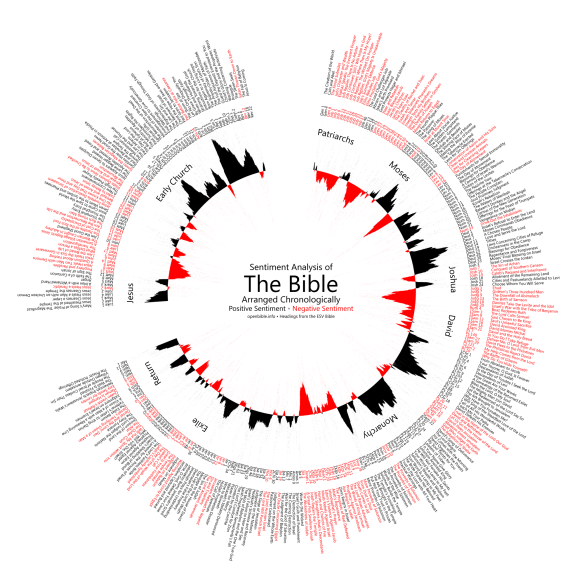
Sentiment analysis of the Bible

Now this is how you make an infographic:

A sentiment analysis of the Bible

Things start off well with creation, turn negative with Job and the patriarchs, improve again with Moses, dip with the period of the judges, recover with David, and have a mixed record (especially negative when Samaria is around) during the monarchy. The exilic period isn’t as negative as you might expect, nor the return period as positive. In the New Testament, things start off fine with Jesus, then quickly turn negative as opposition to his message grows. The story of the early church, especially in the epistles, is largely positive.

Applying Sentiment Analysis to the Bible – openbible.info (via FlowingData)

Continue reading

ColorADD: A colour identification system for the colour blind

A clever and useful system for designers to keep in mind: ColorADD.

The system ID for Dalton Color was developed based on primary colours, represented by graphic symbols where the code is built on logical association and memorable. The concept of adding the color becomes a “game” that allows the knowledge gained through the color-blind, relate symbols – easily identifying colours that represent the combination of simple shapes combined with the basic color combinations. The black and white appear to guide the light and dark shades. The system was constructed through a process of logic and understanding direct association, where the use of primary colours, represented by simple symbols, allowing their rapid inclusion in the “visual vocabulary “user.

This concept of adding color is a mental game, which allows the color blind symbols relate to each other with the colours they represent, without having to memorize them individually. Each primary color code is associated with three forms representing the red, yellow and blue, and from these three forms develops the code. Two other forms have been added representing the black and white representing the shades lighter or darker colours. The secondary colours can be formed using the basic forms is the “mix” the primary pigments together, then forming the composition of a color palette . The gray was divided into two colours: light gray and dark gray. The entire code, covers a considerable number of colours and can be easily transmitted through information available in various communication media, including bulletin boards, catalogs or the product itself.

ColorADD (text translated by Google)

A video shot on the iPhone 4S

Aside

Very cool.

Got an iPhone 4S yesterday and got up this morning to go for a surf. No surf, so thought I’d shoot some stuff to see what the new camera is like on the 4S. Got home, looked at the footage, and couldn’t believe it came out of a phone. Was so excited so thought I’d quickly cut a vid to share the goodness.

It’s actually amazing. The automatic stabilisation seems to work wonders, and gets rid of most the jello. Depth of field is flipping awesome. Colours are really good straight out the camera, but I did give this footage a slight grade.

Flighty birds: My free Creative Commons designs that keep getting stolen anyway

I’ve been having some problems with flighty birds recently. Actually one is a penguin and the other is a dragon. Here they are, together for the first time:
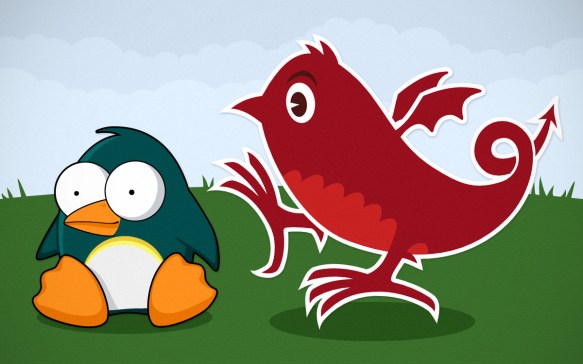

Cartoon penguin meets Twitter dragon.

Two variations of Tux

Original Tux on the left

I created the penguin in early 2009, working on a tiny EeePC, running Linux. I was actually taking a stab at improving the look of Tux, but he went in a different direction.

The dragon was created in early 2010, to look like the familiar Twitter bird, but with a unique Welsh dragon spin.

Both images have gone on to be pretty popular on the web, used for avatars in forums, on Twitter and so on. I deliberately licensed both as Creative Commons Attribution-NonCommercial-ShareAlike. This means that people are welcome to use the images, for free, on condition that they provide a proper credit, and do not seek to profit directly or indirectly from use of my work. Also, they must make any derivative work available under the same terms.

The continuing misadventures of ‘Boggle’

These conditions seem more than reasonable to me, but I’ve spotted examples of people either not knowing or not caring that they are violating this very liberal licence, especially with the cartoon penguin design. There was a guy selling penguin t-shirt prints, and then only last month I found an iPhone game and a Mac software house using him. I ended up giving permission to the latter – they seemed nice enough.

The original Cartoon penguin post had actually become one of my most popular pages, bringing in 100+ hits per day via Google image search… until a few days ago I noticed this had stopped! Compare the following images:
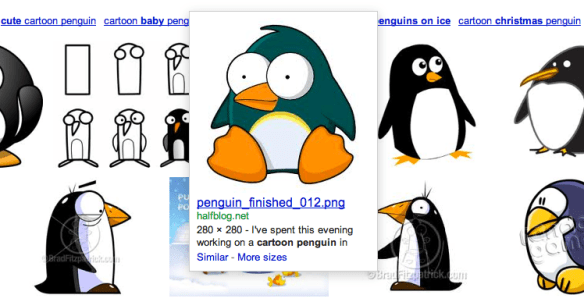
'cartoon penguin' in Google image search - September 2009

This is how the image search for 'cartoon penguin' looked last month (September 2011).

Compare that with the result today:
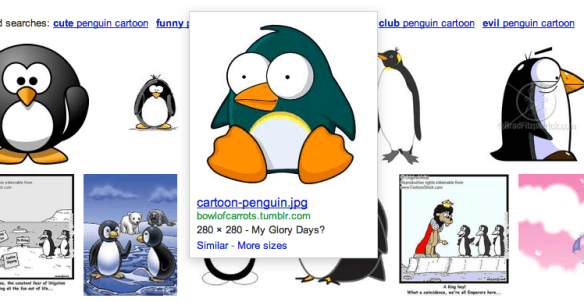
'cartoon penguin' in Google image search - October 2011

...and this is the same search today (October 2011)

Yup, now Google has removed the link to my original page, and instead sends searchers to this charming Tumblr page:
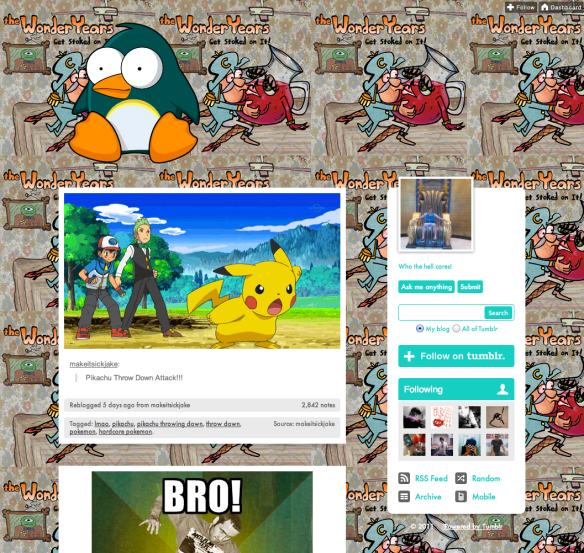
bowlofcarrots, some random dude on Tumblr

SEO surgery

Clearly the guy is no designer or SEO expert, but he has managed to outrank me for my own image! I’m assuming he’s winning because the image is near the top of the page in the title area (that appears on every page), and he’s renamed the image ‘cartoon-penguin.jpg‘, whereas my original is the less useful ‘penguin_finished_012.png‘.

Last night I optimised my site a little in an attempt to win back favour. I also contacted Mr. Bowlofcarrots via his site and Tumblr support, though I don’t really expect any joy from either of them.

It’s surprised me how annoyed I am by this minor injustice. After all, this is an image I was happy enough to give away for free. It occurred to me that even though this Tumblr user isn’t attempting to ‘steal’ my work in the same way as some previous people have, he has nonetheless taken it from me in a more real sense. Quite innocently, he has robbed me of my sense of ownership of the image itself. It’s very frustrating.

The @thisiswales saga

My other ‘bird’, the Twitter dragon, has been on other adventures. In this saga, I found him being used as part of the branding for an official-looking Twitter account calling itself ‘this is Wales‘.
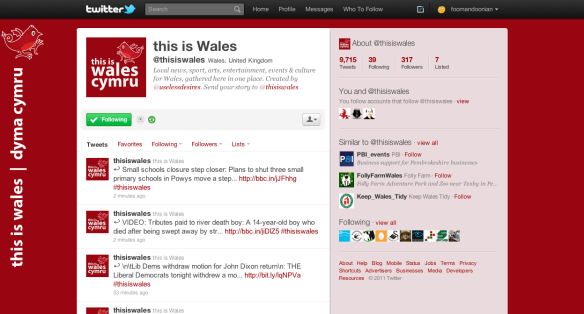
Twitter page for @thisiswales, 5 July 2011

How @thisiswales looked in July, 2011

Official-looking it may be, but that’s simply because it imitates the look and feel of a BBC design, while appropriating the ‘This is X’ brand owned by Northcliffe Media (see This is South Wales / @thisisswales for examples). Not to mention, my Welsh dragon design.

Twitter repliesI asked people on Twitter if I should be upset about this – after all, this is another of my ‘free’ designs, and @thisiswales didn’t actually seem to be for any kind of profit.

It turned out that most were more outraged on my behalf than I was! (Thanks everyone!)

In the process of complaining, I may have upset the account’s owner, but he did remove my design later that day as he promised he would. Well, kind of. As I write this I notice that the background image still contains my work, but I think I’ll declare victory anyway.

The owner denied any wrongdoing, claiming that he “recently took on @thisiswales with logo already in place.” This may be true, but I have actually been aware of the account since July, and at that time it linked to the same Mr. @uselessdesires. Depends how you define recent I suppose.

So what?

I do realise both of these cases are pretty trivial. It’s not like Paperchase or Urban Outfitters have stolen my work to be used to fuel their profit machine. In the worst case, a blogger has been denied 100 hits a day that weren’t really contributing anything of real value anyway.

Cartoon penguin in life preserver and goldfish bowl helmet. But it’s frustrating to offer something for free, yet still have it taken without permission asked or credit given, especially when the casual theft can have a negative impact on me. It makes me want to use a more traditional full-copyright licence, and go after people who take the piss.

I wonder where they’ll turn up next?

UPDATE 2011.10.18: Tumblr got back to me; they have suspended the blog that was using my penguin image. A bit harsh perhaps, but I’m not going to complain. It will be interesting to see if I regain my ranking (or if Mr. Clipart manages to get his Tumblr blog reinstated).

Facebook, Facebook, Facebook

I just followed a fb.me link to a Guardian story about the Occupy protests going on around the world. Heading over to 15october.net, I zoomed in to find a protest happening in Bristol – which is being organised on Facebook.

It’s disgusting how prevalent Facebook has become. Even among the geeky crowd at Dorkbot last night, many people were using Facebook pages in lieu of having their own website. Dorkbot itself, despite having their own site, uses Facebook to organise events and host videos. At least that’s what I hear – I am effectively denied access to this material.

Perhaps I should just come to terms with the fact that one company is going to own so much of the web, but I wish everybody else would instead.

Dorkbot Cardiff #4

I don’t know if it’s the same in other Dorkbots, but Cardiff’s skews heavily towards projects where technology meets art. These can often leave me a bit cold, feeling that I understand how the artist has done something, but not really why.

I did rather enjoy this documentary about Paul Granjon’s Oriel Factory robot exhibit however.

Perhaps it helps me that the messages about recycling and using clean energy seem clear and important in this exhibition. Plus, it looks like a lot of fun!

Continue reading

Dark Resurrection

Video

Volume 0

Master Sorran, is obsessed by his search for an ancient civilization which, according to legend, holds the secret of immortality. After many years he lights upon the wreck of the civilisation’s most powerful starship: the Resurrection.

Sorran ignores the dangers and orders his crew to dock. The explorers and Sorran himself will face the mysteries of the Resurrection and the secret of the origins of the dark side.

Dark Resurrection Volume 0 by Angelo Licata
Continue reading

National Novel Writing Month

Every year I toy with the idea of participating in NaNoWriMo. I don’t consider myself a good writer, but I have lots of ideas for stories and characters. I think I would enjoy the cathartic aspect of just trying to churn out a novel NaNoWriMo style:

National Novel Writing Month is a fun, seat-of-your-pants approach to novel writing. Participants begin writing on November 1. The goal is to write a 50,000 word, (approximately 175 page) novel by 11:59:59, November 30.

Valuing enthusiasm and perseverance over painstaking craft, NaNoWriMo is a novel-writing program for everyone who has thought fleetingly about writing a novel but has been scared away by the time and effort involved.

Because of the limited writing window, the ONLY thing that matters in NaNoWriMo is output. It’s all about quantity, not quality. This approach forces you to lower your expectations, take risks, and write on the fly.

Maybe. Maybe.

Canton Social Media Surgery, Wednesday 5th October


This coming Wednesday
I’ll be at my third social media surgery in Chapter Arts, helping to orient those new to social media.

If you have questions about the hows (and whys) of social media, these surgeries are an excellent opportunity. I’ve been pleasantly surprised how well attended these events have been, and it has been satisfying to help – even in a small way – some non-profits trying to make better use of social media and the web in general. So long as I have the time to donate, I’ll be happy to continue to come along and help others.
Continue reading