Clever website imitates a Google search results page

Michael Jang Photography

Michael Jang Photography imitates a Google search results page with his website.

This is such clever idea, although I think perhaps a photographer would be better off selling himself with his pictures, not his web presence. I actually think it would work a lot better for a social media/SEO type. Nonetheless, I like what he’d done, and is planning to do:

[…] “It is not what it seems,” said Jang, “Along the top and right are ‘ads’ all linking back to photo projects and videos.” As expected of any website, Jang provides his e-mail contact, links to his Facebook, Flickr and blog — all disguised as Google search options in the page header.

Ultimately, Jang intends to cede control of the links featured on his site. “Rather than totally control the content I want more transparency,” said Jang. The site “will link to anything about me, so sometimes there might even be threads that are less than complimentary.”

via wired.com (story found via PetaPixel)

Wikipedia’s comedy synopsis of ‘Baby Got Back’

Quote

The song opens with two young females discussing the physical appearance of a third female, in particular her buttocks, which they find unfathomably large.

In the opening verse, Sir Mix-a-Lot professes his affinity for large buttocks and his inability to disguise this fact from others. He goes on to describe other desirable physical attributes, such as a trim waistline, tight-fitting garments, and unblemished skin. Though the song does not contain a distinct narrative, the author does visit recurring themes, such as female body image as depicted in media, male attitudes toward dating and relationships, and the author’s own sexual prowess.

In later verses he expresses his exasperation with the entertainment industry’s portrayal of the ideal female form. He soundly rejects the notion promulgated by fashion magazines that diminutive buttocks are more desirable. His critique of the women who appeared in contemporary music videos is particularly scathing, likening their appearance to those of prostitutes. To further illustrate his point, he stipulates that the purported ideal proportions of 36-24-36 (measuring the bust, waist, and hip circumferences respectively) would only be pleasing on women with a standing height no greater than 63 inches.

Mix-a-Lot also briefly touches upon the roles that ethnicity, nutrition, and physical fitness play in determining the shape and size of the female buttocks. He recommends that any exercises performed should be limited to the abdominal area. He cautions against a fitness routine strenuous enough to diminish the heft of the gluteal muscles. Though he offers no broad dietary guidelines, Mix-a-Lot contends that the dish “red beans and rice” is an important food staple for maintaining healthy buttocks.

Various lyrics address the fact that some men find no intrinsic value in large buttocks and consequently express a lack of interest. Mix-a-Lot makes clear that he would eagerly strike up relations with any woman overlooked or discarded by such men. The remainder of the narrative is fleshed out with the author’s various attempts to entice women into enjoying a ride in his luxury automobile. [3]

Baby Got Back – Wikipedia, the free encyclopedia

Via codinghorror who says: “I suspect this backdooring (omglol) of humor into Wikipedia through song synopses won’t be tolerated for long.”

Probably, but I had to back this one up here! :D

Updated 2013.01.19 to change the attribution link to the appropriate Wikipedia diff page, instead of the current edit, and to tweak my post title.

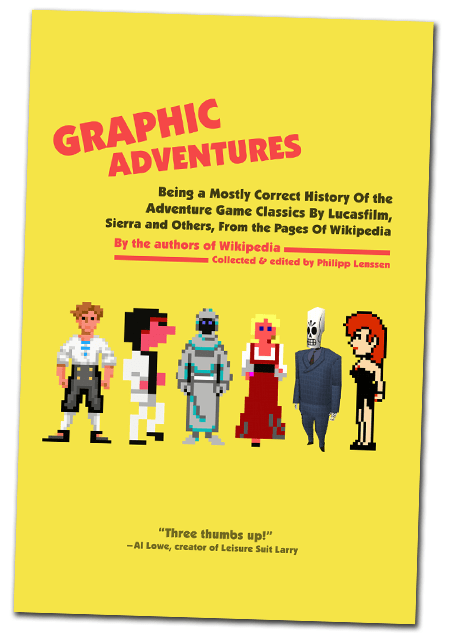
Graphic Adventures: A book of compiled and expanded Wikipedia entries

What I did was edit the Wikipedia articles through heavy or light rewriting, depending on what I figured the article would need to look good in book form. I then went to find additional information from other sources where I felt having more could be fun, and I added screenshots. And then I conducted interviews with many people who were involved in producing the classic graphic adventures. I interviewed creators like Al Lowe of Leisure Suit Larry, Lucasfilm’s David Fox, and Michael Bywater, who worked with Douglas Adams on the game Starship Titanic. The book took much longer than expected… the original idea after all was to merely compile an encyclopedia from Wikipedia, a book for perhaps a small but dedicated group of fans like me. But after sending myself the first draft version, I realized much more editing was needed to have something really fun.

Graphic Adventures: A book of compiled and expanded Wikipedia entries

(via blogoscoped.com)

What a great way to write a book. Philipp Lenssen says he is donating 50% of the book’s revenues to the Wikimedia Foundation, but doesn’t mention whether he contributed any of his original findings back to Wikipedia (although now I think about it, I’m fairly certain Wikipedia discourages original research).

He’s released it under the GNU Free Documentation License, and you can download the HTML documents in a .zip file.

SEO for content producers – the essentials

I’ve been preparing a single page document to give to colleagues who are unfamiliar with search engine optimisation techniques, and I thought it might be useful to post it here. Constructive comments are very welcomed to help me improve this first draft, but do check my note at the bottom so you understand the intended purpose of this list.

Continue reading

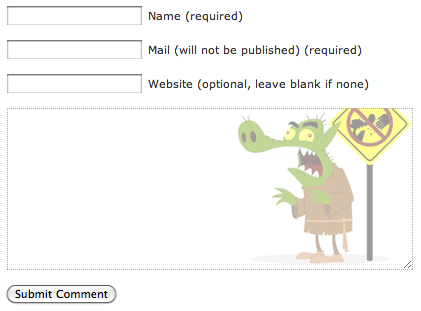
Comment isn’t free: The Sun Chronicle comment paywall

From tomorrow, the Sun Chronicle, a Massachusetts paper, will charge would-be commenters a nominal one-off fee of 99 cents. But it has to be paid by credit card, which means providing a real name and address.

And the name on the credit card will be the name that will appear on comments. So it’s goodbye to anonymity.

(via Paper puts up a paywall for comments – guardian.co.uk)

This actually strikes me as a pretty good idea. I’d return a degree of anonymity by allowing people to choose a display name though. The small fee would stop 99% of trolls dead anyway.

I did notice that the Sun Chronicle had no comments on any of the recent stories I checked. They seem like a pretty small operation though.

I wonder if a service like Disqus could centralise a scheme like this?

Continue reading

Another variation on the slider CAPTCHA

Last week there was a blog post by LukeW proposing a sliding alternative to CAPTCHAs:

[…] the sign up form on They Make Apps uses a slider that asks people to: “show us your human side; slide the cursor to the end of the line to create your account.” Moving the slider to the right completely submits the form and triggers error validation just like a standard Submit button would.

But why stop there? I just spotted this super geeky variation on the same idea on the Adafruit Industries blog:

It seems that it’s their own creation, and is offered as a WordPress plugin:

We are thrilled to release a solve-the-resistor CAPTCHA plugin for WordPress! This plugin will draw a random 5% or 10% resistor and four color band sliders beneath it. The commenter needs to match the colors on the sliders to the colors on the resistor. Commenters don’t actually need to know how to read resistors, but this will help them as they post comments on site that use this plugin.

Resisty – Resistor CAPTCHA – solve the resistor values to post a comment!

Of course, as with the slider alternative the resistor reading could still be easily worked around using crowd-sourced labour, but it’s still a fun idea!

Some common sense about comments

I don’t see my writing as a collaborative effort, and I don’t see my site as a community in which I need to enable internal discussion via comments.

I also disagree with the widespread notion that comments are “discussion”, or that they form a “community”. Discussion and communities require mechanics such as listening and following up that are rarely present in comments.

via Comments – marco.org

#0044CC – The one hundred million dollar colour

Microsoft also tested multiple versions of blue for links in their search results. A specific color of blue (#0044CC) drove $80-$100 million dollars a year increase over the light blue the design team tried first.

(via lukew.com & found via Andrew Parker)

Andrew references Douglas Bowman in his post, who quit Google’s design team, citing an example of the time the company did extensive testing to pick from 41 shades of blue. It seems that perhaps Google have it right.

“Mad libs” style form increases conversion 25-40%

A while ago, I came across a unique registration form built by Jeremy Keith for his audio sharing site, Huffduffer. Though it asked people the same questions found in typical sign-up forms, the Huffduffer registration form did so in a narrative format. It presented input fields to people as blanks within sentences (Mad Libs-style, if you will).

Huffduffer madlibs signup

via lukew.com

There’s even some A/B testing information to lend some weight.

I know I posted a link to this article on Twitter yesterday, but I thought it was such a clever and simple idea that I wanted to make a note of it here.

Posted in Web

Is there any good reason to use title case?

The convention followed by many British publishers (including scientific publishers, like Nature, magazines, like The Economist and New Scientist, and newspapers, like The Guardian and The Times) is the same used in other languages (e.g., French), namely to use sentence-style capitalization in titles and headlines, where capitalization follows the same rules that apply for sentences. This convention is sometimes called sentence case where a term is desired to clarify that title case shall not be applied. It is also widely used in the United States, especially in bibliographic references and library catalogues. Examples of global publishers whose English-language house styles prescribe sentence-case titles and headings include the International Organization for Standardization.

(via en.wikipedia.org)

I’ve developed the habit of using sentence case for headlines, but now I’m facing a situation where I’m probably going to have to adapt to a new style guide and start using Title Case at work. I’ve developed a strong preference for sentence case, and now find title case to be ugly and tabloid-esque.

It seems likely to me that title case is a hangover from the days of more primitive typesetting, when you would need to distinguish between BIG HEADLINES, Important Headlines, and regular text.

In these days of HTML and CSS, is there really any good reason to use title case?

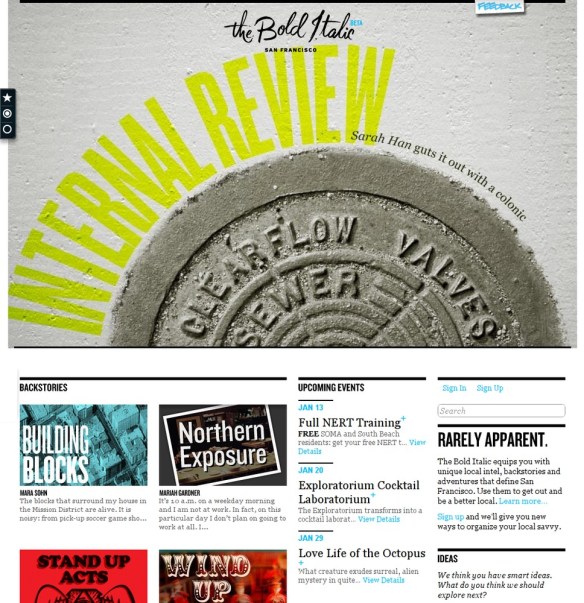
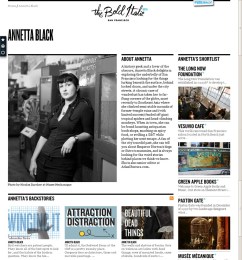
The Bold Italic: Covering local stories, venues and events with style

The Bold Italic is not about typography. It’s not a news site either, but it feels like one – albeit a very trendy news site. In fact, it’s about ‘local discovery’ – trendy San Francisco types write about their local obsessions. Venues, merchants and events are also covered. From the about page:

Just when you thought you were a pretty savvy local, along came The Bold Italic. Our mission is to help people become better locals, equipping our members with rare local intel, backstory and potential adventures.

Our writers, the Bold Locals, find their way behind-the-scenes in San Francisco and come back with backstories of distinctive, offbeat local experiences.

A San Franciscan, such as yourself, can keep pieces of these backstories — a particular merchant, landmark, or product — in the Clipbook. That’s the tab on the left with shapes on it.

It’s a hugely appealing site. Anyone considering a local web project should study it closely.

Emotion Markup Language

The W3C just completed the first draft of the Emotion Markup Language (EmotionML 1.0).

Um, why?

Use cases for EmotionML can be grouped into three broad types:

  1. Manual annotation of material involving emotionality, such as annotation of videos, of speech recordings, of faces, of texts, etc;
  2. Automatic recognition of emotions from sensors, including physiological sensors, speech recordings, facial expressions, etc., as well as from multi-modal combinations of sensors;
  3. Generation of emotion-related system responses, which may involve reasoning about the emotional implications of events, emotional prosody in synthetic speech, facial expressions and gestures of embodied agents or robots, the choice of music and colors of lighting in a room, etc.

If you’re still not getting the why, they have a list of 39 possible use cases. I’m wondering if it could be used for interactive fiction somehow?

I love crap like this!

WikiReader

WikiReader The WikiReader is a funky Hitch-Hikers Guide style gadget that gives you Wikipedia in your pocket. I love the form, the touchscreen, the low power consumption, the low price and that it uses a MicroSD card. You can subscribe to bi-annual updates and they will post you the cards, or you can download the (4GBs of) data yourself.

I’m waiting for an e-reader gadget like this, but the size of a paperback, that allows you to put any data on the card to read. Ideally running some flavour of Linux. And none of this copy protection nonsense!

That’s all I want. Continue reading