
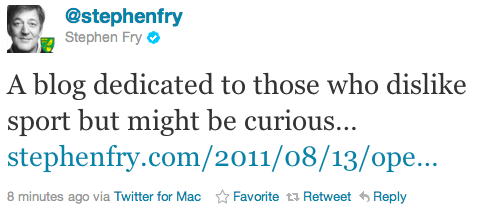
I’m sure for some this is a point of pure pedantry, but it bugs me nonetheless. Let me clarify:
- A blog is a particular type of website that contains many blog posts.
- The verb use ‘I am up updating my blog’ is appropriate, but not ‘I am writing a blog’. (Technically, I appreciate you are writing a blog, but it is more likely you mean to say ‘I am writing a blog post’ or ‘I am blogging’.)
- A single entry on a blog, like this one, is a blog post (or simply a post, if you prefer).
You are very welcome.
Is human communication to blame for the London riots?
Quote
In its coverage, the Daily Mail quoted one tweeter, AshleysAR as follows: “Ashley AR’ tweeted: ‘I hear Tottenham’s going coco-bananas right now. Watch me roll.”
However, AshleysAR’s full, unedited quote on Twitter reads: “I hear Tottenham’s going coco-bananas right now. Watch me roll up with a spud gun :|”.
Suddenly the tone of the message becomes markedly less sinister. Ashley later threatens to join in with a water pistol.
Despite the claim of Tottenham MP David Lammy that the riots were “organised on Twitter”, there is little evidence of their orchestration on the site’s public feeds.
Looking back through Saturday night’s postings, DanielNothing’s stream offers some promise of substantiating the theory with his comment: “Heading to Tottenham to join the riot! who’s with me? #ANARCHY”.
But it is followed soon after by: “Hang on, that last tweet should’ve read ‘Curling up on the sofa with an Avengers DVD and my missus, who’s with me?’ What a klutz I am!”
(via Is technology to blame for the London riots? – bbc.co.uk)
How long before we have another Twitter joke trial farce?
Canton Social Media Surgery
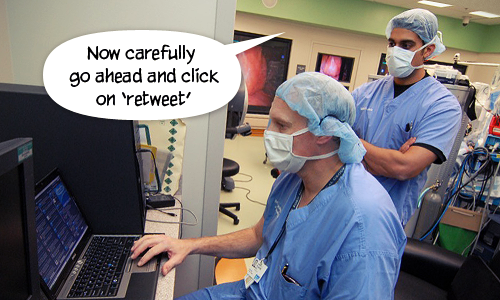
This Wednesday (3rd August) I’m going to head along to the social media surgery in Chapter Arts (in the Cwtch). Operations start at 5pm and patients should be stitched up by 7pm. (Perhaps I should drop the surgery metaphor.)
Facebook’s Registration Tool increases sign-ups by 300%
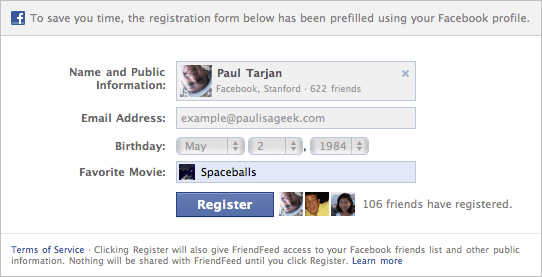
I still refuse to use Facebook, a decision that is validated every time company hits the news, but I have to admit, if I were to build a site that required registration I would be sorely tempted to use this registration tool:
Facebook has launched a new registration tool that enables websites to offer quick and easy social options for users to sign-up.
This is a terrific alternative to using Facebook Login, (formerly known as Facebook Connect) especially when 1) You would like to provide an option for those users who don’t have Facebook account, 2) Your site requires additional information not available on Facebook, or 3) You want the flexibility of HTML, molding the login to your site in any way you see fit.
It’s ideal to minimize any sort of inconvenience for the user on your website, and traditionally, a registration page has been a big turn off for users. Often times they don’t see the value. With Facebook’s registration tool, you make it easy for people to sign up and bring their friends with them, and it’s proven that people are more likely to follow through with the sign up process, will be active on sites longer, share more content, and return more often. For example, FriendFeed beta tested the tool and their sign ups by users with Facebook increased by 300%.
(via Facebook’s Registration Tool – marketaire.com)
Continue reading
Why you should use the location field in Twitter
I have two good reasons why you should consider using the location field for its intended purpose:
- You’re not being as clever as you think (see below).
- One of the best uses of Twitter is finding out what is happening locally.
Personally, I will almost always follow someone local to me. If you’re a postman in Hull, then who cares, but if you might be my postman, then you could be really interesting to follow.
You don’t have to type out your whole address or anything. City or county is close enough to be handy.
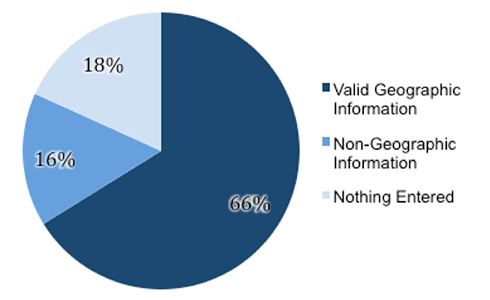
The only relationship Facebook really cares about: Your data and those who will pay them for it.
Facebook continues to use UX design for mild acts of evil. This is their latest ploy to take your information that was once private and expose it to the world
Yesterday, something I said on Twitter seems to have resonated. “It takes a court order to get your personal data from Twitter, but just anyone can get it from Facebook.”
Many people skim read (at best) or don’t read at all (at worst) messages about changes to terms of service like this. They just click the “I accept” or “Allow” button, trusting that an application or service has their best interests at heart. To make sure its users fully understand the implications of clicking “Allow”, Facebook should disable that button until a user confirms that they have read and understand what all this really means for them, their children and their privacy.
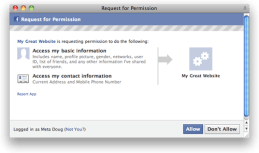
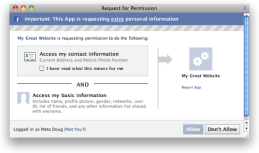
(via Hardly your grandmother’s Facebook New User Object fields – stuffandnonsense.co.uk)
So you found something cool on the internet…

So you found something cool on the internet...
Loldwell and Rosscott created this handy “So you found something cool on the Internet” comic flowchart to help encourage proper attribution of people’s work found on the Internet.
“See Something? Cite Something.” Amen brother!
Help support these awesome guys by buying one of their t-shirts or posters.
(via Comic Flowchart That Encourages Attribution of Work Found Online – laughingsquid.com)
Continue reading
Could Facebook be around forever?
Douglas Rushkoff is absolutely right, Facebook will go down. It’ll be another long decline that – like AOL and Yahoo! – will still be hugely profitable and popular in the mainstream for years after its prime.
[…] These companies are being valued as if they will be our permanent means for identifying ourselves.
Yet social media is itself as temporary as any social gathering, nightclub or party. It’s the people that matter, not the venue. So when the trend leaders of one social niche or another decide the place everyone is socializing has lost its luster or, more important, its exclusivity, they move on to the next one, taking their followers with them. […]
We will move on, just as we did from the chat rooms of AOL, without even looking back. When the place is as ethereal as a website, our allegiance is much more abstract than it is to a local pub or gym. We don’t live there, we don’t know the owner, and we are all the more ready to be incensed by the latest change to a privacy policy, or to learn that every one of our social connections has been sold to the highest corporate bidder.
So it’s not that MySpace lost and Facebook won. It’s that MySpace won first, and Facebook won next. They’ll go down in the same order.
(via Facebook hype will fade – edition.cnn.com)
Maybe not though… I wonder if Facebook could become the Arcadia Group of the web. Maybe the next big social networking site could be… Facebook. Sort of. Just like most of the big high street retail brands are owned by the same few companies, Facebook would be the parent company of many federated niche-networks.
Link
I had already written multiple Twitter bots by this time so I decided to just use some of my existing code to poll Twitter’s search API. Essentially, the “documents” I mentioned above were actually tweets containing the terms “book” or “books.” Two and a half days later I had a working prototype that could generate a book recommendation from a given tweet. It was at this time that I added steps 5 and 6:
Tag URLs returned from Amazon’s ItemSearch with an affiliate ID; and Reply to the tweeting user with their new book suggestion
Four months later and I had generated over $7,000 in sales for Amazon with over $400 commission for myself.
(via How I Made Money Spamming Twitter with Contextual Book Suggestions – charleshooper.net)
Read this is you are determined to build a Twitter keyword spambot. The author throttled the amount of tweets, recorded usernames so he wouldn’t annoy the same person twice and generally did his best to build a relevant spambot with good etiquette.
Goodbye Delicious, hello Pinboard.in
 While the future of Flickr is in doubt, it seems like Bartz’s axe is ready to fall on Delicious, and a few other Yahoo! services.
Today I looked for a few Delicious alternatives. I really like the look of PressMark, a fork of WordPress, but decided that it may be a bit much effort to maintain and I wasn’t confident it was being actively developed.
A couple of people suggested Pinboard.in, and after a bit of investigation I signed up (paying $7.41).
Pinboard is a bookmarking website for introverted people in a hurry.
The focus of the site is less on socializing, and more on speed and utility. The goals of the site, in order of priority, are:
- Never lose data
- Be ridiculously fast
- Offer useful features
Link

Top 10 overused buzzwords in LinkedIn Profiles in the USA – 2010
- Extensive experience
- Innovative
- Motivated
- Results-oriented
- Dynamic
- Proven track record
- Team player
- Fast-paced
- Problem solver
- Entrepreneurial
(via blog.linkedin.com)
I am a highly motivated team player with extensive experience producing innovative, dynamic, fast paced and results-oriented work. As an innovative problem solver with a proven track record and a dynamic entrepreneurial streak, you will soon discover that I am basically the all singing, all dancing crap of the world.
Job please!
The Facebook ‘super-logoff’
Mikalah uses Facebook but when she goes to log out, she deactivates her Facebook account. She knows that this doesn’t delete the account – that’s the point. She knows that when she logs back in, she’ll be able to reactivate the account and have all of her friend connections back. But when she’s not logged in, no one can post messages on her wall or send her messages privately or browse her content. But when she’s logged in, they can do all of that. And she can delete anything that she doesn’t like. Michael Ducker calls this practice “super-logoff” when he noticed a group of gay male adults doing the exact same thing.
(via Risk Reduction Strategies on Facebook – zephoria.org)
This would be a good trick to pull when you have a job interview coming up.
Lifehacker made a tip out of this practice: Use the “Super-Logoff” Technique to Exercise Tighter Control Over Your Facebook Profile
“You can’t polish a turd, but you can roll it in glitter”
Quote
[…] And commercial radio is really simple. Like many other businesses, it has products and it has customers. The audiences are not the customers, they’re the product. The customers are the advertisers.
via Myspace – now with glitter (via @Dizzyjam)
Excellent post about My_____. I’m a big fan of writers who can distil complex issues into powerful paragraphs.
How to gracefully promote yourself online
I think I may start a series of posts where I digest articles that may (or may not) have some good information in them. This particular article, ‘How to gracefully promote yourself online’ (CNN), sounds like it may have something insightful in it, but you’d be forgiven if you gave up after reading the first eight paragraphs of nothing much.
Allow me to summarise via the medium of bullet points:
- Test your PR campaign on family and friends first.
- Proofread it first though.
- Only reach out when you have something to say.
- Be upfront about how often you will send out email.
- Be ethical with contact information.
- Make newsletters ‘unboring’.
- Thank your customers/fans.
Roger Ebert on the merits of Twitter
I vowed I would never become a Twit. Now I have Tweeted nearly 10,000 Tweets. I said Twitter represented the end of civilization. It now represents a part of the civilization I live in. I said it was impossible to think of great writing in terms of 140 characters. I have been humbled by a mother of three in New Delhi. I said I feared I would become addicted. I was correct.
Tweet! Tweet! Tweet! – Roger Ebert’s Journal
Ebert lays out a good set of rules for making the most out of Twitter, describes how it has become particularly important to him, shares some observations and even talks about some of the many other interesting Twitter users he follows, with reasons why.
Simply one of the best posts on Twitter I have read.
If you’re not following him, you should be: @ebertchicago
Some common sense about comments
I don’t see my writing as a collaborative effort, and I don’t see my site as a community in which I need to enable internal discussion via comments.
I also disagree with the widespread notion that comments are “discussion”, or that they form a “community”. Discussion and communities require mechanics such as listening and following up that are rarely present in comments.
A branding lesson from Leroy Stick, aka @BPGlobalPR
Quote
You know the best way to get the public to respect your brand? Have a respectable brand. Offer a great, innovative product and make responsible, ethical business decisions. Lead the pack! Evolve! Don’t send hundreds of temp workers to the gulf to put on a show for the President. Hire those workers to actually work! Don’t dump toxic dispersant into the ocean just so the surface looks better. Collect the oil and get it out of the water! Don’t tell your employees that they can’t wear respirators while they work because it makes for a bad picture. Take a picture of those employees working safely to fix the problem. Lastly, don’t keep the press and the people trying to help you away from the disaster, open it up so people can see it and help fix it. This isn’t just your disaster, this is a human tragedy. Allow us to mourn so that we can stop being angry.
(Leroy Stick, The Man Behind @BPGlobalPR)
A justifiably angry article explaining why it’s okay to hit BP with the big Twitter stick. Makes me wish I had fought with Twitter to keep my @virginmedia account. They weren’t destroying the planet or anything, but they did (and do) have terrible customer service.
[Edited post to switch link from Gizmodo to the actual source. Screw Gizmodo, I thought it was their scoop.]
Should you delete your Facebook account?
This May 31st is Quit Facebook Day, but I won’t be deleting my account. No, I got rid of it a few weeks ago. As much as I’d like to claim that this was entirely some kind of ethical stance, the simple truth was that I didn’t actually make much use of the service. If I had the same negative feelings about Twitter, quitting would be a much tougher decision.
Should you leave Facebook? Maybe. It’s certainly a question that a lot of people are asking. Then, if they decide to, they ask ‘so how the hell do I delete the thing?’ Enough that this has become a Google suggested result:
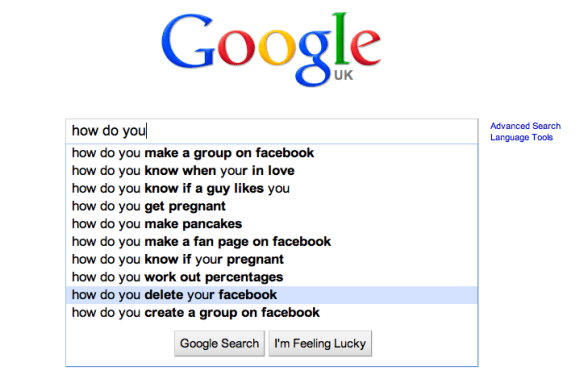
There’s actually a website dedicated to helping you find the elusive ‘delete’ hidden in the unnecessarily complicated settings. You can find out how well you have protected your privacy at Profile Watch. There’s also a handy bookmarklet at Reclaim Privacy that will similarly assess your profile. For a laugh, you can also read through some posts of other Facebook users, who probably think they are talking to their friends, not the entire internet: Openbook.
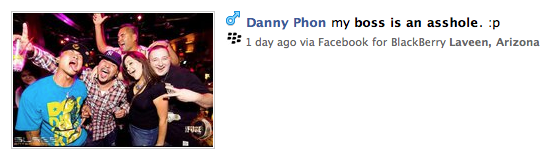
Are there real reasons to be worried? Well, after Facebook held a developer conference, lots of worried Google engineers left. And Google has hardly earned any privacy gold stars. And then there’s Mark Zuckerburg, the man behind the company, with a few thoughts on privacy (taken from an IM conversation when he was creating the service, then called The Facebook):
Zuck: Yeah so if you ever need info about anyone at Harvard
Zuck: Just ask.
Zuck: I have over 4,000 emails, pictures, addresses, SNS
[Redacted Friend’s Name]: What? How’d you manage that one?
Zuck: People just submitted it.
Zuck: I don’t know why.
Zuck: They “trust me”
Zuck: Dumb fucks.
Business Insider also has a fascinating expose on Zuckerburg. Decide for yourself if it holds much water, and if you think his character is likely to have improved in the last six years.
It’s also interesting to witness how Facebook has eroded the default privacy settings over the years, from friends and family to almost completely exposing everything.
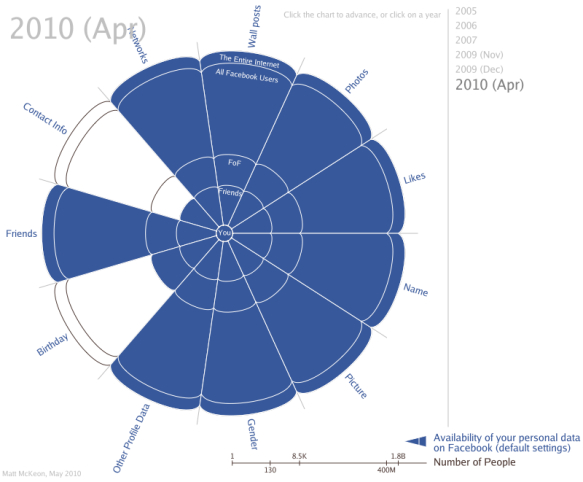
While most users may not understand/care about these issues, there are plenty who do. Enough that when a new project to create an open-source distributed social network asked for $10,000 to get started, they were overwhelmed with donations. As I write this, they have over $170,000 pledged.
So I guess Facebook just gives me the creeps.
Anatomy of a tweet
Image

How to fake being social on social networks
Updating three social networks daily sounds like an easy task. But what if your goal is to update these sites a certain number of times in specific ways, but after a busy week, you realize you may have updated each site with a status update daily, but forgotten to accept friend request or respond to messages. So for this to do list item, I will define what specific updates I would like to do daily.
- Twitter daily actions
- Check and respond to direct messages
- Check and respond to Mentions
- Send three relevant status updates daily
- Facebook daily actions
- Check and respond to inbox messages
- Update business pages
- Happy Birthday greetings
- Check and respond to group / page discussions
- Send three relevant status updates
[etc, etc]
(via How to Write a Clearly Defined To Do List – kikolani.com)
… what the hell? I’ve never needed a reminder to check messages people send me. You just read them. If you are too busy, you read them when you’re done or need a bit of a break. This stuff shouldn’t be a chore. It shouldn’t be so unintuitive that you need a fucking list to remind yourself that you give a shit what your ‘friends’ are saying to you!
Oh, and please, don’t forget to ‘send three relevant status updates daily’. It hardly matters if you don’t have anything interesting to say, does it? Just knock up some drivel about how to sell your crap on Twitter without looking like you’re just trying to sell your crap.
I should probably just not read blogs like this…
 halfblog.net