
On the subject of inequality, this TED talk by Richard Wilkinson makes good use of data to show that unequal incomes can have a dramatic negative effect across society.
Category Archives: Design
A rising tide raises all boats. Nice, if you can afford a boat.
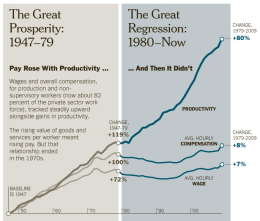 The charts below are from a September 2011 New York Times article, The Limping Middle Class. I moan a lot about shoddy infographics on this blog, but this isn’t one of those – this takes some complicated information and turns it into a story to make a very powerful point.
An informational graphic. See how it’s supposed to work?
I wonder if a similar presentation of UK data would be equally eye-opening?
Logo design for a conference: Inner Worlds, Outer Worlds
Last year I designed a logo for a conference to be held at the University of Birmingham called Inner Worlds, Outer Worlds [PDF], with a variety of talks and workshops on the subject of ‘developing personal and institutional narratives in support of LGBTQ students’.
I was pretty happy with the metaphor behind the final logo, and I think the conference put it to good use. You can see my exploration and development process below.
Penguin cartoon update
Status

To any of you who have followed my cartoon penguin saga, I can happily report that Google has recently re-discovered my illustration, and have seen fit to return it to the search result pages. Just like nothing happened, I am suddenly getting an extra 100+ visits per day from ‘cartoon penguin’ seekers. There is one small difference however: In its finite wisdom, Google has decided that this stub page is the best result now, not the actual blog post which includes a much larger image.
Whatever.
Khoi Vinh: On the Grid
Khoi Vinh: On the Grid from The Color Machine on Vimeo.
We sat down with Khoi Vinh, former Design Director of NYTimes.com to discuss the subject that has made his work most noteworthy: the grid. And in his case, the “g” almost deserves to be capitalized. The result is an illuminating conversation about Khoi’s plans for the future, first interest in the field of design, and even the grid’s complex relationship with emotion.
Link
These ‘Bayhem’ infographics strike a good balance of style and substance.
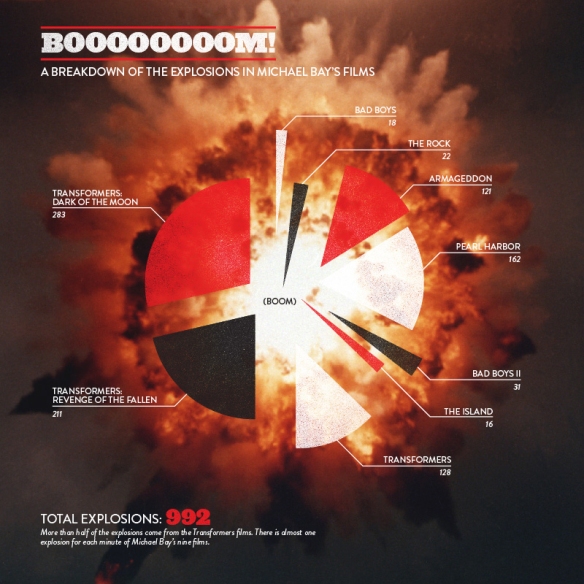
After extensively examining Michael Bay’s filmography, I have ascertained that his movies have a lot of explosions and death.
Me and anyone else who has seen a Michael Bay movie.
Avería: The Average Font
Here’s an interesting generative typeface, created by averaging a large collection of fonts on a computer: Avería.

Then it occurred to me: since my aim was to average a large number of fonts, perhaps it would be best to use a very simple process, and hope the results averaged out well over a large number of fonts. So, how about splitting each letter perimeter into lots of (say, 500) equally-spaced points, and just average between the corresponding positions of each, on each letter? It would be necessary to match up the points so they were about the same location in each letter, and then the process would be fairly simple.
The result is a surprisingly readable typeface, with an appealing hand-drawn quality.
Women defy biology to avoid giving birth on Halloween
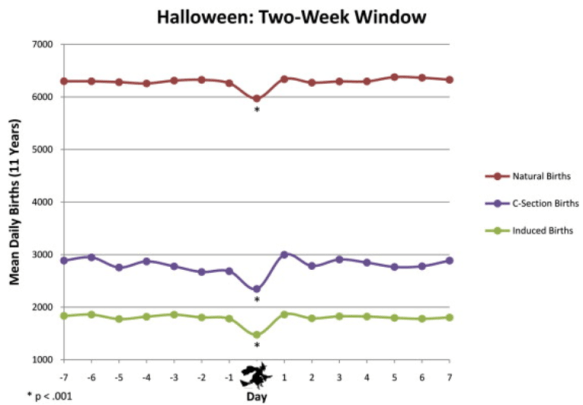
“But wait, what does Halloween Day have to do with giving birth? Or any day, for that matter? Don’t women just have babies when the time comes?” Well, apparently not, because, according to researchers at Yale, women can and do choose to avoid bringing their babies into the world concurrently with the “Festival of the Dead.”
I’m not just talking C-sections — the phenomenon inexplicably holds true for C-sections and spontaneous births. And Halloween isn’t the only holiday that has women strongly influencing their birth timing, either. This research ultimately leaves me with more questions than answers, but sometimes that’s the best kind of science.
(via Women defy biology to avoid giving birth on Halloween – trynerdy.com)
Open Paper
Status
I’m gradually migrating over the content from my Open Paper Tumblr blog. It was originally started because I had an idea to crowdsource content and design for a Newspaper Club project. While I was trying to decide what the paper should be about, I collected interesting, inspirational and useful links on the blog. These will be preserved here under the tag Open Paper, alongside regular halfblog.net posts.
I’d still like to produce a paper, but I probably won’t crowdsource the content.
A guide to brand colours
This graphic from Usability Post draws data from Cymbolism, a web site attempting to classify the meanings behind colours:
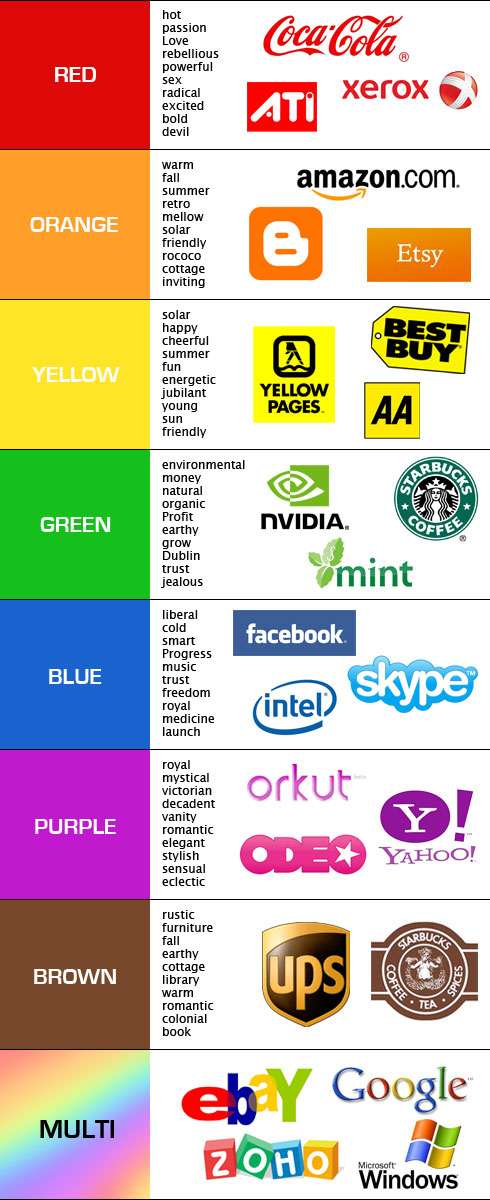
One of the key elements of building a strong brand is color selection. Every color has a different feel and various associations. By choosing a color or a combination of colors for your brand identity, you will take on those associations. Colors will evoke certain emotions and feelings towards your brand so it is vital to choose a color that will represent your identity effectively.
A Guide to Choosing Colors for Your Brand – usabilitypost.com
I also appreciated the insight in this post on the function of rounded corners.
Point d’ironie⸮
I can’t see obscure punctuation like the ‘snark’ finding a place any time soon. People seem to have enough problems with the punctuation we already have. Besides, sarcasm symbol would instantly reduce the humour in the sarcasm – it’s a bit like explaining a joke.

Another mark, now obscure, is the point d’ironie, sometimes known as a “snark.” A back-to-front question mark, it was deployed by the 16th-century printer Henry Denham to signal rhetorical questions, and in 1899 the French poet Alcanter de Brahm suggested reviving it. More recently, the difficulty of detecting irony and sarcasm in electronic communication has prompted fresh calls for a revival of the point d’ironie. But the chances are slim that it will make a comeback.
Link
A monstrously brilliant typography project:

An edition of Mary Shelley’s Frankenstein laid out using characters and glyphs from PDF documents obtained through internet searches. The incomplete fonts found in the PDFs were reassembled into the text of Frankenstein based on their frequency of use. The most common characters are employed at the beginning of the book, and the text devolves into less common, more grotesque shapes and forms toward the end.
Link
A fascinating look into the design of the new Guardian iPad app.
We have created something that is a new proposition, different to other digital offerings. It works in either orientation and nothing is sacrificed. Instead of it being based on lists, breaking news, and the fastest updates it’s instead designed to be a more reflective, discoverable experience. This gives it the potential to have a design capable of responding to the news… just like a newspaper.
The Guardian iPad edition: ‘Put the newspaper on the iPad’ – guardian.co.uk
Sentiment analysis of the Bible
Now this is how you make an infographic:
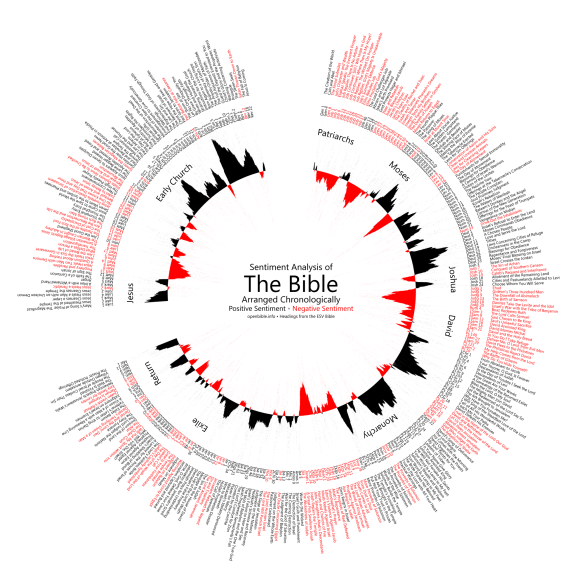
Things start off well with creation, turn negative with Job and the patriarchs, improve again with Moses, dip with the period of the judges, recover with David, and have a mixed record (especially negative when Samaria is around) during the monarchy. The exilic period isn’t as negative as you might expect, nor the return period as positive. In the New Testament, things start off fine with Jesus, then quickly turn negative as opposition to his message grows. The story of the early church, especially in the epistles, is largely positive.
Applying Sentiment Analysis to the Bible – openbible.info (via FlowingData)
ColorADD: A colour identification system for the colour blind
A clever and useful system for designers to keep in mind: ColorADD.

The system ID for Dalton Color was developed based on primary colours, represented by graphic symbols where the code is built on logical association and memorable. The concept of adding the color becomes a “game” that allows the knowledge gained through the color-blind, relate symbols – easily identifying colours that represent the combination of simple shapes combined with the basic color combinations. The black and white appear to guide the light and dark shades. The system was constructed through a process of logic and understanding direct association, where the use of primary colours, represented by simple symbols, allowing their rapid inclusion in the “visual vocabulary “user.
This concept of adding color is a mental game, which allows the color blind symbols relate to each other with the colours they represent, without having to memorize them individually. Each primary color code is associated with three forms representing the red, yellow and blue, and from these three forms develops the code. Two other forms have been added representing the black and white representing the shades lighter or darker colours. The secondary colours can be formed using the basic forms is the “mix” the primary pigments together, then forming the composition of a color palette . The gray was divided into two colours: light gray and dark gray. The entire code, covers a considerable number of colours and can be easily transmitted through information available in various communication media, including bulletin boards, catalogs or the product itself.
ColorADD (text translated by Google)
Flighty birds: My free Creative Commons designs that keep getting stolen anyway
I’ve been having some problems with flighty birds recently. Actually one is a penguin and the other is a dragon. Here they are, together for the first time:
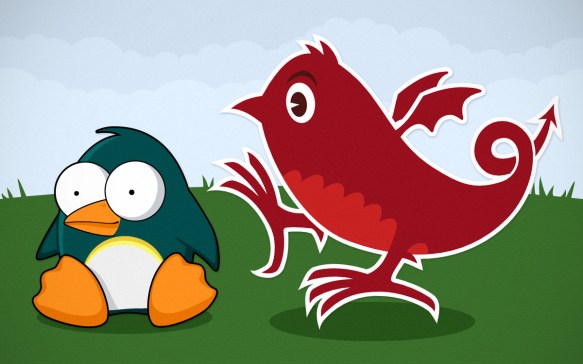
Original Tux on the left
The dragon was created in early 2010, to look like the familiar Twitter bird, but with a unique Welsh dragon spin.
Both images have gone on to be pretty popular on the web, used for avatars in forums, on Twitter and so on. I deliberately licensed both as Creative Commons Attribution-NonCommercial-ShareAlike. This means that people are welcome to use the images, for free, on condition that they provide a proper credit, and do not seek to profit directly or indirectly from use of my work. Also, they must make any derivative work available under the same terms.
The continuing misadventures of ‘Boggle’
These conditions seem more than reasonable to me, but I’ve spotted examples of people either not knowing or not caring that they are violating this very liberal licence, especially with the cartoon penguin design. There was a guy selling penguin t-shirt prints, and then only last month I found an iPhone game and a Mac software house using him. I ended up giving permission to the latter – they seemed nice enough.
The original Cartoon penguin post had actually become one of my most popular pages, bringing in 100+ hits per day via Google image search… until a few days ago I noticed this had stopped! Compare the following images:
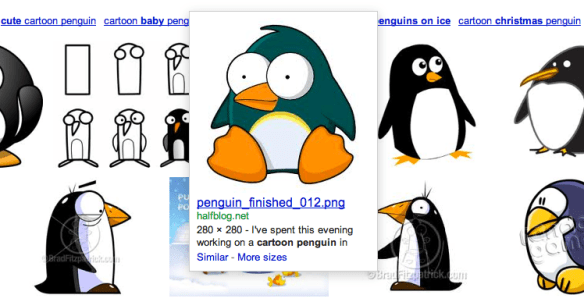
This is how the image search for 'cartoon penguin' looked last month (September 2011).
Compare that with the result today:
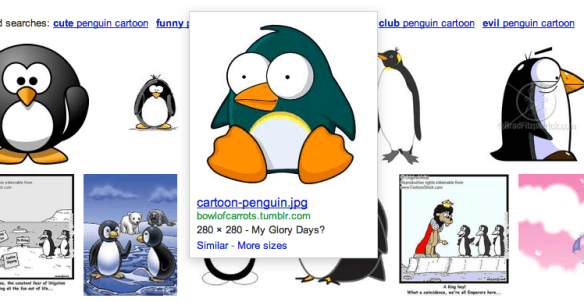
...and this is the same search today (October 2011)
Yup, now Google has removed the link to my original page, and instead sends searchers to this charming Tumblr page:
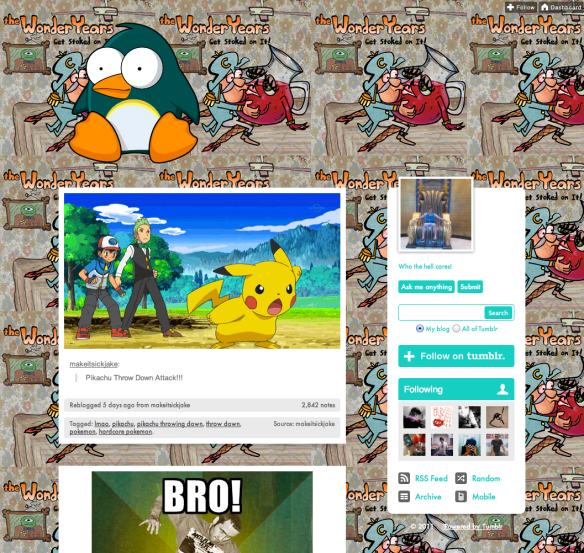
SEO surgery
Clearly the guy is no designer or SEO expert, but he has managed to outrank me for my own image! I’m assuming he’s winning because the image is near the top of the page in the title area (that appears on every page), and he’s renamed the image ‘cartoon-penguin.jpg‘, whereas my original is the less useful ‘penguin_finished_012.png‘.
Last night I optimised my site a little in an attempt to win back favour. I also contacted Mr. Bowlofcarrots via his site and Tumblr support, though I don’t really expect any joy from either of them.
It’s surprised me how annoyed I am by this minor injustice. After all, this is an image I was happy enough to give away for free. It occurred to me that even though this Tumblr user isn’t attempting to ‘steal’ my work in the same way as some previous people have, he has nonetheless taken it from me in a more real sense. Quite innocently, he has robbed me of my sense of ownership of the image itself. It’s very frustrating.
The @thisiswales saga
My other ‘bird’, the Twitter dragon, has been on other adventures. In this saga, I found him being used as part of the branding for an official-looking Twitter account calling itself ‘this is Wales‘.
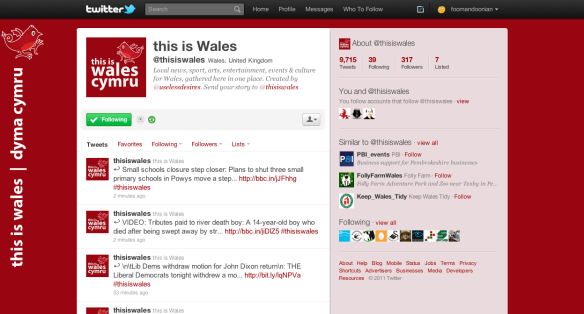
How @thisiswales looked in July, 2011
Official-looking it may be, but that’s simply because it imitates the look and feel of a BBC design, while appropriating the ‘This is X’ brand owned by Northcliffe Media (see This is South Wales / @thisisswales for examples). Not to mention, my Welsh dragon design.
 I asked people on Twitter if I should be upset about this – after all, this is another of my ‘free’ designs, and @thisiswales didn’t actually seem to be for any kind of profit.
It turned out that most were more outraged on my behalf than I was! (Thanks everyone!)
In the process of complaining, I may have upset the account’s owner, but he did remove my design later that day as he promised he would. Well, kind of. As I write this I notice that the background image still contains my work, but I think I’ll declare victory anyway.
The owner denied any wrongdoing, claiming that he “recently took on @thisiswales with logo already in place.” This may be true, but I have actually been aware of the account since July, and at that time it linked to the same Mr. @uselessdesires. Depends how you define recent I suppose.
So what?
I do realise both of these cases are pretty trivial. It’s not like Paperchase or Urban Outfitters have stolen my work to be used to fuel their profit machine. In the worst case, a blogger has been denied 100 hits a day that weren’t really contributing anything of real value anyway.
 But it’s frustrating to offer something for free, yet still have it taken without permission asked or credit given, especially when the casual theft can have a negative impact on me. It makes me want to use a more traditional full-copyright licence, and go after people who take the piss.
I wonder where they’ll turn up next?
UPDATE 2011.10.18: Tumblr got back to me; they have suspended the blog that was using my penguin image. A bit harsh perhaps, but I’m not going to complain. It will be interesting to see if I regain my ranking (or if Mr. Clipart manages to get his Tumblr blog reinstated).
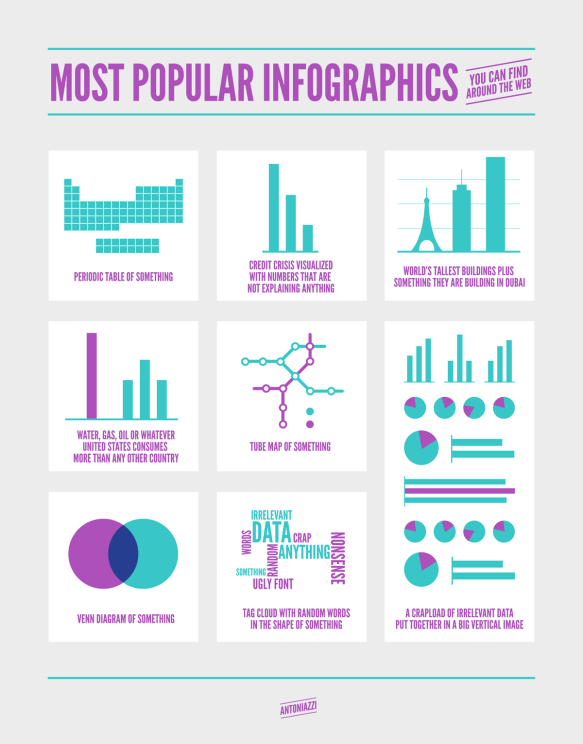
Most popular infographics
Link
Off Book, Typography by PBS Arts.
In episode 2 of Off Book, typeface designers Jonathan Hoefler and Tobias Frere-Jones outline the importance of selecting the right font to convey a particular feeling. Graphic designer Paula Scher talks about building identity in messaging, while Eddie Opara uses texture to create reaction. Infographic designers Julia Vakser and Deroy Peraza map complicated data sets into digestible imagery, mixing color, graphics and type.
Link
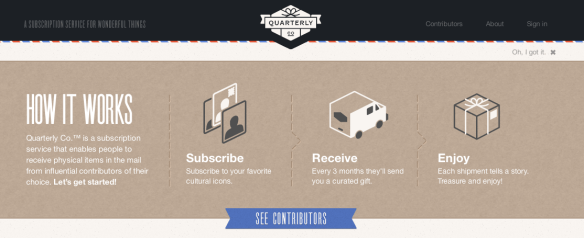
Quarterly Co. is a subscription service that lets you receive awesome things in the mail. You can subscribe to people you find interesting and, once every three months, they will send you a package right to your doorstep.
 halfblog.net