Link

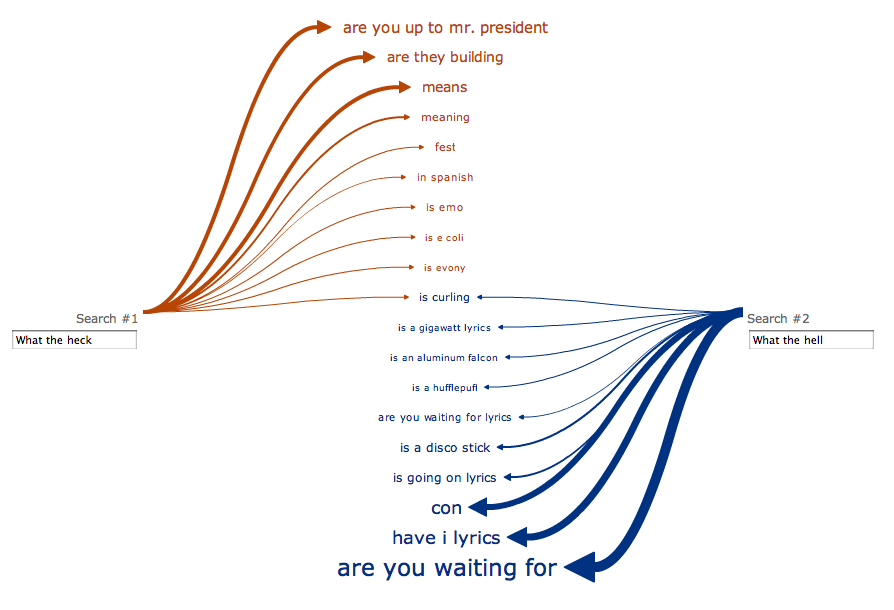
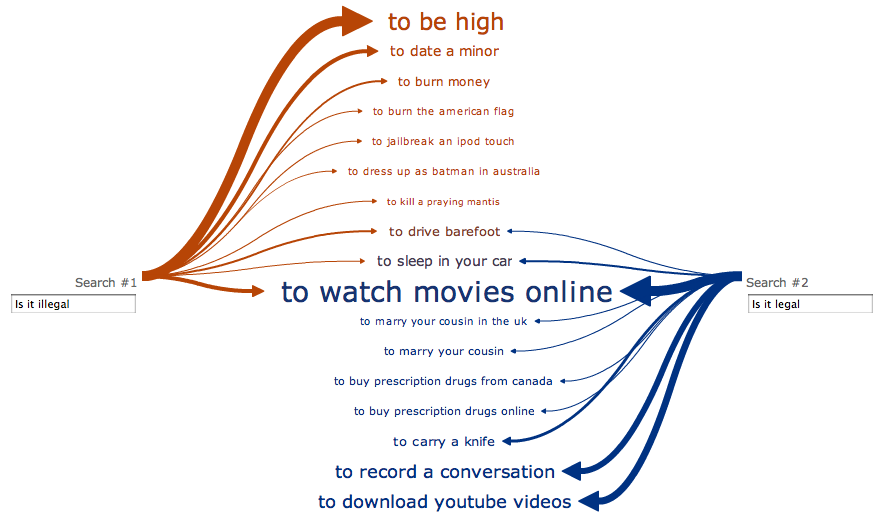
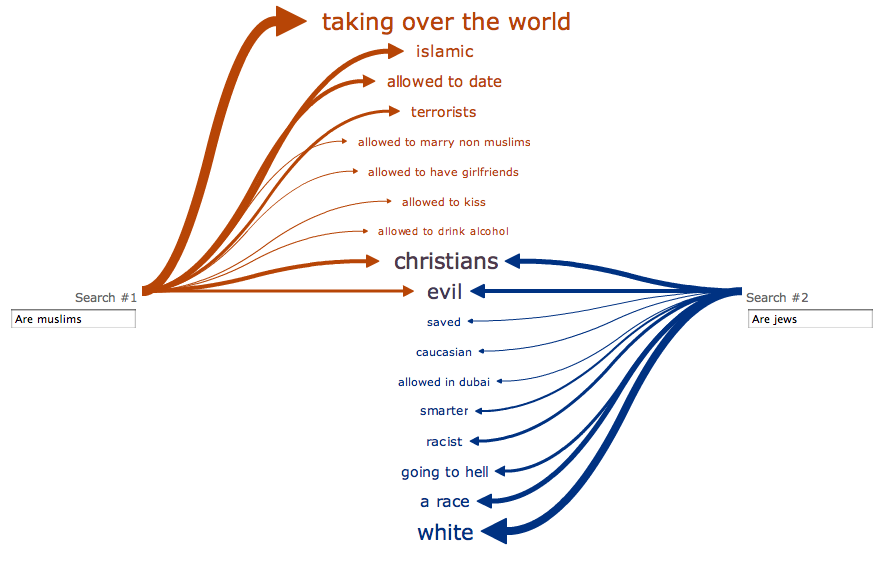
Web Seer is a fascinating tool that lets you explore what questions people are typing into Google, and compare it to other questions to see where they overlap. Admittedly, I can’t think of a real world use for this, but it’s fun to play with. If you find an interesting comparison, please leave a link in the comments!

More info on the Web Seer project page.

Continue reading

Insightful landing page case study

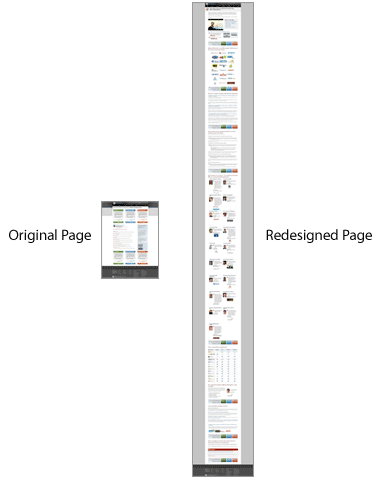
In our analysis of Rand’s effective face-to-face presentation we noticed that he needed at least five minutes to make the case for SEOmoz PRO. Yet the existing web page was more like a one-minute summary. Once we added the key elements of Rand’s presentation, the page became much longer:

Short versus long body copy case study

It’s interesting to note that Amazon.com, which is known for its relentless testing, tends to have extremely long product pages. Just see the page for its Kindle reader.

via conversion-rate-experts.com

There’s a lot of useful information in this article, but this page length comparison and the technique of writing copy with ‘curiosity rather than overt “buy me” language’ were the big takeaways for me.

Posted in SEO | Tagged

#0044CC – The one hundred million dollar colour

Microsoft also tested multiple versions of blue for links in their search results. A specific color of blue (#0044CC) drove $80-$100 million dollars a year increase over the light blue the design team tried first.

(via lukew.com & found via Andrew Parker)

Andrew references Douglas Bowman in his post, who quit Google’s design team, citing an example of the time the company did extensive testing to pick from 41 shades of blue. It seems that perhaps Google have it right.

“Mad libs” style form increases conversion 25-40%

A while ago, I came across a unique registration form built by Jeremy Keith for his audio sharing site, Huffduffer. Though it asked people the same questions found in typical sign-up forms, the Huffduffer registration form did so in a narrative format. It presented input fields to people as blanks within sentences (Mad Libs-style, if you will).

Huffduffer madlibs signup

via lukew.com

There’s even some A/B testing information to lend some weight.

I know I posted a link to this article on Twitter yesterday, but I thought it was such a clever and simple idea that I wanted to make a note of it here.

Posted in Web

How to fake being social on social networks

Updating three social networks daily sounds like an easy task. But what if your goal is to update these sites a certain number of times in specific ways, but after a busy week, you realize you may have updated each site with a status update daily, but forgotten to accept friend request or respond to messages. So for this to do list item, I will define what specific updates I would like to do daily.

  1. Twitter daily actions
    • Check and respond to direct messages
    • Check and respond to Mentions
    • Send three relevant status updates daily
  2. Facebook daily actions
    • Check and respond to inbox messages
    • Update business pages
    • Happy Birthday greetings
    • Check and respond to group / page discussions
    • Send three relevant status updates

[etc, etc]

(via How to Write a Clearly Defined To Do List – kikolani.com)

… what the hell? I’ve never needed a reminder to check messages people send me. You just read them. If you are too busy, you read them when you’re done or need a bit of a break. This stuff shouldn’t be a chore. It shouldn’t be so unintuitive that you need a fucking list to remind yourself that you give a shit what your ‘friends’ are saying to you!

Oh, and please, don’t forget to ‘send three relevant status updates daily’. It hardly matters if you don’t have anything interesting to say, does it? Just knock up some drivel about how to sell your crap on Twitter without looking like you’re just trying to sell your crap.

I should probably just not read blogs like this…

“haha. This you????”

I’ve only had two of these phishing DMs that are currently all the rage on Twitter. Curiosity got the better of me, so I followed the link. I’m tempted to create a dummy account and give it the credentials to see what it does.

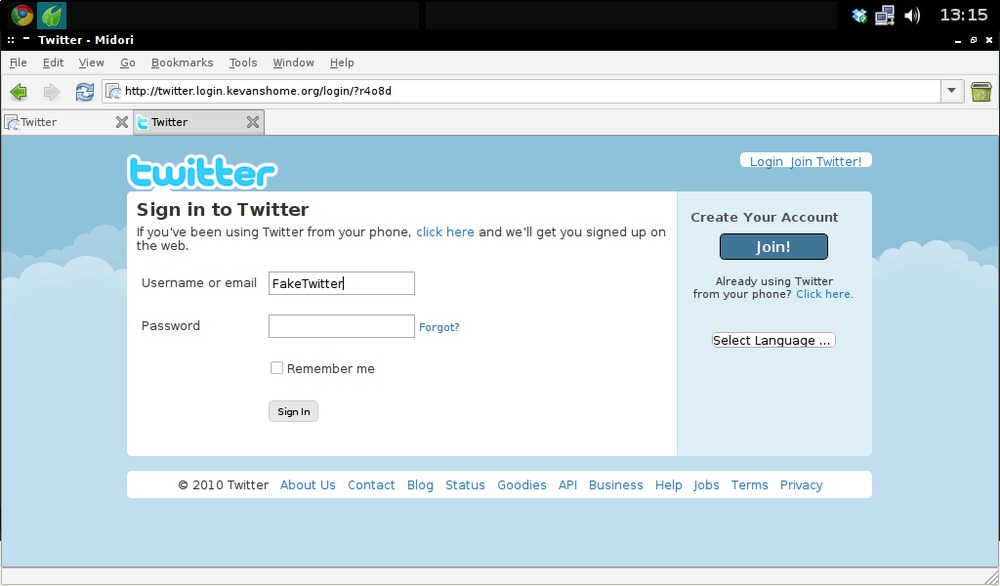
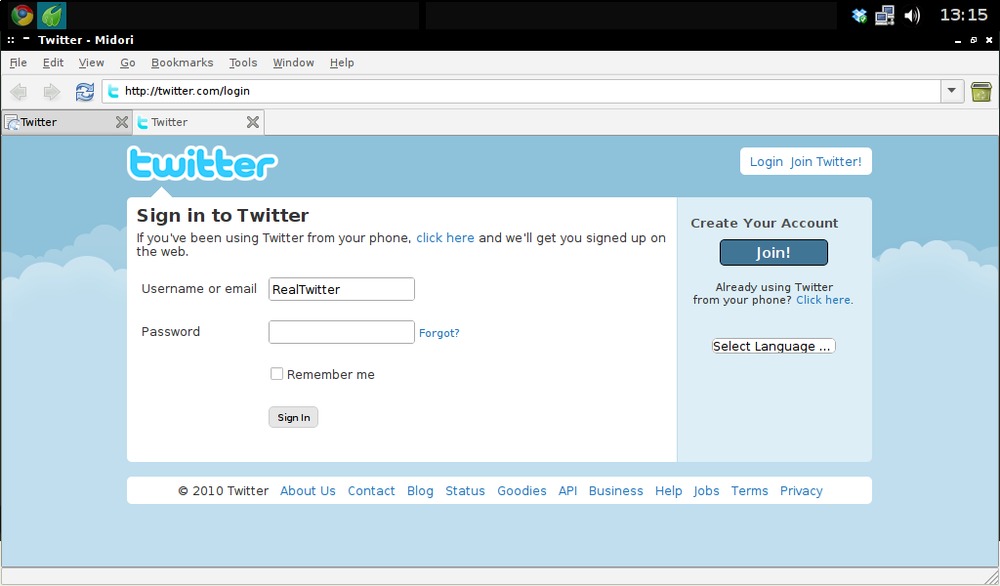
I’ve attached screenshots, comparing the fake login page with the real one, and the destination you get to when you give the fake page your credentials. (I used fake info, naturally!) It’s just an empty Blogger blog. Most of the other links on the fake page don’t work.

Honestly, I can see how people are taken in. I instantly noticed the padding errors where they hadn’t duplicated the page properly, but Twitter hasn’t always had the best design, so I could easily believe it was the real login page on a bad day. Of course, the URL is totally wrong, but that could be missed by people with no reason to doubt the link.

Verified by Visa: How not to design authentication

A widely deployed system intended to reduce on-line payment card fraud is fraught with security problems, according to University of Cambridge researchers.

The system is called 3-D Secure (3DS) but known better under the names Verified by Visa and MasterCard SecureCode. Implemented and paid for by e-commerce vendors, the systems require a person to enter a password or portions of a password to complete an on-line purchase.

As a reward for investing in the systems, merchants are less liable for fraudulent transactions and are stuck with fewer chargebacks. But banks such as the Royal Bank of Scotland are now holding consumers to a higher level of liability if fraudulent transactions occur using either system, said Steven J. Murdoch, a security researcher at the University of Cambridge.

via pcworld.idg.com.au

I’ve been aware of the security issues with Verified by Visa for a while now, but it’s becoming increasingly difficult to avoid using the scheme. Right now I’m having to decide if it’s worth compromising my security for a cool pair of trainers. Previously, I’ve been able to use PayPal, or some other alternative, but Adidas offer VbV or nothing.

If you shop online often, read up on this a little. here’s a link to the actual paper, which is quite short and readable.

Veri ed by Visa and MasterCard SecureCode: or, How Not to Design Authentication [PDF 164KB]

The Internet is hard

Banners, logos, carefully crafted wordsmithery – this is all filler, we’ve found out. Users have been calloused by 15 or so years of surfing through bad ads and marketing babble, and they are unconsciously tuning out everything but the one thing they came to find.

For example, none of the 200 or so confused Facebook users who commented on our earlier post read the post itself, the huge logo at the top of the page, the many links to non-Facebook-related content or the huge, all-bold paragraph about how ReadWriteWeb is not, in fact, some ill-conceived redesign of Facebook. They simply searched for “Facebook login” and, upon navigating to our site, scrolled until they found the one button they wanted to click. Which brings us to our third assertion.

(via readwriteweb.com)

RRW has a post up about the confusion that was caused recently when one of their stories became a top Google result for ‘Facebook login’, and hundreds of confused Facebookers mistook the blog for a new Facebook design.

Some important lessons here.

Interesting column about which NY Times stories are the most shared

More emotional stories were more likely to be e-mailed, the researchers found, and positive articles were shared more than negative ones. Longer articles generally did better than shorter articles, although Dr. Berger said that might just be because the longer articles were about more engaging topics.

[…]

Building on prior research, the Penn researchers defined the quality as an “emotion of self-transcendence, a feeling of admiration and elevation in the face of something greater than the self.”

They used two criteria for an awe-inspiring story: Its scale is large, and it requires “mental accommodation” by forcing the reader to view the world in a different way.

“It involves the opening and broadening of the mind,” write Dr. Berger and Dr. Milkman, who is a behavioral economist at Wharton.

(via nytimes.com)

It sounds like a really interesting study. I’ve had a notion for some years now to start a blog on ‘futurology’ or something similar. Now I’m wondering if that could be a hit…

Is there any good reason to use title case?

The convention followed by many British publishers (including scientific publishers, like Nature, magazines, like The Economist and New Scientist, and newspapers, like The Guardian and The Times) is the same used in other languages (e.g., French), namely to use sentence-style capitalization in titles and headlines, where capitalization follows the same rules that apply for sentences. This convention is sometimes called sentence case where a term is desired to clarify that title case shall not be applied. It is also widely used in the United States, especially in bibliographic references and library catalogues. Examples of global publishers whose English-language house styles prescribe sentence-case titles and headings include the International Organization for Standardization.

(via en.wikipedia.org)

I’ve developed the habit of using sentence case for headlines, but now I’m facing a situation where I’m probably going to have to adapt to a new style guide and start using Title Case at work. I’ve developed a strong preference for sentence case, and now find title case to be ugly and tabloid-esque.

It seems likely to me that title case is a hangover from the days of more primitive typesetting, when you would need to distinguish between BIG HEADLINES, Important Headlines, and regular text.

In these days of HTML and CSS, is there really any good reason to use title case?

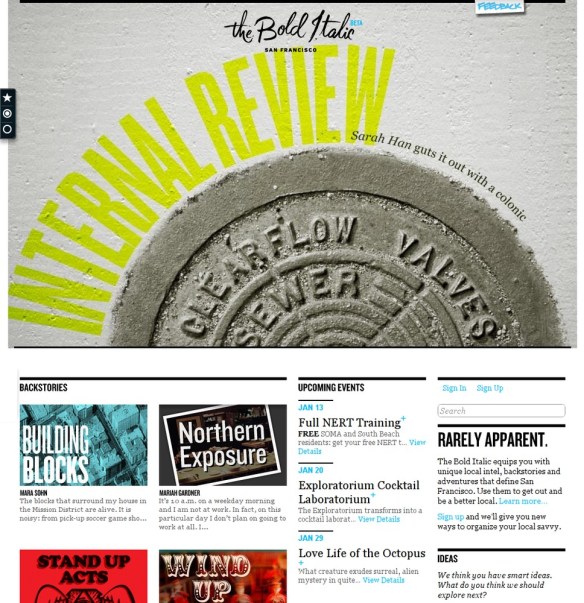
The Bold Italic: Covering local stories, venues and events with style

The Bold Italic is not about typography. It’s not a news site either, but it feels like one – albeit a very trendy news site. In fact, it’s about ‘local discovery’ – trendy San Francisco types write about their local obsessions. Venues, merchants and events are also covered. From the about page:

Just when you thought you were a pretty savvy local, along came The Bold Italic. Our mission is to help people become better locals, equipping our members with rare local intel, backstory and potential adventures.

Our writers, the Bold Locals, find their way behind-the-scenes in San Francisco and come back with backstories of distinctive, offbeat local experiences.

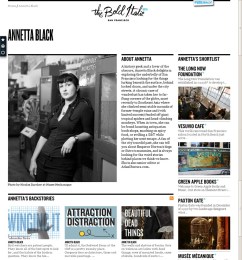
A San Franciscan, such as yourself, can keep pieces of these backstories — a particular merchant, landmark, or product — in the Clipbook. That’s the tab on the left with shapes on it.

It’s a hugely appealing site. Anyone considering a local web project should study it closely.

Emotion Markup Language

The W3C just completed the first draft of the Emotion Markup Language (EmotionML 1.0).

Um, why?

Use cases for EmotionML can be grouped into three broad types:

  1. Manual annotation of material involving emotionality, such as annotation of videos, of speech recordings, of faces, of texts, etc;
  2. Automatic recognition of emotions from sensors, including physiological sensors, speech recordings, facial expressions, etc., as well as from multi-modal combinations of sensors;
  3. Generation of emotion-related system responses, which may involve reasoning about the emotional implications of events, emotional prosody in synthetic speech, facial expressions and gestures of embodied agents or robots, the choice of music and colors of lighting in a room, etc.

If you’re still not getting the why, they have a list of 39 possible use cases. I’m wondering if it could be used for interactive fiction somehow?

I love crap like this!

WikiReader

WikiReader The WikiReader is a funky Hitch-Hikers Guide style gadget that gives you Wikipedia in your pocket. I love the form, the touchscreen, the low power consumption, the low price and that it uses a MicroSD card. You can subscribe to bi-annual updates and they will post you the cards, or you can download the (4GBs of) data yourself.

I’m waiting for an e-reader gadget like this, but the size of a paperback, that allows you to put any data on the card to read. Ideally running some flavour of Linux. And none of this copy protection nonsense!

That’s all I want. Continue reading

How do you turn 3.9million internet pirates into 7million? A lesson in statistics.

Where the British Government’s official figure on the level of illegal filesharing in the UK came from:

  • Survey 1,176 people
  • 136 admit of filesharing – that’s 11.6%
  • Beef that up a bit, some must have been lying: 16.3% sounds good.
  • Let’s assume there are 40million people in the country with net access
  • (Actual figure according to the ONS: 33.9m)
  • That’s a shocking 7million pirates in the UK!
  • (Actual figure: 3.9million)

And guess where the figure came from: Government > Forrester Research > Jupiter Research > Commissioned by the BPI, the music trade body. This stuff drives me batshit.

A dirty little trick to get more followers on Twitter

About a year ago I gave up caring who started following me on Twitter, largely because of the proliferation of blatant spammers. I put up a note on my bio saying that if people really wanted me to reciprocate, the should send me a message, and I would certainly follow back if they were an interesting real person, and not some spam account (or worse). This still seems perfectly reasonable to me.

More recently though I decided I should take a more active interest in those who choose to follow me. I started using the excellent Topify, which makes it easy to identify spammers and I check out anyone who seems interesting.

Consequently, I’ve spotted an annoying trend.

There are many, many users who follow about 200 more people than follow them back. They are taking advantage of the fact that about half of the people that they follow, will follow them back! For whatever reason a large number of people feel it is the done thing to just blindly follow back anyone who follows them, however spammy, offensive or bizarre the new follower is! Personally, I don’t understand this behaviour in the slightest: I don’t want spam in my Twitter stream – so I don’t follow spammers. It’s simple.

Nonetheless, if you want to steadily grow your follower base, add 100 new people a day. Then, after you’ve been doing this for a few days, go back and unfollow all those who didn’t follow you in return, while continuing to follow new people. This way your ratio will always be near enough 1:1, making you look legitimate and popular. Eventually, when you reach an acceptable target (say, 10,000 followers) you can have a big purge and get rid of a lot of the mindless sheep you have accumulated. Say, 20-30% of them. Now it looks like you are a power user. Any new visitors to your profile will assume that you are hugely important and that maybe they should listen to you too.

So there you go, now you can claim to be an SEO-demigod, and have huge numbers of low-quality followers seeming to back it up.

Or you could just use Twitter like a normal person.

The Virgin Media Twitter account saga

I was finally able to access the Gmail account that I used for my @virginmedia Twitter profile that Virgin Media ‘stole’ from me earlier this month. I now know that I received only one email from Twitter on the subject. There was no opportunity to change the name myself, or to fight my position. They also stripped the avatar, background image and bio (presumably because these reinforced the ‘impersonation’), leaving me with @notvirginmedia. I’ve copied the email from Twitter below.

Hi There,

We’ve received a complaint from Virgin Media, UK. It has come to our attention that your Twitter account:

http://twitter.com/virginmedia

is in violation of our basic Terms of Service, specifically article 4 which mentions impersonation:

  1. You must not abuse, harass, threaten, impersonate or intimidate other Twitter users.

In this case “impersonation” is the issue. Impersonation is against our terms of service unless it’s parody. The standard for defining parody is, “Would a reasonable person be aware that it’s a joke.”

To settle this issue we’ve changed the user name to “notvirginmedia” in the full name and username fields in order to eliminate confusion. You can change your real and user names to something else if you’d like:

  1. Visit Twitter.com/settings
  2. Edit the Full Name and Username fields
  3. Click “Save”

but please honor Twitterʼs Terms of Service accordingly. We appreciate your cooperation in this matter.

Thanks,

Twitter Support

However you define parody or impersonation in legal terms, I’d imagine my Twitter profile was in a pretty grey area. I had copied the branding and used their company name, but the bio line (‘We’re Virgin Media, you’re just a customer’) and the tweeted content was pretty clearly parody and not produced or endorsed by Virgin Media.

I have reconfigured Twitterfeed and tweaked the design of the page to make it a clearer parody. I’m not interested in fighting this in any way, but I think a lot less of Twitter as a result.

One unexpected angle on all this is the Virgin Media Twitter profile itself. Although they only have five updates, despite launching a major new service, the are at least @ replying to some users. Hopefully they will use Twitter as a positive force. I originally set up the account out of frustration through shitty service. Twitter is an excellent way to provide a small amount of technical support (that you don’t have to pay for!) or to provide service level updates, etc.

Let’s hope they use it for good!