
This video was made entirely on the iPhone, primarily so I could play with Cinema FX for Video, ReelDirector and iMovie (for iPhone).
Category Archives: Miscellania
The Ferris Bueller Fight Club theory
This trailer is well done (if a bit overlong) but the theory behind it is amazing.
My favorite thought-piece about Ferris Bueller is the “Fight Club” theory, in which Ferris Bueller, the person, is just a figment of Cameron’s imagination, like Tyler Durden, and Sloane is the girl Cameron secretly loves.
One day while he’s lying sick in bed, Cameron lets “Ferris” steal his father’s car and take the day off, and as Cameron wanders around the city, all of his interactions with Ferris and Sloane, and all the impossible hijinks, are all just played out in his head. This is part of the reason why the “three” characters can see so much of Chicago in less than one day — Cameron is alone, just imagining it all.
It isn’t until he destroys the front of the car in a fugue state does he finally get a grip and decide to confront his father, after which he imagines a final, impossible escape for Ferris and a storybook happy ending for Sloane (“He’s gonna marry me!”), the girl that Cameron knows he can never have.
(via Cool Papa Bell / metatalk.metafilter.com)
I don’t think for a second that Ferris Bueller was written with this complicated extra dimension in mind, but I’m curious to watch the film again and see if it holds water retrospectively!
Toe Fluff
Steve Rack is an artist. He designed a character called Toe Fluff, which he thought would be great toy. In fact, he liked Toe Fluff so much that he decided to base an exhibition on it. To shake things up he asked his friends to customize Toe Fluff as part of the show. Well, since Steve’s ‘call for submissions’, things kind of snowballed! The project is now open to all artists. All you have to do is download the template and get creative!
The July 15th deadline for entries is fast approaching, but there’s still time to create something fun. I’ve just entered one myself:


To the left is the template everyone has to work from. It’s really worth looking through the other entries on the Toe Fluff website as there is some amazing work. You could also follow @SteveRack on Twitter.
Secret Cinema: A theatre experience I would enjoy
It was an incredible experience, and we hadn’t even been “evacuated” to the second warehouse next door to watch Blade Runner yet. That happened at 9pm, and the atmosphere was electric — literally, in fact: a reproduction of the floodlit building featured during the movie’s climax was projected onto the huge warehouse’s right-hand wall as the film reached its crescendo, to cheers and applause. Two actors, in costume, were suspended in fixed positions at the top of the wall, recreating in real life what we were seeing on-screen.
Odeon, take note: THIS is how to get people off BitTorrent and into cinemas.
(via Review: Secret Cinema brings Blade Runner to London)
This sounds amazing.
Want to make a living as a creator online? Find your ‘true fan’ number.
While some artists have discovered this path without calling it that, I think it is worth trying to formalize. The gist of 1,000 True Fans can be stated simply:
A creator, such as an artist, musician, photographer, craftsperson, performer, animator, designer, videomaker, or author – in other words, anyone producing works of art – needs to acquire only 1,000 True Fans to make a living.
A True Fan is defined as someone who will purchase anything and everything you produce. They will drive 200 miles to see you sing. They will buy the super deluxe re-issued hi-res box set of your stuff even though they have the low-res version. They have a Google Alert set for your name. They bookmark the eBay page where your out-of-print editions show up. They come to your openings. They have you sign their copies. They buy the t-shirt, and the mug, and the hat. They can’t wait till you issue your next work. They are true fans.
(via 1,000 True Fans – kk.org)
He goes on to explain that the number of ‘true fans’ may be different depending on what you want to do, how many people you work with and even where you live. Personally, I would drop the ‘1,000’ bit.
Anyway, I’ve heard this notion expressed before, I think in an interview with Jonathan Coulton. As someone who has been a passionate fan of several writers, artists and filmmakers I can totally believe in this model. You don’t have to buy into the notion that you either become a megastar or a failure. So long as you know you’re great at whatever it is you do, there should be a way to make a living out of it.
More fun with HDR
Gallery

This gallery contains 4 photos.
I still haven’t bought Photomatix, so these are still watermarked, but I’m still just exploring what’s possible. I don’t think I’m going to like how HDR landscapes look, but architectural shots can look great. Vivid colours really jump out too.
Should you delete your Facebook account?
This May 31st is Quit Facebook Day, but I won’t be deleting my account. No, I got rid of it a few weeks ago. As much as I’d like to claim that this was entirely some kind of ethical stance, the simple truth was that I didn’t actually make much use of the service. If I had the same negative feelings about Twitter, quitting would be a much tougher decision.
Should you leave Facebook? Maybe. It’s certainly a question that a lot of people are asking. Then, if they decide to, they ask ‘so how the hell do I delete the thing?’ Enough that this has become a Google suggested result:
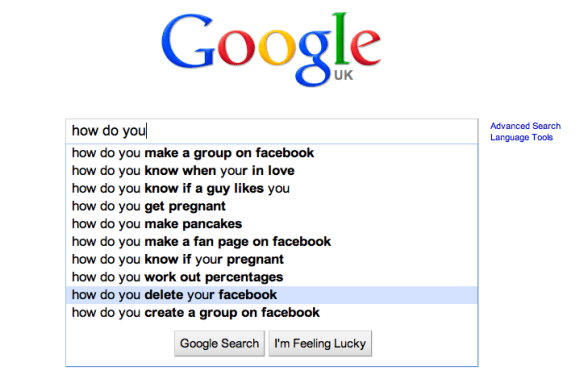
There’s actually a website dedicated to helping you find the elusive ‘delete’ hidden in the unnecessarily complicated settings. You can find out how well you have protected your privacy at Profile Watch. There’s also a handy bookmarklet at Reclaim Privacy that will similarly assess your profile. For a laugh, you can also read through some posts of other Facebook users, who probably think they are talking to their friends, not the entire internet: Openbook.

Are there real reasons to be worried? Well, after Facebook held a developer conference, lots of worried Google engineers left. And Google has hardly earned any privacy gold stars. And then there’s Mark Zuckerburg, the man behind the company, with a few thoughts on privacy (taken from an IM conversation when he was creating the service, then called The Facebook):
Zuck: Yeah so if you ever need info about anyone at Harvard
Zuck: Just ask.
Zuck: I have over 4,000 emails, pictures, addresses, SNS
[Redacted Friend’s Name]: What? How’d you manage that one?
Zuck: People just submitted it.
Zuck: I don’t know why.
Zuck: They “trust me”
Zuck: Dumb fucks.
Business Insider also has a fascinating expose on Zuckerburg. Decide for yourself if it holds much water, and if you think his character is likely to have improved in the last six years.
It’s also interesting to witness how Facebook has eroded the default privacy settings over the years, from friends and family to almost completely exposing everything.
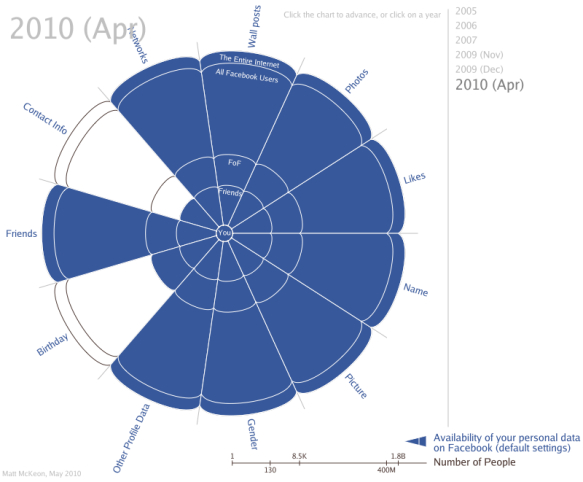
While most users may not understand/care about these issues, there are plenty who do. Enough that when a new project to create an open-source distributed social network asked for $10,000 to get started, they were overwhelmed with donations. As I write this, they have over $170,000 pledged.
So I guess Facebook just gives me the creeps.
HuffPo uses A/B testing to write better headlines
From direct mail to web design, A/B testing is considered a gold standard of user research: Show one version to half your audience and another version to the other half; compare results, and adjust accordingly. Some very cool examples include Google’s obsessive testing of subtle design tweaks and Dustin Curtis’ experiment with direct commands and clickthrough rates. (“You should follow me on Twitter” produced dramatically better results than the less moralizing, “Follow me on Twitter.”)
So here’s something devilishly brilliant: The Huffington Post applies A/B testing to some of its headlines. Readers are randomly shown one of two headlines for the same story. After five minutes, which is enough time for such a high-traffic site, the version with the most clicks becomes the wood that everyone sees.
(via How The Huffington Post uses real-time testing to write better headlines – niemanlab.org)
I also found it interesting that they are considering splitting up the content they serve by IP address, so they can serve the East and West coasts better.
Nifty fifty: Taking the Canon EF 50mm f1.8 II for a spin
Gallery

This gallery contains 7 photos.
Since buying the 550D I’ve had many people suggest a 50mm lens to me, usually the 50mm f1.8. Convinced by the sheer volume of advice more than anything, I went ahead and treated myself! There’s no doubt this will be … Continue reading
First pictures taken with my Canon 550D
Gallery

This gallery contains 12 photos.
This weekend I bought the Canon 550D I had decided to get, so of course I needed to try it out. There’s a nice old cemetery near me, which is ideal for this kind of thing. I spent a few hours there … Continue reading
What exactly is it I want to do?
I’ve been giving a lot of thought recently to what exactly it is I want to do for a living. The key themes come through pretty strong: I want to do something creative, something with a big internet component, and something independent or with a small team. I don’t expect for one second that someone will read this post and just give me my dream job, but the very act of collecting all these thoughts has been hugely valuable to me. And who knows, perhaps I’ll find a programmer or writer to collaborate with on something.
What follows is a list of examples of the kind of work I could easily see myself doing…
Doctor Who business jargon
Quote
“Weeping Angel” problem – an issue in a project (or similar) which is under control while someone is actively watching it but will go badly wrong the moment that no-one is observing/managing.
This great example of project management speak just got emailed around work, via Yammer:
Watch YouTube in ASCII mode, save bandwidth
Aside
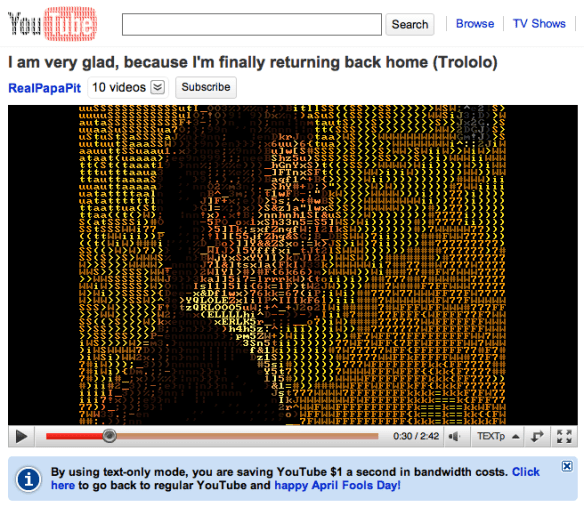
The first April Fool I have seen this year.
GeekTool: A system monitor for Mac OS X
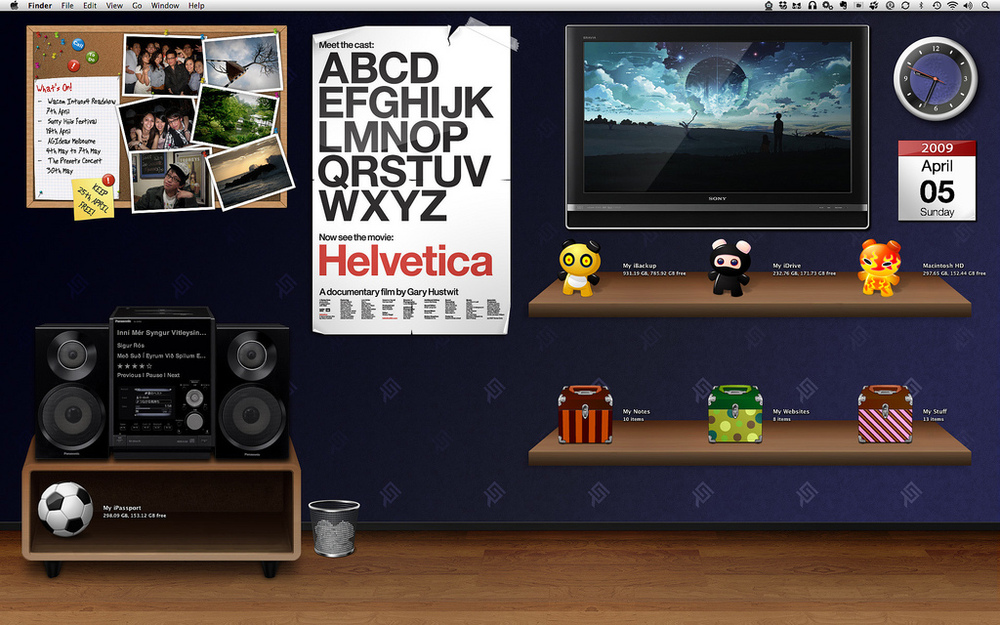
GeekTool is a system monitor for Mac OS X, which will let you display system information or various feeds from the internet on your desktop. It’s like Conky for Linux, if that means anything to you. There are many, many scripts you can use to display weather forecasts, CPU and RAM usage, free HD space, the latest XKCD, unread emails, the track now playing, Twitter messages and pretty much anything else you can think of. As the examples I’ve attached to this post show, you can do some really creative desktops.
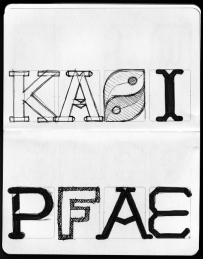
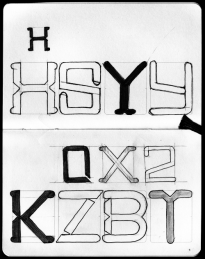
My first attempt at an original typeface design

This is still early days, but it’s starting to come together. My major reservation is that it looks a little – familiar. I’m a bit worried I may be unconsciously imitating another font I have seen. It has a certain T26 vibe.
“haha. This you????”
I’ve only had two of these phishing DMs that are currently all the rage on Twitter. Curiosity got the better of me, so I followed the link. I’m tempted to create a dummy account and give it the credentials to see what it does.
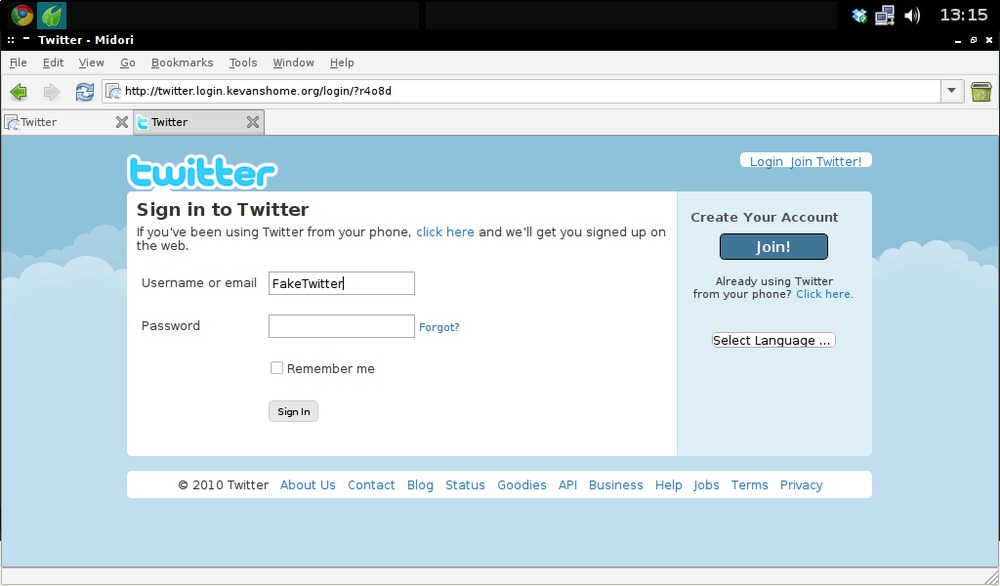
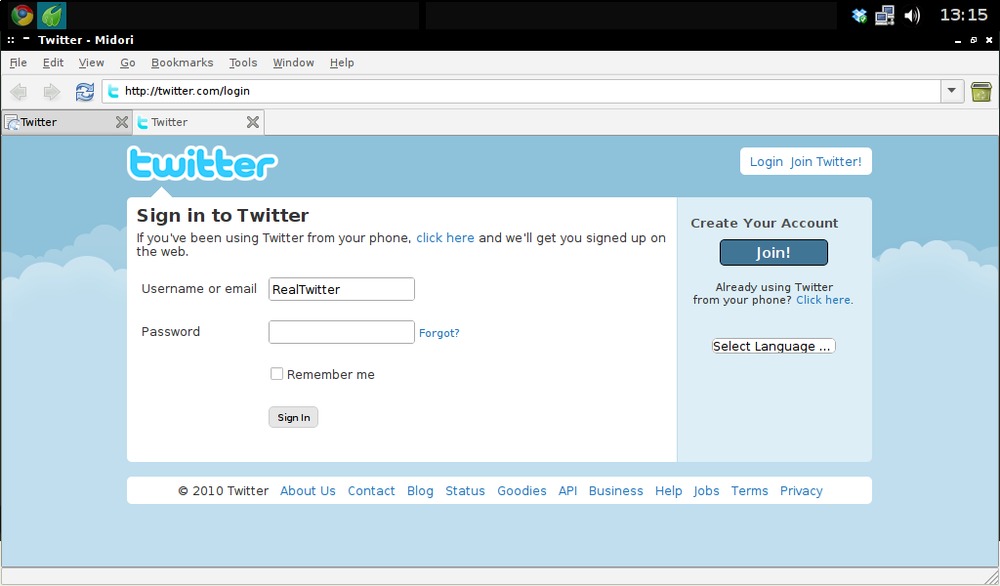
I’ve attached screenshots, comparing the fake login page with the real one, and the destination you get to when you give the fake page your credentials. (I used fake info, naturally!) It’s just an empty Blogger blog. Most of the other links on the fake page don’t work.
Honestly, I can see how people are taken in. I instantly noticed the padding errors where they hadn’t duplicated the page properly, but Twitter hasn’t always had the best design, so I could easily believe it was the real login page on a bad day. Of course, the URL is totally wrong, but that could be missed by people with no reason to doubt the link.
Verified by Visa: How not to design authentication
A widely deployed system intended to reduce on-line payment card fraud is fraught with security problems, according to University of Cambridge researchers.
The system is called 3-D Secure (3DS) but known better under the names Verified by Visa and MasterCard SecureCode. Implemented and paid for by e-commerce vendors, the systems require a person to enter a password or portions of a password to complete an on-line purchase.
As a reward for investing in the systems, merchants are less liable for fraudulent transactions and are stuck with fewer chargebacks. But banks such as the Royal Bank of Scotland are now holding consumers to a higher level of liability if fraudulent transactions occur using either system, said Steven J. Murdoch, a security researcher at the University of Cambridge.
I’ve been aware of the security issues with Verified by Visa for a while now, but it’s becoming increasingly difficult to avoid using the scheme. Right now I’m having to decide if it’s worth compromising my security for a cool pair of trainers. Previously, I’ve been able to use PayPal, or some other alternative, but Adidas offer VbV or nothing.
If you shop online often, read up on this a little. here’s a link to the actual paper, which is quite short and readable.
Veri ed by Visa and MasterCard SecureCode: or, How Not to Design Authentication [PDF 164KB]
3ds Max vs. Blender: Revealing results of a CG software user survey
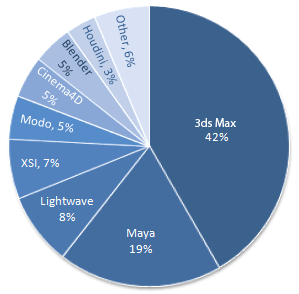 It’s clear from the pie chart that 3ds Max is the giant in the market here, with Maya (also an Autodesk product) the next big player. If you scroll down the article, what really stands out is that both of these packages consistently rank the lowest in user satisfaction.
I was surprised to see that Lightwave has such a small share. I’ve always had a soft spot for it, but perhaps in recent years the situation has changed. I stopped doing 3D work around the same time that Modo came out, and I was aware that many were switching loyalties then.
The Cinema and Houdini get big positives, but I’m especially pleased to see the open-source Blender rank so highly in most responses. I’m hoping to get back into CG graphics soon, and I’d love to invest my energies in free software.
(via cgenie.com)
Geronimo! Adventures in Space and Type: Part 3
Another late night progress report for ‘my’ Doctor Who font. Mostly subtle tweaks, but these usually take the longest. There’s still a lot I’m not keen on, in Particular the V. Both Y‘s are ugly, but I’m fairly happy with the current G and Q situation.
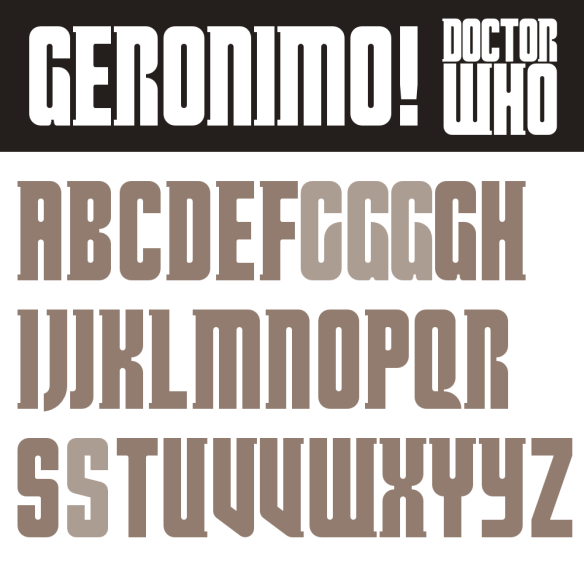
I’m open to constructive criticisms and suggestions at this point.

Geronimo! Adventures in Space and Type: Part 2
Progress report for day two of the ‘Geronimo!’ Doctor Who font experiment. Most of it is basically there, but I’m pretty unhappy with some of the details. Nothing like kerning has even been attempted here, this is literally just so I can see how the whole alphabet looks.
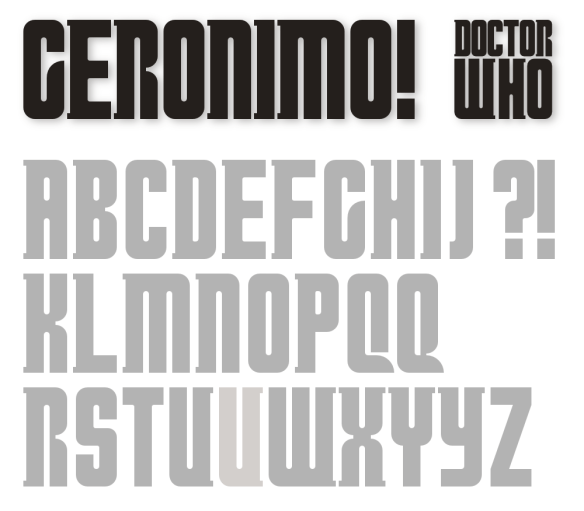
Now I need to work on how to make the difficult characters (B, G, Q, Y, V) work, and what, if anything, I can do to improve the bland characters (E, F, S, Z).
I still plan to do numbers and some of the more essential special characters(“, &, #, ~, @, +, – and parentheses).
 halfblog.net