Make retro computer game sound effects with sfxr/cfxr

sfxr/cfxr

Fun!

This is a little tool I made in connection with the 10th Ludum Dare competition held in December 2007. Its original purpose was to provide a simple means of getting basic sound effects into a game for those people who were working hard to get their entries done within the 48 hours and didn’t have time to spend looking for suitable ways of doing this.

The idea was that they could just hit a few buttons in this application and get some largely randomized effects that were custom in the sense that the user could accept/reject each proposed sound.

via sfxr – drpetter.se

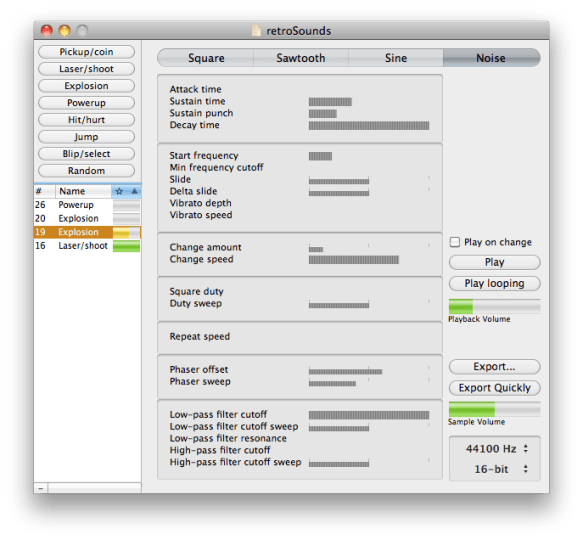
You can grab Windows and Linux versions of sfxr from that page. He also links through to cfxr, a Mac port (screenshot above).

I found this through a Unity video tutorial I’m watching.

F.lux: Set your screen’s colour temperature based on time of day

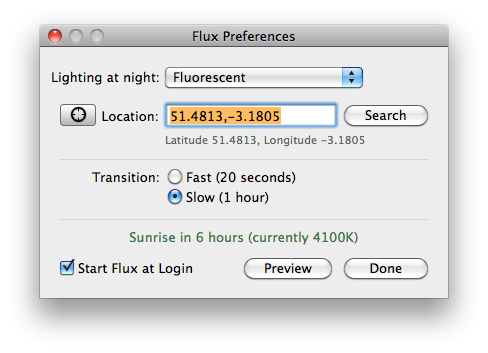
F.lux preferences

During the day, computer screens look good—they’re designed to look like the sun. But, at 9PM, 10PM, or 3AM, you probably shouldn’t be looking at the sun.

f.lux

F.lux fixes this: it makes the color of your computer’s display adapt to the time of day, warm at night and like sunlight during the day.

It’s even possible that you’re staying up too late because of your computer. You could use f.lux because it makes you sleep better, or you could just use it just because it makes your computer look better.

via stereopsis.com/flux

My 27″ monitor throws out a lot of light, and F.lux instantly makes it much easier on my eyes. I’m not sure if I’m going to be able to live with it though, as even after 15 minutes, I can still perceive a yellowish hue. It may be because I have two types of fluorescent bulbs in this room, and neither are giving the colour temperature the app expects. A fine-tuning control may help.

For someone who isn’t interested in graphics work of any kind, this free download may be a lifesaver (or at least a life-improver).

Available for Mac, Linux and Windows.

(via @randallb / Tumblr)

Down and Out in the Uncanny Valley

David from Ironic Sans has an interesting idea for a film:

Idea: The uncanny valley as a plot element

I’ve been thinking the past few days about the uncanny valley in animation. I think it could be used as a plot element in a movie. Through some bit of sci-fi magic, an all-CGI character exists in our real world, but nobody accepts him because there’s something just not right about him. He exists in the uncanny valley and so everyone has a bit of revulsion or discomfort about him.

But that’s as far as I’ve gotten. I’m not sure what kind of story would best make use of this idea. How does a CGI character live in our world? Is it a ToonTown kind of thing, where animated characters have always lived among us, and he’s the first CGI character to be born? Or is it magic? I don’t like the idea of magic in a story like this. I think it should either be sci-fi somehow, or just left unexplained.

via Idea: The uncanny valley as a plot element – ironicsans.com

I left a comment with my own suggestion for how it could be done:

I love it. They would have to live in California, outside LA, in an area dubbed the Uncanny Valley.

Or maybe it’s a future where pretty much everyone wears contacts that allow them to see augmented reality – 3D creations blended seamlessly into our surroundings. Mostly this is used to display flashy ads, and stuff. However, Uncanny Bob is one of the first computer generated creations to become sentient. He meets up with a group of renegade CG characters (misfits from old ad campaigns: a Coke Santa Claus, a swimsuit model, some kids cartoon characters etc) and together they find a sympathetic human hacker who agrees to break into Big Ad Company and rescue their consciousness from the local sever onto the internet at large so they won’t ever be deleted.

Posted by: Foomandoonian | November 16, 2010 1:20 PM

Could make a great short film!

Continue reading

Can the art of a paedophile be celebrated?

He regularly had sex with two of his daughters, his sisters and even the family dog.

I did not know this! From a 2007 BBC News story:

Piece of work

For some of Gill’s fans, even looking at his work became impossible. Most problematically, he was a Catholic convert who created some of the most popular devotional art of his era, such as the Stations of the Cross in Westminster Cathedral, where worshippers pray at each panel depicting the suffering of Jesus.

In 1998, spurred on by a cardinal’s praise for Gill, Margaret Kennedy, who campaigns for Ministers and Clergy Sexual Abuse Survivors, called for the works to be removed.

“Survivors couldn’t pray at the Stations of the Cross. They were done by a paedophile. The very hands that carved the stations were the hands that abused.

“He abused his maids, his prostitutes, animals, he was having sex with everything that moved – a very deranged man sexually.”

But the Catholic Church would not budge an inch. The former Westminster Cathedral administrator, Bishop George Stack, retains an unequivocal view.

“There was no consideration given to taking these down. A work of art stands in its own right. Once it has been created it takes on a life of its own.”

It might be easier to make this argument for the Stations of the Cross than for nude sketches of Gill’s teenage daughter.

via Can the art of a paedophile be celebrated? – news.bbc.co.uk

Create strong passwords

I thought this was a good method for creating strong but easy to remember passwords.

What to do Suggestion Example
Start with a sentence or two (about 10 words total). Think of something meaningful to you. Long and complex passwords are safest. I keep mine secret. (10 words)
Turn your sentences into a row of letters. Use the first letter of each word. lacpasikms (10 characters)
Add complexity. Make only the letters in the first half of the alphabet uppercase. lACpAsIKMs (10 characters)
Add length with numbers. Put two numbers that are meaningful to you between the two sentences. lACpAs56IKMs (12 characters)
Add length with punctuation. Put a punctuation mark at the beginning. ?lACpAs56IKMs (13 characters)
Add length with symbols. Put a symbol at the end. ?lACpAs56IKMs” (14 characters)

Test your password with a password checker

A password checker evaluates your password’s strength automatically. Try our secure password checker.

via Create strong passwords – microsoft.com

To add complexity with case though, I might use vowels to select uppercase letters instead. Splitting the alphabet in half seems like it would be much trickier to remember, for me at least.

Found via Tech Radar’s 25 internet security tips, which has 24 other excellent suggestions…

Unity

Unity

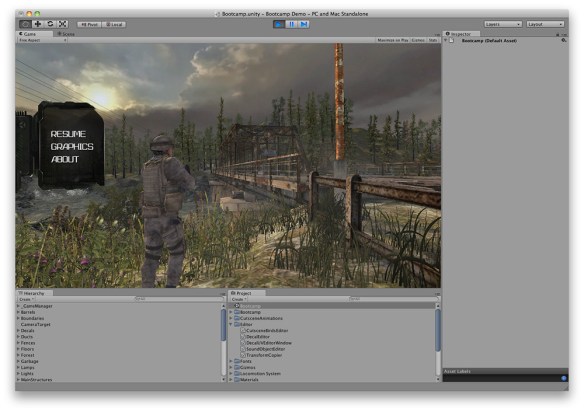
Unity is an integrated authoring tool for creating 3D video games or other interactive content such as architectural visualizations or real-time 3D animations. Unity is similar to Director, Blender game engine, Virtools or Torque Game Builder in the sense that an integrated graphical environment is the primary method of development.

The editor runs on Windows and Mac OS X and can produce games for Windows, Mac, Wii, iPad, or iPhone platforms. It can also produce browser games that use the Unity web player plugin, supported on Mac and Windows. The web player is also used for deployment as Mac widgets. Support for Xbox 360 and PlayStation 3 have recently been added.

[…]

There are two main licenses: Unity and Unity Pro. The Pro version has additional features, like render-to-texture and postprocessing effects. The Free version also displays a splash screen (in standalone games) and a watermark (in web games).

via Unity (game engine) – en.wikipedia.org

I’m adding this to my list of things to learn. The Pro version is expensive ($1500, plus $400 for iOS or another $1500 for iOS pro or Android pro), but it looks like the free version doesn’t skimp on anything really important. I already have a lot of complementary skills, so I think I could be up and running pretty quickly here.

Continue reading

Link

Datamoshing is a form of glitch art which occurs when ‘the I-frames or key-frames of a temporally compressed video are removed, causing frames from different video sequences to bleed together‘.

HOW TO DATAMOSH (See also: PART 2: ENTER THE P-FRAME and PART 3: THE DATAMOSH ACTUALLY HAPPENS)

They guy behind these videos seems to have popularised the technique with a Chairlift music video for Evident Utensil, but Sony would rather you didn’t see it.

(Shh, it’s on Metacafe.)

Continue reading

Magnasanti: Totalitarian death state built in SimCity

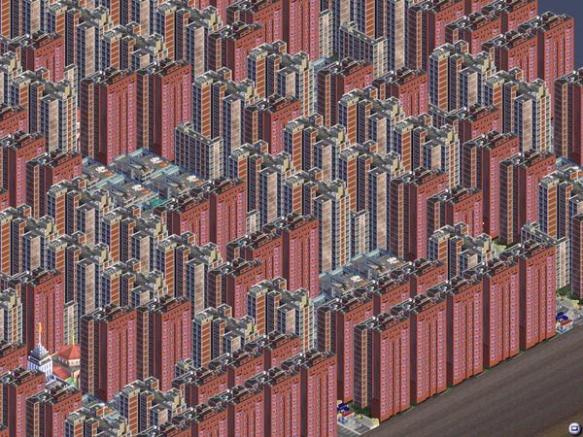
Vincent Ocasla says that in fashioning the “Magnasanti” metropolis, he has “beaten” SimCity by creating the max stable population of six million. It consists of four grids of identical 12 x 12 grids with everyone’s workplace within walking distance. There are no roads, the city runs entirely on subways. There’s zero abandoned buildings zero congestion, and zero water pollution. It sounds like paradise, but it hides a dark core with a sinister message for would-be top-down urban planners.

via How SimCity Teaches Us The Pinnacle Of Urban Planning Is A Totalitarian Death State – consumerist.com

Continue reading

Lekki: Marketing old mobiles

Lëkki is a French company specializing in “revamped” mobile phones from the 1990s, reinvigorated with bright new paint jobs.

via Anyone Want A Retro Mobile? – retrothing.com

This is a brilliant marketing idea.

  1. Find scrapheap tech.
  2. Apply cosmetic improvements, slick packaging and lifestyle marketing.
  3. Sell to retro geeks, eco nerds, design hipsters and luddites.
  4. Profit.

Or: Reinvent refuse, recycle!

Continue reading

Automatypewriter: A new way to interact with fiction

A new way to interact with fiction from Jonathan M. Guberman on Vimeo.

The Automatypewriter is a typewriter that can type by itself: […]

It can also detect what’s being typed on it. It can be used to send text to and/or receive text from a computer via USB. It was designed as a platform for playing interactive fiction games, in particular to play custom software being developed for it by Jim Munroe.

via Automatypewriter – upnotnorth.net

Welcome to the world of tomorrow…

Trying to look into the future is a grand old time, one that countless science fiction writers and visionaries have done more than a century. From Julies Verne predicting space rockets to Gene Roddenberry’s flip mobile phones to William Gibson defining cyberspace before it existed, science fiction writers have been leading the way towards technology’s future.

via Have we already caught up to science fiction? – thenextweb.com

What a dumb article. I thought The Next Web was better than this. Ignoring for a minute the two errors in that opening paragraph, what is the question exactly? Let me rephrase:

‘Are we living in the future already? Not the really distant future of course, just the near future. Because it feels like we’re really close to living in the near future if we aren’t already.’

The role of SF has never really been to predict the future anyway. It’s a genre more interested in exploring the themes of today, often by taking them to logical extremes to help us reflect. Verne didn’t predict space rockets – he imagined them. Likewise, Roddenberry didn’t invent the communicator – he devised a means of letting his characters communicate over vast distances.

I’ll leave you with Chad Catacchio’s insightful closing words:

“The future might not be now, but to me, it’s close.”

Link

Very cool! Though I’d be reluctant to use one, because who knows what nasties could be on the stick?

I am pleased to preview ‘Dead Drops’ a new project which I started off as part of my ongoing EYEBEAM residency in NYC the last couple weeks. ‘Dead Drops’ is an anonymous, offline, peer to peer file-sharing network in public space. I am ‘injecting’ USB flash drives into walls, buildings and curbs accessable to anybody in public space. You are invited to go to these places (so far 5 in NYC) to drop or find files on a dead drop. Plug your laptop to a wall, house or pole to share your files and date. Each dead drop contains a readme.txt file explaining the project. ‘Dead Drops’ is still in progress, to be continued here and in more cities. Full documentation, movie, map and ‘How to make your own dead drop’ manual coming soon! Stay tuned.

via “Dead Drops” preview – datenform.de

I wonder what it would take to make a wi-fi dead drop?

See also:

Dead drop (Wikipedia)

Some fun Sarah Jane Adventures stuff I designed!

Today was my final day at BBC Wales after handing in my notice last month. Though I still have absolutely no regrets, I have actually been enjoying more creative freedom over the last few weeks. If the previous two years had been similar, I may not have left…

Anyway, I thought I’d show and tell some of the things I’ve made. You can find all these in the SJA Fun and Games section.

Sarah Jane Adventures — Storyteller

Continue reading

How do you like them apples?

This weekend while visiting St Fagans I decided to look upstairs in the workman’s institute for the first time – to discover a massive collection of apples on display. Seemingly this was an event organised for ‘Apple Day‘. My camera was in my hand as I’d been snapping away all day, so I naturally took a picture – only to be loudly tutted at.

It seems – according to the prominent signs I had missed – that photography was not allowed because the information on the laminated cards next to all the apples is the property of a library. Apparently a photograph would constitute a reproduction of this information, and that’s when the lawyers got involved and decided to spoil the fun for everybody.

They had quite a detailed sign explaining exactly why. I’d like to have taken a picture of it, but it was very busy and I felt quite conspicuous. I got the impression that the organisers didn’t like the situation much either, but didn’t have any real choice.