Obscure and invented punctuation marks

Andorpersand

An andorpersand

There’s something fascinating to me about obscure punctuation marks. I think it’s that I have great sympathy for smart people who attempt to solve problems that regular people don’t really care about.

Flavorwire recently posted a roundup of interesting real punctuation marks (an article that seems to have been cribbed from an older mental_floss post actually). Most of these are the creations of Hervé Bazin who proposed new exclamation and question mark variations to signify acclamation, certainty, doubt, love and others.

Hervé Bazin's punctuation marks

Hervé Bazin’s proposed punctuation marks for acclamation, certainty, doubt and love

On the lighter side, College Humor has recently invented eight new punctuation marks (that it thinks) we desperately need.

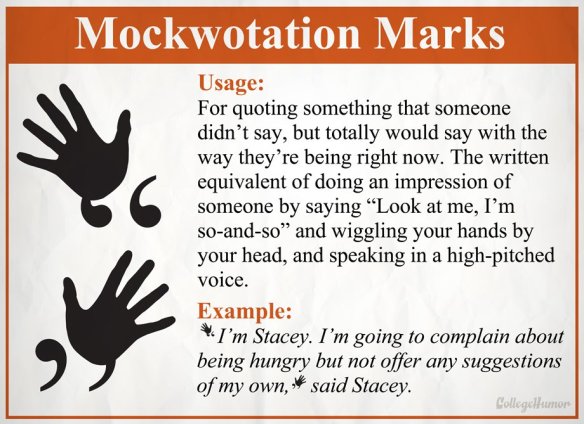
Mockwotation marks
Mockwotation marks

The mockwotation marks are my absolute favourites. I would do away with the actual quotation mark elements and just keep the wavy hands.

Similarly, I wonder if there could be a fun use for an air quotes / scare quotes punctuation mark? I would use them to distance myself from some awful turn of phrase by indicating that it’s not something I would usually say.


Air quote punctuation marks

More punctuation fun →

As one Posterous closes, another Posthaven opens

posterous In news that must have surprised no-one, Posterous has announced that it will be turning off the lights in a few months.

On April 30th, we will turn off posterous.com and our mobile apps in order to focus 100% of our efforts on Twitter. This means that as of April 30, Posterous Spaces will no longer be available either to view or to edit.

Now two of the original co-founders of Posterous — Garry Tan and Brett Gibson — are soon going to launch a new blogging platform called Posthaven that pledges never to be acquired and to be a home for your blog that will last forever.

Continue reading

Ideas for Minecraft

Skeleton skull For me one of the big appeals of Minecraft is imagining what features I’d like to see added to the game.

The Minecraft developers are actually surprisingly receptive to ideas from the community, often incorporating suggestions and making alterations to the game based on player feedback. And if an idea isn’t really suitable for the game but is very cool anyway, there’s always the thriving modding community to make it a reality.

Personally though, I just like the thought exercise. My outlet for these ideas has been the Minecraft Suggestions subreddit. I recently realised that I had contributed many more suggestions than I realised over there, so I thought I would compile (most of) them here.

Be warned: This post is geeky, even by the standards of this blog!

‘Brain Bats’ this way →

Discourse: The WordPress of forum software

Discourse logo Discourse is a new discussion platform (ie: forum software) from Jeff Atwood, Robin Ward and a host of other smart people who have founded a new company together. As Civilized Discourse Construction Kit, Inc they intend to create ‘the WordPress of forum software’.

Discourse is a product that is badly needed. Most forum software in use today is showing its age1, but forums themselves are still going strong.

Forums are the dark matter of the web, the B-movies of the Internet. But they matter. To this day I regularly get excellent search results on forum pages for stuff I’m interested in. Rarely a day goes by that I don’t end up on some forum, somewhere, looking for some obscure bit of information. And more often than not, I find it there.
Civilized Discourse Construction Kit – codinghorror.com

Continue reading

Courier Prime: A free font for screenplays

Courier Prime is a free and open source monospaced typeface by Alan Dague-Greene. It’s an improved Courier, designed to be ‘less blobby’ with a bolder bold and real italics.

Courier Prime

Since the beginning, screenplays have been written in Courier. Its uniformity allows filmmakers to make handy comparisons and estimates, such as 1 page = 1 minute of screen time.

But there’s no reason Courier has to look terrible. We set out to make the best damn Courier ever.

Continue reading

Upcoming events in Cardiff for creative geeks

Preamble: Firstly, check out The Alternate Diff blog for more things to do in Cardiff (found via a profile on the Cardiff Blogs blog). Secondly, I’ve created a new page to serve as a public editorial calendar for this blog. It’s going to serve mostly to remind me about upcoming blogging topics, but those may frequently be local events so there’ll be some overlap.

Onto the events →

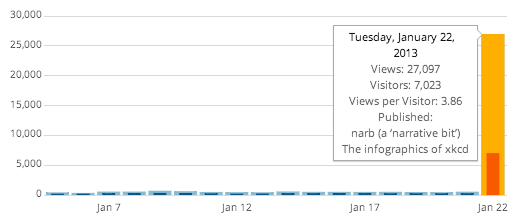
The infographics of xkcd

Log scale Most infographics on the web consist of generic graphics backed up with (lots of) poorly researched text.

When done well these informational graphics use charts, diagrams and illustrations to make complex ideas easier to comprehend. At their best the results can be quite illuminating.

Randall Munroe has produced more than a few great infographics for xkcd. His infographics can be broken down into three rough categories:

  1. Pure gag charts,
  2. Jokey graphics with a serious point, and…
  3. Well-researched highly informative graphics with some jokes sprinkled throughout.

For this post I’ve compiled the more informative types. There’s a list of some (but not all) of xkcd’s novelty graphs and charts at the end of this post.

For science! →

Why the Moon landings couldn’t have been faked

S.G. Collins explains how the technology didn’t exist in 1969 to actually fake the Moon landings in the way most conspiracy theorists seem to believe. Even if you were Stanley Kubrick.

http://www.youtube.com/watch?v=sGXTF6bs1IU

I particularly love his delivery: he’s both monotonous and compelling, sarcastic and likeable.

Important note: I’ve seen people complaining about the ‘unnecessary gay joke’ he makes at the end – a play on the ‘homo’ in ‘homo sapien’. Of course, this is actually a reference to the latin meanings of the words: Homo is the genus of hominids that includes modern man and sapien loosely translates as ‘wise man’.

(via Gizmodo)

The Up-Goer Five Text Editor (and how to use it for SEO)

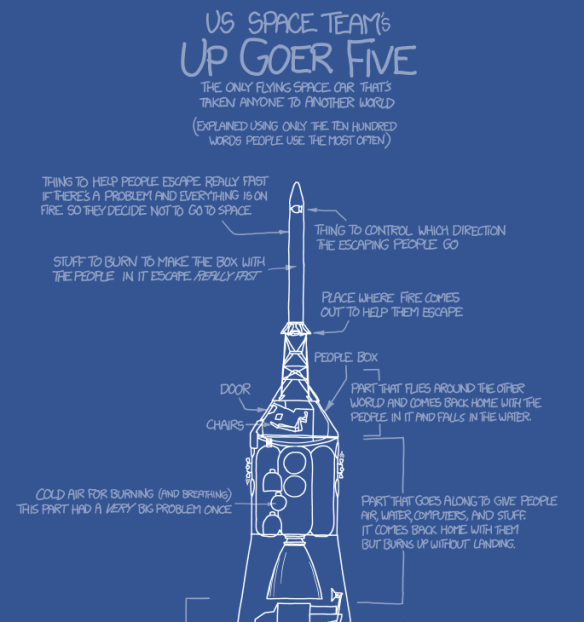
Up Goer Five is one of Randall Munroe’s more famous recent xkcd infographics in which he attempts to describe the workings of a Saturn V rocket using only most commonly used 1,000 words in the English language. Here’s just a part of it:

Up Goer Five, cropped

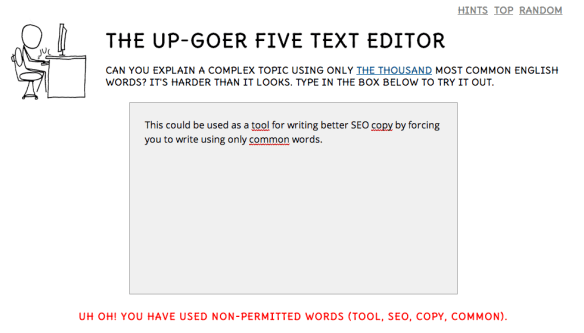
Inspired by this, The Up-Goer Five Text Editor is a fun tool (created by Theo Sanderson) that restricts the user to just the same 1,000 words. Anything not in that tiny dictionary will be given familiar squiggly red underlines.

The Up-Goer Five Text Editor

The Up-Goer Five Text Editor

Scientists have been trying to explain the work they do using only this reduced language. Here’s the work of a paleontologist summarised:

I study tracks, trails, places where animals make homes, and shit, both new and old, and figure out how animals do these things.
Tony Martin, paleontologist

Some of these passages come across as quite patronising (“We burn dead black stuff so that we can build things, power our houses and make our cars go.”), but some of the better ones are quite poetic. io9 has a beautiful description of Saturn:

There is a world that goes around the sun, ten times farther away from the sun than the world we live on. This world is really big – about ten times as wide as our world – and most of it is thick air pulled tight together. It has big beautiful rings around it, made of many pieces of ice.
A loving upgoerfive intro to Saturn and some of its moons, by Rachel Klippenstein

It’s worth reading the full thing.

What does this have to do with SEO? →

My Twitter archive

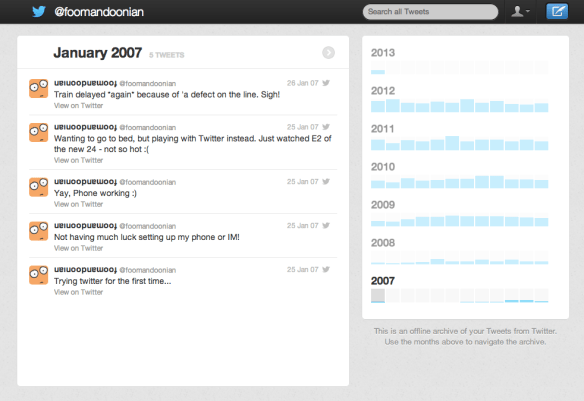
I’ve finally been able to download my tweet archive from Twitter. I’m really impressed with how they’ve made the data browsable and easy to explore. Here are my first tweets from January 2007:

My tweets from January 2007

Fascinating, no? You can also see some account details, which informed me that I am user ID #703,673 and that I joined on 25 Jan 2007, 8:53:08 PM (UTC).

You can get your own tweets (if they are available to you) via your settings at twitter.com/settings/account.

What else do you get? →

Why is this BBC website not available in the UK?

Updated: See end of post.

A Digg linked article I find a lot of my reading material via Digg, who occasionally link to a BBC Future story that looks like the kind of thing I’d be interested in.

However these articles (which appear on a bbc.com domain, not bbc.co.uk) are blocked from within the UK. Instead, I am presented with a ‘help’ page that tells me the following:

BBC Future (international version)

We’re sorry but this site is not accessible from the UK as it is part of our international service and is not funded by the licence fee. It is run commercially by BBC Worldwide, a wholly-owned subsidiary of the BBC, the profits made from it go back to BBC programme-makers to help fund great new BBC programmes. You can find out more about BBC Worldwide and its digital activities at www.bbcworldwide.com.

‘Dear Points of View…’ →