Cardiff Life: Welcome to my brilliantly varied blog!

It has been brought to my attention that this blog was given a rather flattering write-up in the September issue of Cardiff Life magazine! I’ve copied the text below, adding in the links to the relevant pages for any Cardiff Life readers who want to specifically check out something mentioned:

Cardiff Life excerpt about halfblog.netBlog: halfblog.net

Run by Geoff Rogers, the content is brilliantly varied, ranging from stuff about Cardiff Design Festival to the musings of American futurist Buckminster Fuller. And there’s a fantastic series of posts taken from his old ChromaFeed.tv blog, which has clips from interesting short films, animations and such-like (check out the No Robots clip), together with erudite thoughts and comments.

Sarah Mia’s blog Falling Forward is also featured, and Neil Cocker gets a whole half-page on his Cardiff Start initiative.

My thanks to Cardiff Life for the plug!

Continue reading

Vi Hart on how (and why) she makes her YouTube videos

Vi HartVi Hart is a ‘professional mathemusician’ and YouTuber, currently employed by Kahn Academy. She makes brilliant animated ‘mathematical doodle’ videos that have become extremely popular.

The two videos that interested me the most however aren’t about mathematics, but about YouTube. In the first Vi explains (with a great deal of recursion) how she makes her videos: her process, production tricks and equipment used. All in her usual fun style.

In the second video she tackles why she makes her videos, and reads passages that have inspired her from anthropologist Edmund Snow Carpenter’s “They Became What They Beheld” (1970) and explains how those ideas relate to YouTube today.

How To Make A Video About How To Make A Video About How To Make A Video About How To Make

They Became What They Beheld: Medium, Message, Youtubery

In a third video, another young YouTuber has made a more conventional behind the scenes feature and interview with Vi.

Buckminster Fuller on earning a living

Quote

Ah, the Tory brain. Never mind the super-rich, it’s paying plumbers cash-in-hand that’s truly immoral. This week we’re all being called lazy.

Whenever I read one of these Tory stories — which seems to be about every week — I’m always reminded of Buckminster Fuller, who had this to say about the ‘value’ of hard work:

Buckminster Fuller

We must do away with the absolutely specious notion that everybody has to earn a living. It is a fact today that one in ten thousand of us can make a technological breakthrough capable of supporting all the rest. The youth of today are absolutely right in recognizing this nonsense of earning a living. We keep inventing jobs because of this false idea that everybody has to be employed at some kind of drudgery because, according to Malthusian-Darwinian theory, he must justify his right to exist. So we have inspectors of inspectors and people making instruments for inspectors to inspect inspectors. The true business of people should be to go back to school and think about whatever it was they were thinking about before somebody came along and told them they had to earn a living.

— Buckminster Fuller, New York Magazine, 1930

A man well ahead of his time, and ours.

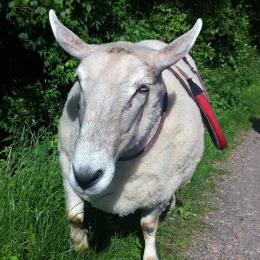
Meet Nick Boing Boing, pet sheep

Nick Boing Boing, pet sheep Today I was surprised and amused to see a pet sheep being taken for a walk along the Taff in north Cardiff.

Nick is perfectly happy to be petted (though he’s a bit smelly) and seemed to be completely unfazed by dogs. He is 22 stone though, so it’s probably the dogs that need to be worried.

Continue reading

Bendito Machine

This gorgeous and surreal animation is the fourth in the Bendito Machine series.

Bendito Machine IV – Fuel the Machines, by Jossie Malis

Now Jossie is running a Kickstarter campaign to continue the series and make a computer game.

This story begins six years ago when I, tired from all the global cretinism, decided to create a universal fable about human conflicts and enigmatic mystifying eyes that watch everything. After some months devoted to materializing this idea, the short film Bendito Machine premiered at festivals all over the world, receiving support that exceeded all my expectations. What I originally envisioned as a therapy to channel all that accumulated displeasure, turned out to be (thanks to the friendly welcome of the Internet world) the seed of an uncommon animation series which has occupied quite a sizeable part of my last six years.

Handy links

Touchdown on Mars

On August 6, 2012 the Curiosity rover will attempt a completely automated landing in Gale Crater on Mars. Curiosity is about five times larger than Spirit or Opportunity, so it can’t just deploy a huge beach-ball and bounce to safety — instead it needs to pull off a much more precise (and dramatic!) landing.

Challenges of Getting to Mars: Curiosity’s Seven Minutes of Terror

Team members at NASA’s Jet Propulsion Laboratory share the challenges of the Curiosity Mars rover’s final minutes to landing on the surface of Mars.

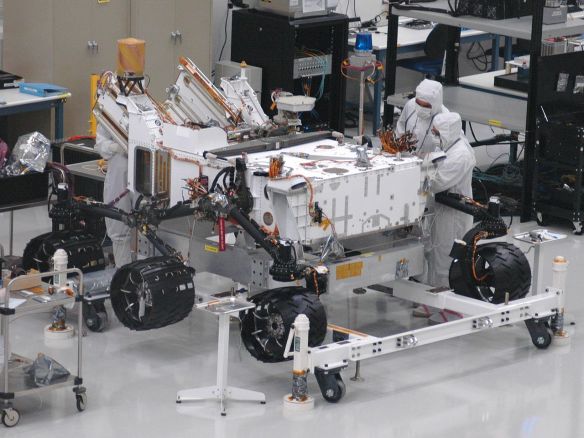
That video is all the more impressive when you have a mental image of exactly how large the Mars Science Laboratory is:

The Mars Science Laboratory

Actual size

Continue reading

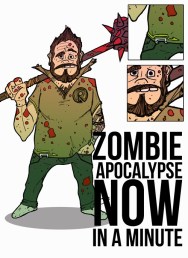
Zombie Apocalypse Now In A Minute

Keith Zombie Apocalypse Now In A Minute is a Cardiff-set webcomic documenting the rise of the undead in Wales. Inspired by Shaun of the Dead and the feel of a post-match Cardiff, the story follows the adventures of Keith, an overweight, sarcastic bartender who attempts to hide out in the castle.

The webcomic is the work of Jamie McGowan who himself runs a bar in Cardiff, which has no doubt provided him with plenty of inspiration. The artwork is stylish and imaginative, and captures Cardiff perfectly.

Continue reading

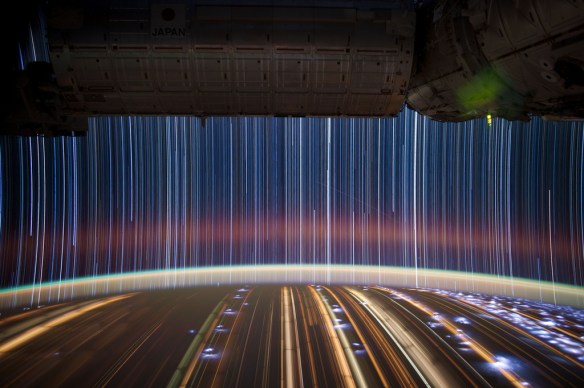
Long exposure photographs from the International Space Station

Talk about stunning!

ISS Star Trails, a set on Flickr from NASA_JSC_Photo

Expedition 31 Flight Engineer Don Pettit relayed some information about photographic techniques used to achieve the images: “My star trail images are made by taking a time exposure of about 10 to 15 minutes. However, with modern digital cameras, 30 seconds is about the longest exposure possible, due to electronic detector noise effectively snowing out the image. To achieve the longer exposures I do what many amateur astronomers do. I take multiple 30-second exposures, then ‘stack’ them using imaging software, thus producing the longer exposure.”

Continue reading

Pizza / not pizza

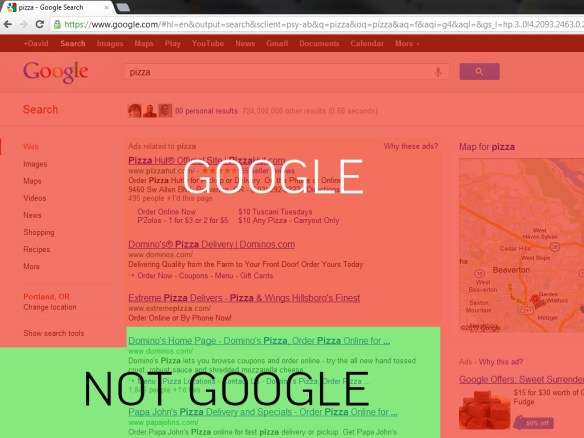
Here is the Google search results page for ‘pizza’, circa 2012:

Google results for 'Pizza' — 2012

Clearly what you want to see and what Google wants you to see are now two different things. It wasn’t always like this. (And in fairness, it isn’t always as bad as this example.) Continue reading

11 reasons your infographic isn’t an infographic

Ian Lurie demolishes crap infographics:

OK everyone. Take a deep, freaking breath. I can’t sneeze right now without spraying germs on someone’s attempt at a data-driven work of art.

Here’s why the poster you paid someone $400 to make isn’t an infographic:

  1. Lack of clarity. Infographics should ease and speed the consumption of information. If you take something you can express in 25 words and turn it into 1000 x 3000 pixels of eye-watering garbage, it’s not an infographic. It’s a waste of paper.
  2. Lack of data. Infographics used to communicate data. Like this. Now, apparently, I can turn a fax machine manual into a poster and get it posted to 55 different infographics directories. Retch.
  3. Low information density. An infographic is more effective than words describing the same subject. Otherwise it’s art. Which is cool and all. But it’s not an infographic.
  4. Lack of flow. An infographic should lead me from introduction to conclusion, somehow. It should help me solve or understand a problem. If it doesn’t, it’s a graphic, minus the info. This Visually piece is a great example of infographic flow.

[Etc…]

Water bear: the cockroach of microbes

Tardigrades (commonly known as water bears or moss piglets) may reach a length of 1.5 millimetres. The name water bear comes from the way they walk, reminiscent of a bear’s gait. They can be found across the world, from the highest peaks to the deepest oceans, and scientists now think they may even be able to survive interplanetary space travel:

Water bear in moss Researchers in 2007 launched anhydrobiotic adults into orbit above Earth to see if they would survive. Those animals endured naked exposure to space for 10 days, and a few even made it through an excessive dose of ultraviolet radiation while back on Earth.

Other laboratory experiments show that adult tardigrades can survive cold near absolute zero (-459 degrees Fahrenheit), heat exceeding 300 degrees Fahrenheit, pressures dozens of times greater than at the bottom of the Marianas Trench, and intense blasts of radiation.

Continue reading