
These are the Stanford Guidelines for Web Credibility, a common sense contrast to the kind of advice you may find elsewhere. They all seem obvious when you read them, but it’s nice to see that it’s all been researched. Continue reading
Yearly Archives: 2010
Link
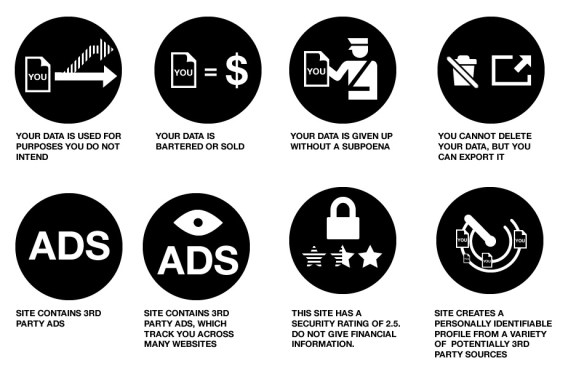
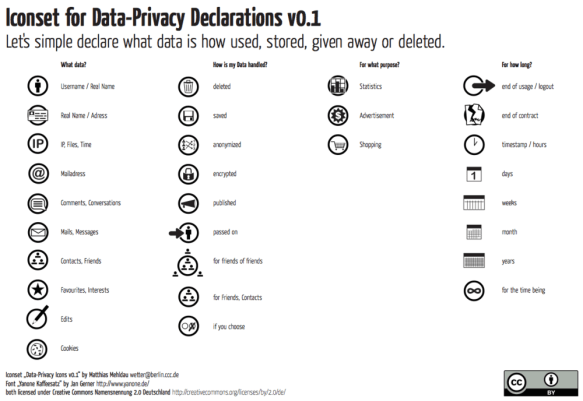
These privacy icons by Aza Raskin for Mozilla’s privacy icon project are interesting. Hopefully we will end up with some clear icons in Firefox to make us aware of what is happening with all our data. I doubt they will be this complicated though. I do really like these earlier Creative Commons style Data Privacy Declaration icons however. (via netzpolitik.org)
Creating linkbait: A guide for the untalented
So you want to get links, but don’t know how to start creating linkable content? Let me walk you through my process for creating awesome linkbait.
via A Simple Guide to Creating Linkbait – SEOmoz
Allow me to summarise:
1. Take your ‘inspiration’ from what your competitors are doing.
2. Can you put a spin on any of that? Don’t copy, just do something similar to whatever is already popular.
3. Create your content. Hire people to do this if you lack talent.
4. Get people to link to your content. Ass licking always helps.
And whatever you do, don’t take any risks!
Don’t feed the trolls
I just spotted this neat use of illustration on Neatorama‘s comment form:

See also: Another variation on the slider CAPTCHA
Sexy CSS3 infographics: I propose a revolution!
There have been two separate trends on the web in recent months and years:
- Infographics are everywhere, typically in the form of long JPEGs. These are often criticised as being poor examples of information design (or just poor examples of design), but they still seem popular.
- Creating snazzy effects with CSS3 and HTML5. Increasing support for dropshadows, rounded corners, gradients, real fonts, rotation and all other kinds of nice visual enhancements, has resulted in masses of experimental designs. It’s even possible to create many types of fantastic (and terrible) charts and graphs, as well as icons and illustrations.
So CSS3 and infographics are a natural fit. They could be interactive, animated, hyperlinked, semantic and searchable. Besides, making big dumb JPEGs for the web just seems like a retrograde step. Why not put that effort into making a really nice page?

My David Lanham portrait

Dave is a designer at the Iconfactory and responsible for the ultimate Twitter icon, Ollie the Twitterrific bird, but he broke his foot while playing soccer over the Fourth of July. That means that the poor guy is relegated to staying off his feet at home. Rather than wallow in self-pity, he decided to use the opportunity to keep himself from going completely Rear Window and offer up his design skills to the Internet public.
(See also: Wired, Cnet, TUAW, Gizmodo, and plenty of others.)
Sitting for a portrait over FaceTime was a really strange experience, but David is very friendly and made it a lot of fun. He did two sketches in about ten minutes, as well as taking some screeshots for reference and he later produces the final product in Illustrator. I’m thrilled with the result! (Trivia: Apparently I am the first portrait to have received a pattern background.)

My print and other assorted goodies

My view of the Facetime portrait session
David said he had been overwhelmed with requests as a result of the extensive coverage in the geek press, and was now booked up until December and after then he will decide whether to carry on with more, or not.
You can see many more portraits in his Flickr set, follow @dlanham on Twitter and absolutely check out his website. (He has loads of great wallpapers and icons!)
Post edited 2010.08.16: I received my portrait in the post today, with a bonus sticker. I’ve added a photograph to the gallery at the top of the post. It’s a lovely quality print. I think it looks great. :)
The Cult of Mac: On being an Apple ‘fanboi’
Back in 1994, Italian novelist Umberto Eco (writer of “Foucault’s Pendulum” and “The Name of The Rose”) published a now-legendary, whimsical piece in the Italian news weekly Espresso, contending that the Microsoft/Apple rivalry is “a religious war.” Eco was “firmly of the opinion” that the Macintosh is Catholic; “It is cheerful, friendly, conciliatory, it tells the faithful how they must proceed step by step to reach — if not the kingdom of heaven — the moment in which their document is printed.” He pointed out that with a Mac you deal with simple formulae and sumptuous icons, and “everyone has a right to salvation.”
On the other hand, Eco contended, the (then mostly DOS-based) PC was Protestant, “or even Calvinistic,” demanding difficult decisions and interpretations, taking “for granted the idea that not all can reach salvation.” The PC user “is closed within the loneliness of his own inner torment.”
Is Apple a Cult, a Religion or a Brand? – theappleblog.com
 My computer history, briefly, has been Acorn Electron, Amiga 500, various PCs running Windows 95, then ME and finally XP, which brings me to the machines I use now. I have an Eee-PC netbook (which for a year was my only personal computer). I experimented with a few Linux distros and eventually settled on CrunchBang Linux.
I also bought an iPhone 3G in this period, which eventually helped me decide to buy a 27″ iMac, which I think is absolutely fantastic. Continue reading
PageRank explained with an interactive diagram
This is an excellent page that explains the mathematics behind Google’s PageRank and illustrates it with an interactive diagram. You can arrange a series of pages, link them to each other and see the resulting PageRanks.

PageRank explained with JavaScript
After ‘the science bit’ he concludes with this little piece of wisdom that I hope all SEO ‘experts’ actually get to:
How can I use this to drive traffic to my website?
If you take anything from this article take with it the spirit of sharing knowledge. Knowledge is the only type of content that is truly valuable and there should be no doubt that search engines now and of the future will try their best to make sure it ends up at the top of their search results.
He has a pretty cool piece of JavaScript animated ASCII art on his homepage too: http://williamcotton.com/
The Yes Men Fix The World: Movie released on P2P to avoid legal challenge
Another brilliant example of BitTorrent being used for good and further proof that the internet makes it harder than ever for big companies and organisations to have complete control over their own message.
The Yes Men pose as corporations, governmental organizations or NGOs they believe are hypocritical or enacting harmful policies. They deliver speeches, send out press releases and set up websites to either take the organization’s policies to what The Yes Men believes are their logical conclusions, or to reverse the organization’s official position.
In theory, the latter is useful as a PR stunt because it forces the organization to step forward and reiterate its potentially unpopular or controversial stance on an issue, thus raising awareness in the public and turning up the heat.
via mashable.com
You can download “The Yes Men Fix The World” from Vodo, and find out more at theyesmen.org.
(I love the message in the footer of their site: Take what you want! We live in the Creative Commons.)
Graphic Adventures: A book of compiled and expanded Wikipedia entries
What I did was edit the Wikipedia articles through heavy or light rewriting, depending on what I figured the article would need to look good in book form. I then went to find additional information from other sources where I felt having more could be fun, and I added screenshots. And then I conducted interviews with many people who were involved in producing the classic graphic adventures. I interviewed creators like Al Lowe of Leisure Suit Larry, Lucasfilm’s David Fox, and Michael Bywater, who worked with Douglas Adams on the game Starship Titanic. The book took much longer than expected… the original idea after all was to merely compile an encyclopedia from Wikipedia, a book for perhaps a small but dedicated group of fans like me. But after sending myself the first draft version, I realized much more editing was needed to have something really fun.
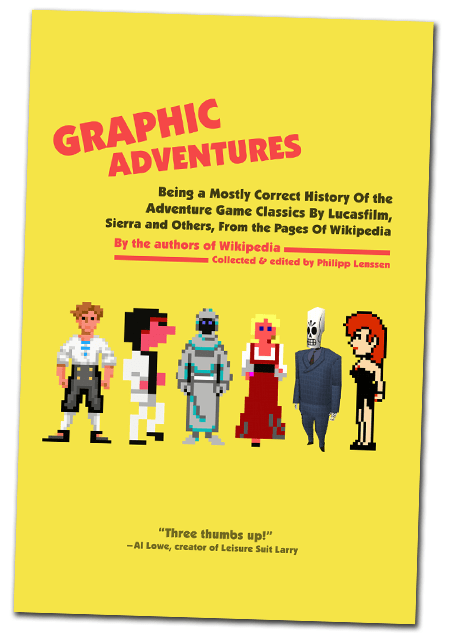
(via blogoscoped.com)
What a great way to write a book. Philipp Lenssen says he is donating 50% of the book’s revenues to the Wikimedia Foundation, but doesn’t mention whether he contributed any of his original findings back to Wikipedia (although now I think about it, I’m fairly certain Wikipedia discourages original research).
He’s released it under the GNU Free Documentation License, and you can download the HTML documents in a .zip file.
‘Area Man Passionate Defender Of What He Imagines Constitution To Be’
[…] People ignorant of the facts could simply choose not to vote. But instead, it appears that misinformed people often have some of the strongest political opinions. A striking recent example was a study done in the year 2000, led by James Kuklinski of the University of Illinois at Urbana-Champaign. He led an influential experiment in which more than 1,000 Illinois residents were asked questions about welfare — the percentage of the federal budget spent on welfare, the number of people enrolled in the program, the percentage of enrollees who are black, and the average payout. More than half indicated that they were confident that their answers were correct — but in fact only 3 percent of the people got more than half of the questions right. Perhaps more disturbingly, the ones who were the most confident they were right were by and large the ones who knew the least about the topic. (Most of these participants expressed views that suggested a strong antiwelfare bias.)
(via How facts backfire – mobile.boston.com)
I have a strong opinion that it’s predominantly right-wingers and religious nutjobs that suffer from this fact ignorance, and no evidence will convince me otherwise…
Seriously though, I’ve maintained for a while now that we should live in a referendum based democracy where we vote regularly on all the key issues (that we feel strongly enough to vote on), and that each vote has a factual test with it. You have to score above a certain threshold for your vote to count. Or perhaps your vote has a weighted value. It wouldn’t even matter if people cheated and were provided answer sheets by biased parties – they would still have to tell their followers the truth.
(Headline via The Onion, BTW. It’s mentioned in the Boston Globe article, which is well worth a read. I hope it makes you angry.)
iPhone Super 8: Cinema FX for Video
This video was made entirely on the iPhone, primarily so I could play with Cinema FX for Video, ReelDirector and iMovie (for iPhone).
The Ferris Bueller Fight Club theory
This trailer is well done (if a bit overlong) but the theory behind it is amazing.
My favorite thought-piece about Ferris Bueller is the “Fight Club” theory, in which Ferris Bueller, the person, is just a figment of Cameron’s imagination, like Tyler Durden, and Sloane is the girl Cameron secretly loves.
One day while he’s lying sick in bed, Cameron lets “Ferris” steal his father’s car and take the day off, and as Cameron wanders around the city, all of his interactions with Ferris and Sloane, and all the impossible hijinks, are all just played out in his head. This is part of the reason why the “three” characters can see so much of Chicago in less than one day — Cameron is alone, just imagining it all.
It isn’t until he destroys the front of the car in a fugue state does he finally get a grip and decide to confront his father, after which he imagines a final, impossible escape for Ferris and a storybook happy ending for Sloane (“He’s gonna marry me!”), the girl that Cameron knows he can never have.
(via Cool Papa Bell / metatalk.metafilter.com)
I don’t think for a second that Ferris Bueller was written with this complicated extra dimension in mind, but I’m curious to watch the film again and see if it holds water retrospectively!
SEO for content producers – the essentials
I’ve been preparing a single page document to give to colleagues who are unfamiliar with search engine optimisation techniques, and I thought it might be useful to post it here. Constructive comments are very welcomed to help me improve this first draft, but do check my note at the bottom so you understand the intended purpose of this list.
Comment isn’t free: The Sun Chronicle comment paywall
From tomorrow, the Sun Chronicle, a Massachusetts paper, will charge would-be commenters a nominal one-off fee of 99 cents. But it has to be paid by credit card, which means providing a real name and address.
And the name on the credit card will be the name that will appear on comments. So it’s goodbye to anonymity.
(via Paper puts up a paywall for comments – guardian.co.uk)
This actually strikes me as a pretty good idea. I’d return a degree of anonymity by allowing people to choose a display name though. The small fee would stop 99% of trolls dead anyway.
I did notice that the Sun Chronicle had no comments on any of the recent stories I checked. They seem like a pretty small operation though.
I wonder if a service like Disqus could centralise a scheme like this?
Toe Fluff
Steve Rack is an artist. He designed a character called Toe Fluff, which he thought would be great toy. In fact, he liked Toe Fluff so much that he decided to base an exhibition on it. To shake things up he asked his friends to customize Toe Fluff as part of the show. Well, since Steve’s ‘call for submissions’, things kind of snowballed! The project is now open to all artists. All you have to do is download the template and get creative!
The July 15th deadline for entries is fast approaching, but there’s still time to create something fun. I’ve just entered one myself:


To the left is the template everyone has to work from. It’s really worth looking through the other entries on the Toe Fluff website as there is some amazing work. You could also follow @SteveRack on Twitter.
Link
I just found out that Apple have a page on their site dedicated to technical drawings of their ‘iProduct’ range, including the iPhone 4. It’s for accessory makers, but would also be handy for creating 3D models, if you like that kind of thing. Which I do.

There’s a goldmine of resources I didn’t realise they had here, including hardware icons and Mac logo, as well as tons of developer stuff, which is really the point of the site.
Dalton Maag are killing Helvetica and going open source
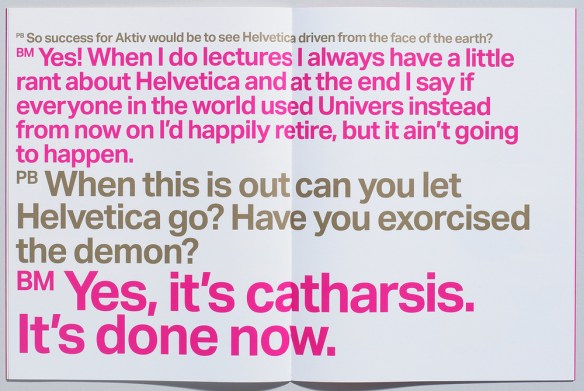
I was lucky enough to see Bruno Maag talk at the Millenium Centre last year at a Cardiff Design Festival talk. He was interesting, entertaining, and although he was mainly talking about the challenges of designing non-western type, he still managed to get a little dig in about Helvetica. In this video he goes into more length on the subject of Helvetica’s general unworthiness:
As someone who is still newly interested in type design, it’s inspirational to hear someone talk so passionately on the differences between what are to the untrained eye, almost identical copies of each other. And with all this Helvetica bashing, presumably he’s been told more than once to ‘put up or shut up’. So he has.
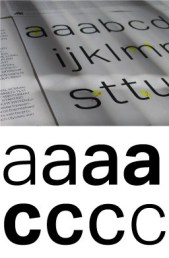 Aktiv Grotesk is a new font family designed to replace Helvetica entirely (for the sum of £222.77). Creative Review has a great interview with Bruno Maag with some interesting theories on how the inferior Swiss font became so popular anyway:
People just use Helvetica because they have heard of it, it’s on everyone’s computer and everyone else uses it.
The Ubuntu Font

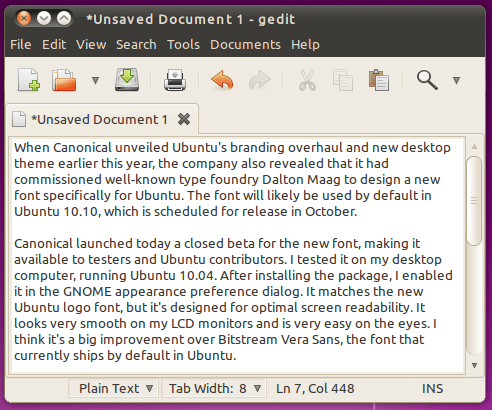
When Canonical unveiled Ubuntu’s branding overhaul and new desktop theme earlier this year, the company also revealed that it had commissioned well-known type foundry Dalton Maag to design a new font specifically for Ubuntu. The font will likely be used by default in Ubuntu 10.10, which is scheduled for release in October.
(via Ars Technica)
This is even better news though – a high quality open source typeface, built to suit the new Ubuntu branding also created by Dalton Maag. As you would expect from an open source project, the font is currently in beta and has just been opened for ‘bug testing’ on the Canonical Design blog.
I hope both parties here can learn some lessons. The open source movement really needs to learn the value of good visual design, and if Dalton Maag are serious about wiping Helvetica off the face of the planet, they could certainly make use of the FOSS model for distributing Aktiv Grotesk. I can’t think of a quicker way of getting it onto everyone’s computer.
John Gruber on Tynt, the ‘Copy/Paste Jerks’
All of this nonsense — the attribution appended to copied text, the inline search results popovers — is from a company named Tynt, which bills itself as “The copy/paste company”.
It’s a bunch of user-hostile SEO bullshit.
Everyone knows how copy and paste works. You select text. You copy. When you paste, what you get is exactly what you selected. The core product of the “copy/paste company” is a service that breaks copy and paste.
The pitch from Tynt to publishers is that their clipboard jiggery-pokery allows publishers to track where text copied from their website is being used, on the assumption that whoever is pasting the text is leaving the Tynt-inserted attribution URL, with its gibberish-looking tracking ID. This is, I believe, a dubious assumption. Who, when they paste such text and find this “Read more:” attribution line appended, doesn’t just delete it (and wonder how it got there)?
via Tynt, the Copy/Paste Jerks
Praise be. There’s also a link to a Google Chrome Tynt blocker plugin, and some other solutions, including how to edit your hosts file.
I’m finding myself at Daring Fireball pretty regularly these days, with a growing amount of respect for Gruber.
Another variation on the slider CAPTCHA
Last week there was a blog post by LukeW proposing a sliding alternative to CAPTCHAs:
[…] the sign up form on They Make Apps uses a slider that asks people to: “show us your human side; slide the cursor to the end of the line to create your account.” Moving the slider to the right completely submits the form and triggers error validation just like a standard Submit button would.
But why stop there? I just spotted this super geeky variation on the same idea on the Adafruit Industries blog:

It seems that it’s their own creation, and is offered as a WordPress plugin:
We are thrilled to release a solve-the-resistor CAPTCHA plugin for WordPress! This plugin will draw a random 5% or 10% resistor and four color band sliders beneath it. The commenter needs to match the colors on the sliders to the colors on the resistor. Commenters don’t actually need to know how to read resistors, but this will help them as they post comments on site that use this plugin.
Resisty – Resistor CAPTCHA – solve the resistor values to post a comment!
Of course, as with the slider alternative the resistor reading could still be easily worked around using crowd-sourced labour, but it’s still a fun idea!
 halfblog.net