Proof that paywalls don’t always have to drive readers away

Journalism Online says that pageviews fell between 0% and 20% and unique visits fell between just 0% and 7% (neither figure a huge disaster when you introduce a paywall), while advertising revenue didn’t fall at all for any of the titles.

It’s worth noting that the newspapers concerned didn’t block all content completely from non-paying visitors. Instead, only readers who view more than a set number of pages per month, usually between 5 and 20, have to pay.

The policy is stark contrast from the most high-profile recent paywall launches – those by Rupert Murdoch in the UK for his Times, Sunday Times and News of the World titles. In those cases, all content is completely blocked until you stump up some cash (or at least sign up for a free trial). We’re still to hear exactly how successful this policy has been. Publisher News International released some vague figures that weren’t very enlightening, while the unofficial word is that the policy didn’t start out well.

(via Proof that paywalls don’t always have to drive readers away – thenextweb.com)

Perhaps a paywall like this could work for community sites too.

If you set this meter conservatively, which we urge people to do, it’s a nonevent for 85, 90, 95 percent of the people who come to your Web site,” Mr. Brill said.

(via Journalism Online Examines Pay Model – nytimes.com)

What a brilliant name!
If you type two spaces after a full stop, you’re doing it wrong. Period.

Every modern typographer agrees on the one-space rule. It’s one of the canonical rules of the profession, in the same way that waiters know that the salad fork goes to the left of the dinner fork and fashion designers know to put men’s shirt buttons on the right and women’s on the left. Every major style guide—including the Modern Language Association Style Manual and the Chicago Manual of Style—prescribes a single space after a period. (The Publications Manual of the American Psychological Association, used widely in the social sciences, allows for two spaces in draft manuscripts but recommends one space in published work.) Most ordinary people would know the one-space rule, too, if it weren’t for a quirk of history. In the middle of the last century, a now-outmoded technology—the manual typewriter—invaded the American workplace. To accommodate that machine’s shortcomings, everyone began to type wrong. And even though we no longer use typewriters, we all still type like we do. (Also see the persistence of the dreaded Caps Lock key.)

The problem with typewriters was that they used monospaced type—that is, every character occupied an equal amount of horizontal space. This bucked a long tradition of proportional typesetting, in which skinny characters (like I or 1) were given less space than fat ones (like W or M). Monospaced type gives you text that looks “loose” and uneven; there’s a lot of white space between characters and words, so it’s more difficult to spot the spaces between sentences immediately. Hence the adoption of the two-space rule—on a typewriter, an extra space after a sentence makes text easier to read. Here’s the thing, though: Monospaced fonts went out in the 1970s. First electric typewriters and then computers began to offer people ways to create text using proportional fonts. Today nearly every font on your PC is proportional. (Courier is the one major exception.) Because we’ve all switched to modern fonts, adding two spaces after a period no longer enhances readability, typographers say. It diminishes it.

(via Space Invaders – Why you should never, ever use two spaces after a period – slate.com)

Amen.

Product placement in movies

[…] did you know the “All restaurants are Taco Bell” scene in Demolition Man was replaced with a horribly-dubbed version that said “Pizza Hut” for the European version?  Or that one of the biggest product placement whores of all time is Michael Bay?  Okay, that second one you probably already knew.

via A Brief History of Conspicuous Product Placement in Movies – filmdrunk.uproxx.com

Wilson

Product placement has a place in movies and television. I’d rather see Michael J. Fox slurping from a Pepsi than have the narrative broken for a few minutes for a commercial break.

Sadly you tend to get both. We’re going to be seeing much more placement in the future too, as advertisers want to be able to market to those who torrent or TiVo their television shows.

Continue reading

Fade In: The Writing of Star Trek: Insurrection

Links abound in this post, but dig in if you’re a Star Trek fan as there’s lots of insights and revelations into the production of one of the most unfairly dismissed Star Trek films. I actually rate Insurrection as one of my favourite Next Gen movies, but there’s no doubt it felt like a heavily compromised entry. An unpublished book by the late Michael Piller, Fade In: The Writing of Star Trek: Insurrection, tells the story.

“They’re not out to make a quick buck, they’re looking to protect the integrity of the franchise and its mythology.” 1998’s Star Trek Insurrection went through a number of different plots before becoming the film we ultimately saw. Starting out as Star Trek: Stardust, the first take on the idea involved Captain Picard going all Heart of Darkness on a former friend from his Starfleet Academy days in a bid to find the Fountain of Youth. That treatment evolved into a remarkably Avatarish story called simply Star Trek IX in which Picard must go upriver to kill a malfunctioning Data as part of a Federation/Romulan alliance to displace strange alien natives from a planet teeming with a valuable and rare ore (spoiler: Picard actually kills Data in this treatment, and Tom Hanks was supposed to have a major role somewhere).

(via “He might have read the document when he was tired, at the end of a long day of being tied to a whale.” – metafilter.com & via Boing Boing)

The PDF of the book was originally released by Trek Core. They included this note:

When 
we 
received
 this 
submission, 
we
 were 
told 
that 
Michael 
Piller 
considered 
this 
book
 his
 last 
great
 gift 
to
 the 
fans
 and
 to 
aspiring
 writers 
everywhere. 

Unfortunately,
 Paramount
 somehow
 got 
it 
suppressed
 from 
being 
published. 

Michael
 Piller 
passed
 away
 in
 2005, 
so
 getting 
this
 book 
published
 will 
never 
be
 possible
 (not 
to 
mention
 Insurrection 
is 
quite 
old
 now, 
so 
a 
book 
about 
it 
wouldn’t
 be 
financially 
feasible 
for 
a
 publisher). 

It’s 
clear 
Michael 
Piller
 wanted 
this 
book 
read, 
so 
we
 felt 
that 
making 
it
 available 
to 
the 
fans 
made
 sense. 

It’s
 an
 amazingly 
detailed 
look 
at 
the 
process 
of 
writing 
the 
movie 
including 
internal 
memos, 
letters, 
pitches, 
story
 drafts, 
etc. 

Enjoy 
this
 unique
 glimpse 
into 
writing 
Star 
Trek 
Insurrection! 

And 
lastly, 
if
 anyone 
can 
provide 
the
 draft 
of 
Star 
Trek 
Insurrection 
that 
is 
missing 
from 
this 
document,
 please
 email 
us.

Continue reading

Tweaking Twain

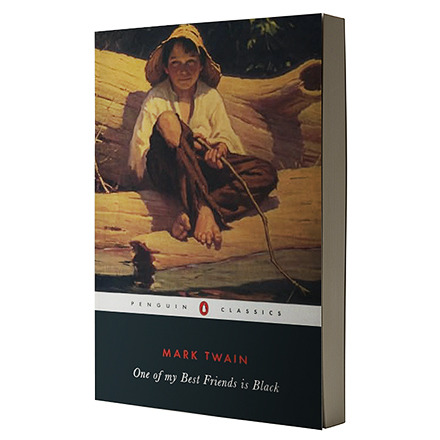
A new edition of the Adventures of Huckleberry Finn, scheduled to be published in February by NewSouth Books, substitutes the word “slave” for the “n-word” and “Indian” for “injun” throughout the book.

The publisher has been accused of censorship and altering a classic of American literature for the sake of political correctness. Early argues that this is just another case of tinkering with texts in order to create a version that best serves its audience.

Continue reading

How Andrew Plotkin raised $31,337 on Kickstarter

There’s no easy answer here. Andrew ‘Zarf’ Plotkin is a big name in interactive fiction, and without his reputation backing up his idea, it would probably have failed. Still, he has some smart suggestions:

Some subjective factors that I can’t measure, but which I’m sure helped:

  • Say up front what you want to do, why you want money, and how that money will be converted into something awesome. (A list of features is not exciting, of itself. Describe an experience.)
  • Have a great video. I wrote a script, and then my co-conspirator Jason McIntosh and I whaled over it. Jason threw away a bunch of stuff and added a bunch of stuff; then we filmed it. Twice.
  • Think about your audience and who wants what. I have contributors who want an iPhone game, contributors who want interactive fiction, contributors who want to support my open-source projects, and contributors who want to support me. These are not all the same people. Rewarding all of these groups appropriately is non-trivial, and there has been some discussion about the way I did it.
  • For a game project, include a demo. (I realized this only barely before launch-day! The demo that I posted represents two intense weekends of work; I hope that’s a good omen for my production rate in 2011.)
  • Don’t be afraid to plug yourself and your CV. I know you’re all saying “how could you fail to promote yourself?!” but I had to be chivvied into it. (Thanks, Jason Scott.)
  • Contrariwise, don’t be a jerk. Actively don’t be a jerk. Say thank you to everybody, early and often.

via Andrew Plotkin: How I raised $24,000 on Kickstarter – money.cnn.com

Related: Hadean Lands: Interactive Fiction for the iPhone – kickstarter.com

10 innovative business models of 2010

Here’s a handy list of the business models featured:

  1. Kickstarter.com
  2. Airbnb.com
  3. Quirky.com
  4. Free with in-app sales
  5. HumbleBundle.com
  6. PayWithaTweet.com
  7. Spotify.com
  8. Groupon.com
  9. Flattr.com
  10. PatientsLikeMe.com

Not every interesting revenue model was included. Some of course missed our selection. I personally didn’t choose penny auction concepts like Swoopo and others. People that joined one of our workshop sessions knew already that these concepts are quite fraudulous. Auction platforms like this aren’t very sustainable. Recent figures already showed that Swoopo is indeed in decline. Other emerging concepts like Quora aren’t on the list either. Although everybody is talking about this relative new content platform, they didn’t figure out what business model to roll out. Sounds very Twitterish, not? If I had to include 1 extra revenue model to this selection, I would go for Gilt.com, which has another interesting approach for selling ‘online deals’. Read more about their margins, cash conversion and so on here.

via 10 business models that rocked 2010 – boardofinnovation.com

I’ve blogged about the Humble Indie Bundle before. Kickstarter really does deserve to be at the top of that list. Though you can support projects from anywhere in the world, you have to be in the US to raise funds. There are lots of imitators though, including IndieGoGo. Flattr is a concept I’m probably going to try out soon too.

Continue reading

Cardiff International Comic Expo

Cardiff International Comic ExpoThis February 26th at the Mercure Hotel there’s going to be a big Cardiff Comic Expo (follow them on Twitter). Tickets are currently £5 each, but they imply that the price may go up in the new year.

There are some very interesting guests, but no megastars (yet). I’ll be interested mostly to see the exhibitors myself, and hopefully discover some interesting indies.

I had no idea this was happening, so I figured others may appreciate the heads up!

8mm Vintage Camera

I had my first visit to a Yo! Sushi today, and took the opportunity to try out 8mm Vintage Camera, a newish iPhone app. Unlike Cinema FX for Video (from the same company), 8mm applies the retro effects to the footage as you shoot it. It’s a bit like Hipstamatic in that respect. Video you shoot is stored in the app, and you can export it to the camera reel or YouTube later.

Footage was edited together with ReelDirector (another Nexvio app).

Link

These animations by the RSA are wonderful. I haven’t seen them all yet, but these two were also very interesting:

  • Smile or Die: Acclaimed journalist, author and political activist Barbara Ehrenreich explores the darker side of positive thinking.
  • Drive: The surprising truth about what motivates us.

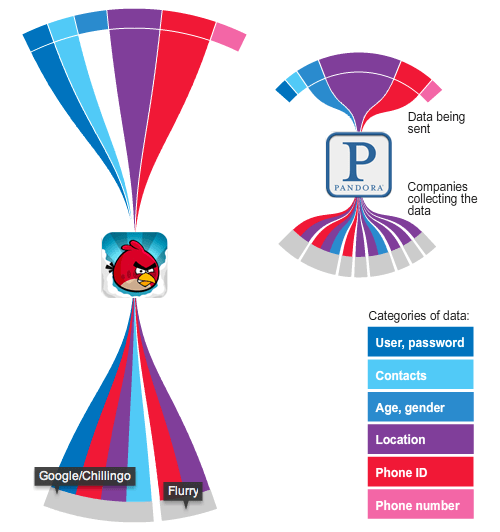
What your apps know about you

This diagram is one of many interactive infographics from the Wall Street Journal, illustrating how many apps are accessing more of your personal data than you may realise.

An examination of 101 popular smartphone “apps”—games and other software applications for iPhone and Android phones—showed that 56 transmitted the phone’s unique device ID to other companies without users’ awareness or consent. Forty-seven apps transmitted the phone’s location in some way. Five sent age, gender and other personal details to outsiders.

The findings reveal the intrusive effort by online-tracking companies to gather personal data about people in order to flesh out detailed dossiers on them.

via Your Apps Are Watching You – online.wsj.com
Continue reading

Snow under a microscope

These are all images of snowflakes, under varying degrees of magnification. I have been collecting them for a few years now, and they never fail to amaze and inspire me.

via akirathedon.com / @akirathedon

What does it feel like to be stupid?

Tonight I joined Quora (It’s like Yahoo! Answers for smart people) and spotted the question What does it feel like to be stupid?

The best answer is from an anonymous user who suffered from an arterial problem which reduced the blood supply to his heart and brain, making him forgetful, slow, and easily overwhelmed…

However, once I got used to it and resigned myself, it was great. Even though I knew I had a worrying illness, I was happy as a pig in mud. I no longer had the arrogance of being frustrated with slow people, I abandoned many projects which reduced a lot of stress, I could enjoy films without knowing what would happen (my nickname before this used to be ‘comic book guy’ if you get the reference), and I became amazingly laid back and happy go lucky. I got on with people much better. I developed much more respect for one of my friends in particular who I always considered slow – it turned out he is much deeper than I thought, I just never had the patience to notice before. You could say I had more time to look around. The world just made more sense. The only negative, apart from struggling to perform at work, and having to write everything down, was that I no longer found sci-fi interesting – it just didn’t seem important. (I’m not joking, although it sounds like a cliché.)

(via What does it feel like to be stupid? – quora.com)

He did recover, and you will be pleased to learn that he regained his love of science fiction.

Continue reading

Fun with the Google Ngram Viewer

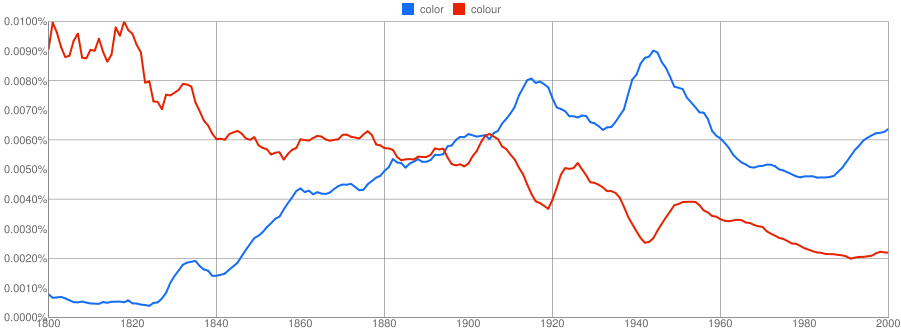
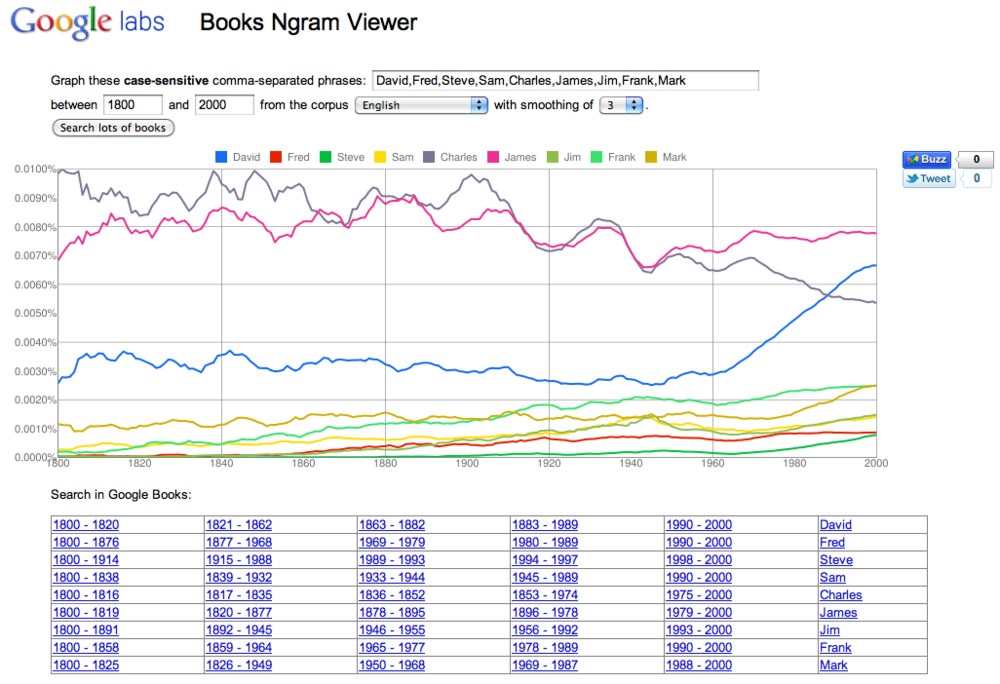
A few days ago Google launched the Google Books Ngram Viewer, a labs project that lets you compare the frequency of word use in published works, and compare these terms over time. For example, the following is a variety of common first names appearing in the English database over the last two hundred years.

Common English first names

You can see that around 1960, the name David suddenly started to gain in popularity. You can narrow the English corpus to American English, British English and English fiction, and also search works in other languages.

Continue reading