The Honest Privacy Policy Act

The following has been reproduced in full from an article in IT World By Dan Tynan: The first truly honest privacy policy – itworld.com.

I’ve got a better solution. Instead of a welter of new laws or regulations, how about just one: The Honest Privacy Policy Act. The HPPA would require every company to post a simple, direct, and brutally honest policy detailing what really happens to your data.

To help this proposal along I’ve come up with one of my own – and it’s 5,085 words shorter than Facebook’s. Here’s what a real privacy policy might look like:

“At COMPANY _______ we value your privacy a great deal. Almost as much as we value the ability to take the data you give us and slice, dice, julienne, mash, puree and serve it to our business partners, which may include third-party advertising networks, data brokers, networks of affiliate sites, parent companies, subsidiaries, and other entities, none of which we’ll bother to list here because they can change from week to week and, besides, we know you’re not really paying attention.

We’ll also share all of this information with the government. We’re just suckers for guys with crew cuts carrying subpoenas.

Remember, when you visit our Web site, our Web site is also visiting you. And we’ve brought a dozen or more friends with us, depending on how many ad networks and third-party data services we use. We’re not going to tell which ones, though you could probably figure this out by carefully watching the different URLs that flash across the bottom of your browser as each page loads or when you mouse over various bits. It’s not like you’ve got better things to do.

Each of these sites may leave behind a little gift known as a cookie — a text file filled with inscrutable gibberish that allows various computers around the globe to identify you, including your preferences, browser settings, which parts of the site you visited, which ads you clicked on, and whether you actually purchased something.

Those same cookies may let our advertising and data broker partners track you across every other site you visit, then dump all of your information into a huge database attached to a unique ID number, which they may sell ad infinitum without ever notifying you or asking for permission.

Also: We collect your IP address, which might change every time you log on but probably doesn’t. At the very least, your IP address tells us the name of your ISP and the city where you live; with a legal court order, it can also give us your name and billing address (see guys with crew cuts and subpoenas, above).

Besides your IP, we record some specifics about your operating system and browser. Amazingly, this information (known as your user agent string) can be enough to narrow you down to one of a few hundred people on the Webbernets, all by its lonesome. Isn’t technology wonderful?

The data we collect is strictly anonymous, unless you’ve been kind enough to give us your name, email address, or other identifying information. And even if you have been that kind, we promise we won’t sell that information to anyone else, unless of course our impossibly obtuse privacy policy says otherwise and/or we change our minds tomorrow. 

We store this information an indefinite amount of time for reasons even we don’t fully understand. And when we do eventually get around to deleting it, you can bet it’s still kicking around on some network backup drives in somebody’s closet. So once we have it, there’s really no getting it back. Hell, we can’t even find our keys half the time — how do you expect us to keep track of this stuff?

Not to worry, though, because we use the very bestest security measures to protect your data against hackers and identity thieves, though no one has actually ever bothered to verify this. You’ll pretty much just have to take our word for it.

So just to recap: Your information is extremely valuable to us. Our business model would totally collapse without it. No IPO, no stock options; all those 80-hour weeks and bupkis to show for it. So we’ll do our very best to use it in as many potentially profitable ways as we can conjure, over and over, while attempting to convince you there’s nothing to worry about.

(Hey, Did somebody hold a gun to your head and force you to visit this site? No, they did not. Did you run into a pay wall on the home page demanding your Visa number? No, you did not. You think we just give all this stuff away because we’re nice guys?  Bet you also think every roomful of manure has a pony buried inside.)

This privacy policy may change at any time. In fact, it’s changed three times since we first started typing this. Good luck figuring out how, because we’re sure as hell not going to tell you. But then, you probably stopped reading after paragraph three.”

I am hereby open sourcing this privacy policy. Feel free to use it on your own sites or suggest it to any that seem deserving (but I’d appreciate a credit and a link, if you’re so inclined).

(via Hacker News)

Vimeo present their terms in a nicely human-readable format. This should be standard practice.

Redrawing the map of Great Britain from a network of human interactions

In other words, these maps show how the borders of countries and counties could be redrawn if they were to reflect communities rather than governmental regions.

The geography of talk in Great Britain

The geography of talk in Great Britain. This figure shows the strongest 80% of links, as measured by total talk time, between areas within Britain. The opacity of each link is proportional to the total call time between two areas and the different colours represent regions identified using network modularity optimisation analysis.

The core regions of Britain

The core regions of Britain. By combining the output from several modularity optimization methods we obtain the results shown in this figure. The thick black boundary lines show the official Government Office Regions partitioning together with Scotland and Wales. The black background spots show Britain’s towns and cities, some of which are highlighted with a label.

via Redrawing the Map of Great Britain from a Network of Human Interactions – plosone.org (CC BY 2.5)

Continue reading

A Declaration of the Independence of Cyberspace

Quote

by John Perry Barlow <barlow@eff.org>

Governments of the Industrial World, you weary giants of flesh and steel, I come from Cyberspace, the new home of Mind. On behalf of the future, I ask you of the past to leave us alone. You are not welcome among us. You have no sovereignty where we gather.

We have no elected government, nor are we likely to have one, so I address you with no greater authority than that with which liberty itself always speaks. I declare the global social space we are building to be naturally independent of the tyrannies you seek to impose on us. You have no moral right to rule us nor do you possess any methods of enforcement we have true reason to fear.

Governments derive their just powers from the consent of the governed. You have neither solicited nor received ours. We did not invite you. You do not know us, nor do you know our world. Cyberspace does not lie within your borders. Do not think that you can build it, as though it were a public construction project. You cannot. It is an act of nature and it grows itself through our collective actions.

You have not engaged in our great and gathering conversation, nor did you create the wealth of our marketplaces. You do not know our culture, our ethics, or the unwritten codes that already provide our society more order than could be obtained by any of your impositions.

You claim there are problems among us that you need to solve. You use this claim as an excuse to invade our precincts. Many of these problems don’t exist. Where there are real conflicts, where there are wrongs, we will identify them and address them by our means. We are forming our own Social Contract . This governance will arise according to the conditions of our world, not yours. Our world is different.

Cyberspace consists of transactions, relationships, and thought itself, arrayed like a standing wave in the web of our communications. Ours is a world that is both everywhere and nowhere, but it is not where bodies live.

We are creating a world that all may enter without privilege or prejudice accorded by race, economic power, military force, or station of birth.

We are creating a world where anyone, anywhere may express his or her beliefs, no matter how singular, without fear of being coerced into silence or conformity.

Your legal concepts of property, expression, identity, movement, and context do not apply to us. They are all based on matter, and there is no matter here.

Our identities have no bodies, so, unlike you, we cannot obtain order by physical coercion. We believe that from ethics, enlightened self-interest, and the commonweal, our governance will emerge . Our identities may be distributed across many of your jurisdictions. The only law that all our constituent cultures would generally recognize is the Golden Rule. We hope we will be able to build our particular solutions on that basis. But we cannot accept the solutions you are attempting to impose.

In the United States, you have today created a law, the Telecommunications Reform Act, which repudiates your own Constitution and insults the dreams of Jefferson, Washington, Mill, Madison, DeToqueville, and Brandeis. These dreams must now be born anew in us.

You are terrified of your own children, since they are natives in a world where you will always be immigrants. Because you fear them, you entrust your bureaucracies with the parental responsibilities you are too cowardly to confront yourselves. In our world, all the sentiments and expressions of humanity, from the debasing to the angelic, are parts of a seamless whole, the global conversation of bits. We cannot separate the air that chokes from the air upon which wings beat.

In China, Germany, France, Russia, Singapore, Italy and the United States, you are trying to ward off the virus of liberty by erecting guard posts at the frontiers of Cyberspace. These may keep out the contagion for a small time, but they will not work in a world that will soon be blanketed in bit-bearing media.

Your increasingly obsolete information industries would perpetuate themselves by proposing laws, in America and elsewhere, that claim to own speech itself throughout the world. These laws would declare ideas to be another industrial product, no more noble than pig iron. In our world, whatever the human mind may create can be reproduced and distributed infinitely at no cost. The global conveyance of thought no longer requires your factories to accomplish.

These increasingly hostile and colonial measures place us in the same position as those previous lovers of freedom and self-determination who had to reject the authorities of distant, uninformed powers. We must declare our virtual selves immune to your sovereignty, even as we continue to consent to your rule over our bodies. We will spread ourselves across the Planet so that no one can arrest our thoughts.

We will create a civilization of the Mind in Cyberspace. May it be more humane and fair than the world your governments have made before.

Davos, Switzerland

February 8, 1996

Continue reading

Gross National Happiness

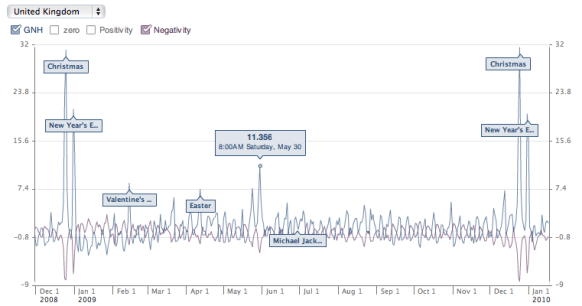
Every day, millions of people share how they feel with the people who matter the most in their lives through status updates on Facebook. These updates are tiny windows into how people are doing. They’re brief, to the point and descriptive of what’s going on this week, today or right now.

Grouped together, these updates are indicative of how we are collectively feeling. Measuring how well-off, happy or satisfied with life the citizens of a nation are is part of the Gross National Happiness movement. When people in their status updates use more positive words — or fewer negative words — then that day as a whole is counted as happier than usual. […]

(via Gross National Happiness – apps.facebook.com)

Continue reading

Magnasanti: Totalitarian death state built in SimCity

Vincent Ocasla says that in fashioning the “Magnasanti” metropolis, he has “beaten” SimCity by creating the max stable population of six million. It consists of four grids of identical 12 x 12 grids with everyone’s workplace within walking distance. There are no roads, the city runs entirely on subways. There’s zero abandoned buildings zero congestion, and zero water pollution. It sounds like paradise, but it hides a dark core with a sinister message for would-be top-down urban planners.

via How SimCity Teaches Us The Pinnacle Of Urban Planning Is A Totalitarian Death State – consumerist.com

Continue reading

Secret Cinema: A theatre experience I would enjoy

It was an incredible experience, and we hadn’t even been “evacuated” to the second warehouse next door to watch Blade Runner yet. That happened at 9pm, and the atmosphere was electric — literally, in fact: a reproduction of the floodlit building featured during the movie’s climax was projected onto the huge warehouse’s right-hand wall as the film reached its crescendo, to cheers and applause. Two actors, in costume, were suspended in fixed positions at the top of the wall, recreating in real life what we were seeing on-screen.

Odeon, take note: THIS is how to get people off BitTorrent and into cinemas.

(via Review: Secret Cinema brings Blade Runner to London)

This sounds amazing.

HuffPo uses A/B testing to write better headlines

From direct mail to web design, A/B testing is considered a gold standard of user research: Show one version to half your audience and another version to the other half; compare results, and adjust accordingly. Some very cool examples include Google’s obsessive testing of subtle design tweaks and Dustin Curtis’ experiment with direct commands and clickthrough rates. (“You should follow me on Twitter” produced dramatically better results than the less moralizing, “Follow me on Twitter.”)

So here’s something devilishly brilliant: The Huffington Post applies A/B testing to some of its headlines. Readers are randomly shown one of two headlines for the same story. After five minutes, which is enough time for such a high-traffic site, the version with the most clicks becomes the wood that everyone sees.

(via How The Huffington Post uses real-time testing to write better headlines – niemanlab.org)

I also found it interesting that they are considering splitting up the content they serve by IP address, so they can serve the East and West coasts better.

GeekTool: A system monitor for Mac OS X

GeekTool is a system monitor for Mac OS X, which will let you display system information or various feeds from the internet on your desktop. It’s like Conky for Linux, if that means anything to you. There are many, many scripts you can use to display weather forecasts, CPU and RAM usage, free HD space, the latest XKCD, unread emails, the track now playing, Twitter messages and pretty much anything else you can think of. As the examples I’ve attached to this post show, you can do some really creative desktops.

Continue reading

3ds Max vs. Blender: Revealing results of a CG software user survey

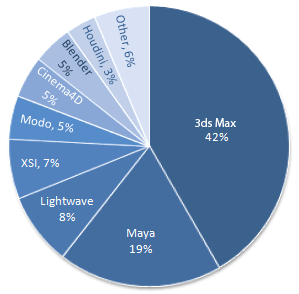
It’s clear from the pie chart that 3ds Max is the giant in the market here, with Maya (also an Autodesk product) the next big player. If you scroll down the article, what really stands out is that both of these packages consistently rank the lowest in user satisfaction.

I was surprised to see that Lightwave has such a small share. I’ve always had a soft spot for it, but perhaps in recent years the situation has changed. I stopped doing 3D work around the same time that Modo came out, and I was aware that many were switching loyalties then.

The Cinema and Houdini get big positives, but I’m especially pleased to see the open-source Blender rank so highly in most responses. I’m hoping to get back into CG graphics soon, and I’d love to invest my energies in free software.

(via cgenie.com)

Emotion Markup Language

The W3C just completed the first draft of the Emotion Markup Language (EmotionML 1.0).

Um, why?

Use cases for EmotionML can be grouped into three broad types:

  1. Manual annotation of material involving emotionality, such as annotation of videos, of speech recordings, of faces, of texts, etc;
  2. Automatic recognition of emotions from sensors, including physiological sensors, speech recordings, facial expressions, etc., as well as from multi-modal combinations of sensors;
  3. Generation of emotion-related system responses, which may involve reasoning about the emotional implications of events, emotional prosody in synthetic speech, facial expressions and gestures of embodied agents or robots, the choice of music and colors of lighting in a room, etc.

If you’re still not getting the why, they have a list of 39 possible use cases. I’m wondering if it could be used for interactive fiction somehow?

I love crap like this!