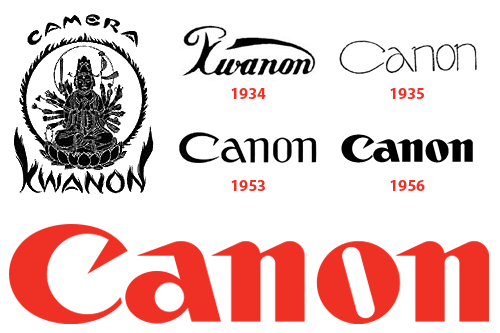
Evolution of the Canon logo (with attribution)

Evolution of the Canon logo

I thought this was interesting:

In 1933, when Precision Optical Instruments Laboratory was established, the name given to cameras manufactured on a trial basis at the time was Kwanon. This title reflected the benevolence of Kwanon, the Buddhist Goddess of Mercy, and embodied the Company’s vision of creating the best cameras in the world. The logo included the word with an image of “Kwanon with 1,000 Arms” and flames.

via Origin of the Logo – canon.com

Precision Optical Instruments Laboratory underwent several name changes before the adoption of Canon Camera Co., Inc., in 1947. This change was significant in that Canon brand and company names were unified for the first time in its history. Several versions of the logo were also used, until a unified version was created in 1953. After further refinements, the logo used today was perfected in 1955. It has remained unchanged for nearly half a century.


via Evolution of the Logo – canon.com

Continue reading

Magnasanti: Totalitarian death state built in SimCity

Vincent Ocasla says that in fashioning the “Magnasanti” metropolis, he has “beaten” SimCity by creating the max stable population of six million. It consists of four grids of identical 12 x 12 grids with everyone’s workplace within walking distance. There are no roads, the city runs entirely on subways. There’s zero abandoned buildings zero congestion, and zero water pollution. It sounds like paradise, but it hides a dark core with a sinister message for would-be top-down urban planners.

via How SimCity Teaches Us The Pinnacle Of Urban Planning Is A Totalitarian Death State – consumerist.com

Continue reading

Lekki: Marketing old mobiles

Lëkki is a French company specializing in “revamped” mobile phones from the 1990s, reinvigorated with bright new paint jobs.

via Anyone Want A Retro Mobile? – retrothing.com

This is a brilliant marketing idea.

  1. Find scrapheap tech.
  2. Apply cosmetic improvements, slick packaging and lifestyle marketing.
  3. Sell to retro geeks, eco nerds, design hipsters and luddites.
  4. Profit.

Or: Reinvent refuse, recycle!

Continue reading

Automatypewriter: A new way to interact with fiction

A new way to interact with fiction from Jonathan M. Guberman on Vimeo.

The Automatypewriter is a typewriter that can type by itself: […]

It can also detect what’s being typed on it. It can be used to send text to and/or receive text from a computer via USB. It was designed as a platform for playing interactive fiction games, in particular to play custom software being developed for it by Jim Munroe.

via Automatypewriter – upnotnorth.net

Welcome to the world of tomorrow…

Trying to look into the future is a grand old time, one that countless science fiction writers and visionaries have done more than a century. From Julies Verne predicting space rockets to Gene Roddenberry’s flip mobile phones to William Gibson defining cyberspace before it existed, science fiction writers have been leading the way towards technology’s future.

via Have we already caught up to science fiction? – thenextweb.com

What a dumb article. I thought The Next Web was better than this. Ignoring for a minute the two errors in that opening paragraph, what is the question exactly? Let me rephrase:

‘Are we living in the future already? Not the really distant future of course, just the near future. Because it feels like we’re really close to living in the near future if we aren’t already.’

The role of SF has never really been to predict the future anyway. It’s a genre more interested in exploring the themes of today, often by taking them to logical extremes to help us reflect. Verne didn’t predict space rockets – he imagined them. Likewise, Roddenberry didn’t invent the communicator – he devised a means of letting his characters communicate over vast distances.

I’ll leave you with Chad Catacchio’s insightful closing words:

“The future might not be now, but to me, it’s close.”