The Domesday Book, freely available online for the first time. You can search by place, name or simply browse the book.
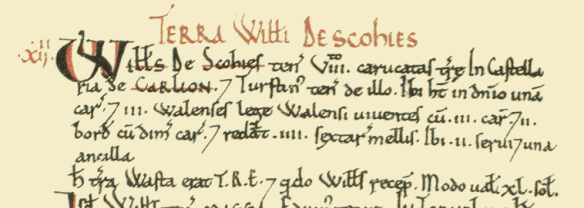

The Domesday Book, freely available online for the first time. You can search by place, name or simply browse the book.
Affordable digital cameras, crowdfunding sites like Kickstarter and IndieGoGo, and video distribution sites like YouTube and Vimeo have all opened the door to a generation of new independent documentary filmmakers.
Many of today’s documentary filmmakers are making bold stylistic choices more often associated with narrative storytelling than documentary filmmaking and finding savvy new ways to engage audiences. By pushing the boundaries of what is considered traditional documentary filmmaking, they are stepping up to compete for the eyes of a generation raised on the often outrageous, unfiltered and unedited user-generated videos that can be found on YouTube and the conflict driven scripted Reality television that fills TV networks.
Stiffs is a five issue mini-series comic currently seeking funding on IndieGoGo. It’s produced in Cardiff, so if you think it sounds cool, give them some support.
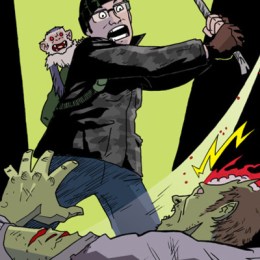
Set in a dead end town in the South Wales Valleys, it follows the adventures of working stiffs Don Daniels, and his monkey life partner (they’re just friends, really) Kenny McMonkey, as they discover that the undead stalk the valley at night. Raised on a steady diet of rubbish horror films and heavy metal, they do what any sane person would: become a pair of bad-ass, hard-living zombie hunters.
The perks are really great too: $20 gets you the whole series, another $5 gets them signed for you, but for $50 you get to commission the series artist to draw whatever you like, and $100 gets you a zombie-cameo in one of the comics!
They’ve already managed to raise $2,048 of the required $3,000, with 16 days still to go, so they’re right on target. I grabbed a preview issue at last year’s Cardiff International Comic Expo, and it looks like a great series. Continue reading
Created by over two years, Slate explains what made David Imus’ map The Essential Geography of the United States of America the Best of Show at the annual competition of the Cartography and Geographic Information Society.

 Wikipedia is amazing, but I’ve come to realise that getting involved in actual editing work there is a very daunting prospect. Adding a link or fixing a typo is simple enough, but when it comes to creating a new article from scratch a new Wikipedian will discover that they have a lot to learn.
In this post I’ve listed what I think are the barriers to entry for an aspiring Wikipedia editor. This post may also be useful as a ‘getting started’ guide.[1]
I just created a special navigation page for this blog that makes pretty good use of the WordPress.com [archives] shortcode.
It looks pretty good on this Twenty Eleven theme using the full-width ‘Showcase template’, but it should work just fine on any WordPress blog. Just grab the code below and give it a try. Continue reading
Some fan has uploaded the out-of-print Blade Runner Sketchbook (1982) to Issuu. Sadly it doesn’t seem like you can download the PDF from there, so go and appreciate it before it vanishes! There are more Blade Runner goodies from the uploader at the Future Noir Tumblr blog.
 People who have followed me on Twitter or this blog for a while may be aware that back in June 2009 I started a Flickr photography group called Thing a Week. The concept is quite simple: To take a picture on a different theme every week.
Now the group is under new management and has a snazzy new website, it seemed like the perfect time for me to get all nostalgic.
This is a neat Wikipedia idea that’s been getting a lot of press today.[1]

Monmouthpedia will be the first Wikipedia project to cover a whole town, creating articles on interesting and notable places, people, artefacts, flora, fauna and other things in Monmouth in as many languages as possible including Welsh.
We are very keen for local people to be involved in what ever way they would like. Computer skills are not that important, it’s the interest and the willingness to be involved, suggesting and writing articles, taking and donating photos and recommending good reference materials. If you speak another language it would be great place to practice your writing skills and learn new vocabulary and grammar. There are a lot of opportunities for community involvement including teaching and learning of I.T skills, local history, natural history, languages and people of different ages working together.[2]
I can see a couple of drawbacks however.
I think I already knew this, but massive hat-tip to Gavin Rothery (@GavRov) and friend for digging up this little tidbit.
I don’t typically make new year’s resolutions, but for 2012 I do have one ambition:
*One deliberate caveat: The film will be very short, with just one or two characters, a simple premise and no real budget. I have no ideas yet, but I want to keep it simple and get it done!
Ratatouille meets The Matrix
“One Rat Short” is a work of love Directed by Alex Weil and created by Charlex Films. From the start we decided not to use anthropomorphic animation. We decided it would take place in two worlds: one so gritty, grimy and dark that the viewer needs to peer into the screen in order to make out the images and the other a sterile white world so brightly lit that you feel the need to turn your head away from the screen. One of the techniques we used was to give a lot of the camera work a hand-held feel and to keep it a little behind the action so that the scenes didn’t seem staged. Lastly and most importantly we kept the story simple and tried to give it heart. The film picked up honors at numerous film festivals, including Best of Show at the Siggraph Computer Animation Festival.
Professors Steve H. Hanke and Richard Conn Henry at Johns Hopkins University are proposing a new calendar in which each date falls on the same day of the week as it did the year before.
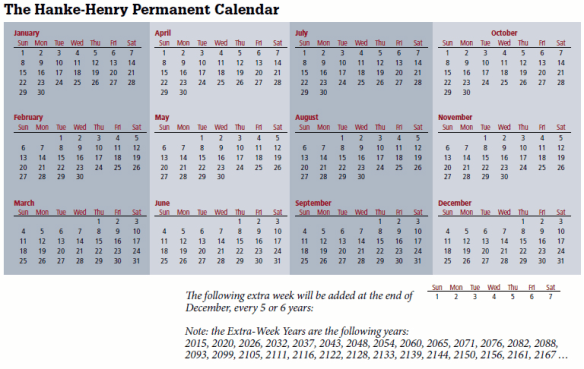
“All of the major (other calendars) have involved breaking the seven-day cycle of the week, which is not acceptable to many people because it violates the Fourth Commandment about keeping the Sabbath Day,” Henry says. “Our version never breaks that cycle.”
The two men also propose eliminating time zones and adopting a universal time around the world to streamline international business.
(via Professors’ proposed calendar synchronizes dates with days – edition.cnn.com)
I love it. It’ll never happen.
A race around the globe.
Bob tells the story of a little hamster that tries to follow his true love around the globe. Can he catch up?
(via gestalten.tv)
Erik Spiekermann explains how he does what he does, and why.
The Atlantic have taken up my campaign against crap infographics:
Now that Obama’s dog has won the War on Christmas, or something, it’s time to get down to a war that really matters: the war on terrible, lying infographics, which have become endemic in the blogosphere, and constantly threaten to break out into epidemic or even pandemic status.
The reservoir of this disease of erroneous infographics is internet marketers who don’t care whether the information in their graphics is right … just so long as you link it. As a Christmas present to, well, everyone, I’m issuing a plea to bloggers to help stop this plague in its track.
 I’ve had a busy evening on Twitter! I recently made a Christmas cracker hat for my Twitter avatar, and I offered to do the same for any of my followers who were interested.
There were a few takers…
(via Penarth house is transformed after renovation – walesonline.co.uk)
Now that’s an improvement!
Social Times yesterday posted an infographic (sponsored by AssistedLivingToday – slogan: ‘Information you can trust’). They introduce it by highlighting the most interesting statistic, which will be the focus of this blog post.
According to a fascinating infographic entitled “How Social Media is Ruining Our Minds,” over the course of the last ten years the average attention span has dropped from 12 minutes to a staggeringly short 5 seconds. As a person deeply ensconced in this connected age my experience shows this to be true. These days, we give a YouTube video just a few seconds to determine if it’s worth it. So what else does social media and technology affect within our minds?
This is the relevant section of the infographic:
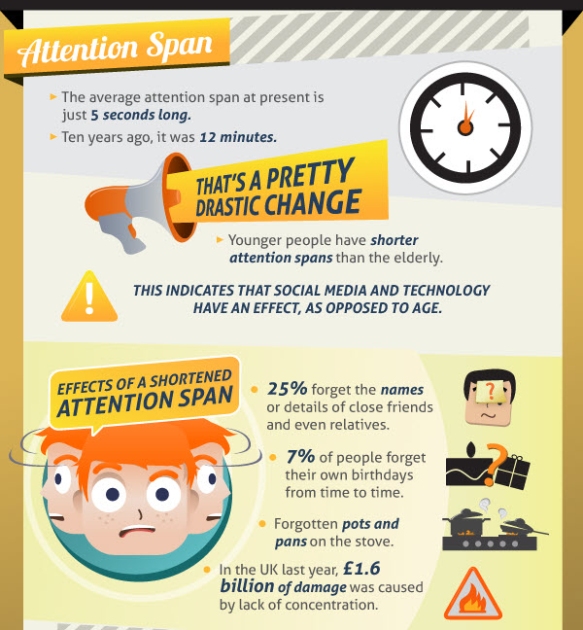
Shocking yes? Perhaps a little too shocking to be true?
Yup…
 halfblog.net