Link

Top 10 overused buzzwords in LinkedIn Profiles in the USA – 2010

  1. Extensive experience
  2. Innovative
  3. Motivated
  4. Results-oriented
  5. Dynamic
  6. Proven track record
  7. Team player
  8. Fast-paced
  9. Problem solver
  10. Entrepreneurial

(via blog.linkedin.com)

I am a highly motivated team player with extensive experience producing innovative, dynamic, fast paced and results-oriented work. As an innovative problem solver with a proven track record and a dynamic entrepreneurial streak, you will soon discover that I am basically the all singing, all dancing crap of the world.

Job please!

Visualizing data is like photography

Visualizing data is like photography. Instead of starting with a blank canvas, you manipulate the lens used to present the data from a certain angle.

[…] After a few minutes of rendering, the new plot appeared, and I was a bit taken aback by what I saw. The blob had turned into a surprisingly detailed map of the world. Not only were continents visible, certain international borders were apparent as well. What really struck me, though, was knowing that the lines didn’t represent coasts or rivers or political borders, but real human relationships. Each line might represent a friendship made while travelling, a family member abroad, or an old college friend pulled away by the various forces of life.

(via Visualizing Friendships – facebook.com)

It would be interesting to see if this data could show communities like the PLoS One map of Great Britain. As it stands, it’s very pretty, but I can’t see much more than areas of high Facebook use…

(via Flowing Data)

Google’s reading age tool

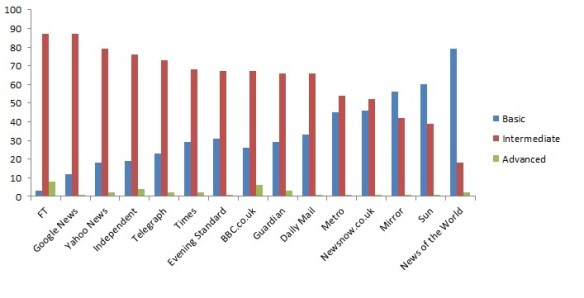
Google have recently added the option to filter your search results by reading level. This could be a great feature for teachers. The virtualeconomics blog has turned this tool onto UK newspaper websites, with some interesting results:

No big surprises that the Sun, Mirror and News of the World sit together at the bottom of the list, or that they’re joined there by the commuter freebie Metro; nor that the FT contains almost no “basic” language pages and the most “advanced”. But the middle of the table is more interesting, with the Guardian scoring much the same reading age as the Daily Mail, and the Independent sitting at the top of the qualities isn’t necessarily what I’d have guessed.

via Google’s reading age tool – comparing UK newspapers – virtualeconomics.co.uk

Continue reading

Google Zeitgeist 2010

Google Zeitgeist 2010 — Global trends: Fastest rising

Above — Global trends: Fastest rising / Below — Facebook vs Twitter.

Google Zeitgeist 2010 — Facebook vs. Twitter

It’s the Google Zeitgeist time of year again, here to demonstrate to me that I have no idea who is famous these days or what real people do online. Facebook just makes it into the top 10 fastest rising search terms, though if you compare it to Twitter, it is much more popular in sheer volume. In fact, it’s much bigger than anything else here.

Amusingly, ‘chatroulette’ tops the list in almost every region, with ‘ipad’ and ‘iphone 4’ always up there too.

Google Zeitgeist 2010: Global / UK

Continue reading

Link

An interesting Time article about Shawn ‘Napster’ Fanning, DVD Jon, Justin ‘WinAmp’ Frankel, Bram ‘BitTorrent’ Cohen and the entertainment industry apocalypse that never happened.

It turns out that there is something that can compete with free: easy. Napster, Gnutella and BitTorrent never attained the user-friendliness that Apple products have, and nobody vets the content on file-sharing networks, so while the number of files on offer is enormous, the files are rotten with ads, porn, spyware and other garbage. When Jobs offered us the easy way out, we took it. Freedom is overrated, apparently — at least where digital media are concerned.

via The Men Who Stole the World – time.com

No such thing as bad publicity – for SEO

A fascinating story about a scumbag sales operation, DecorMyEyes.com, who leaned that a link is a link, and Google doesn’t care if it’s a good review or a scathing rant – so why make the effort to give good service?

“Hello, My name is Stanley with DecorMyEyes.com,” the post began. “I just wanted to let you guys know that the more replies you people post, the more business and the more hits and sales I get. My goal is NEGATIVE advertisement.”

It’s all part of a sales strategy, he said. Online chatter about DecorMyEyes, even furious online chatter, pushed the site higher in Google search results, which led to greater sales. He closed with a sardonic expression of gratitude: “I never had the amount of traffic I have now since my 1st complaint. I am in heaven.”

[…]

The strange part is that Google is intimately familiar with the rage inspired by DecorMyEyes. If you type the company’s name in a Google Shopping search, you’ll see a collection of more than 300 reviews, many of them arias sung in the key of livid.

[…]

In short, a Google side stage — Google Shopping — is now hosting a marathon reading of DecorMyEyes horror stories. But those tales aren’t even hinted at in the company’s premier arena, its main search page.

“It’s fair to say,” Mr. Sullivan concludes, “that this is a failure on Google’s part.”

via For DecorMyEyes, Bad Publicity Is a Good Thing – nytimes.com

Continue reading

Bounce rate demystified

Recently, while looking at the Google analytics for this site, I noticed that my bounce rate was very high. I wasn’t very clear on what this meant, so investigated and concluded that there wasn’t much I could do about it given the type of content I post here.

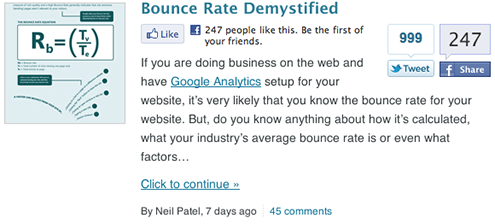
So a new infographic on Kissmetrics caught my eye today: Bounce Rate Demystified.

I’m not a big fan of this current infographic craze, partly because they lock the data into a very web-unfriendly, non-interactive format, and partly because they are usually nothing more than transparent linkbait, with little or no actual informational substance.

My previous post challenged the former complaint. In this post I’ve decided to dissect the bounce rate infographic and see how good the information really is…

Continue reading

The Facebook ‘super-logoff’

Mikalah uses Facebook but when she goes to log out, she deactivates her Facebook account. She knows that this doesn’t delete the account – that’s the point. She knows that when she logs back in, she’ll be able to reactivate the account and have all of her friend connections back. But when she’s not logged in, no one can post messages on her wall or send her messages privately or browse her content. But when she’s logged in, they can do all of that. And she can delete anything that she doesn’t like. Michael Ducker calls this practice “super-logoff” when he noticed a group of gay male adults doing the exact same thing.

(via Risk Reduction Strategies on Facebook – zephoria.org)

This would be a good trick to pull when you have a job interview coming up.

Lifehacker made a tip out of this practice: Use the “Super-Logoff” Technique to Exercise Tighter Control Over Your Facebook Profile

How to make half a million dollars with a virtual asteroid

Many people might balk at the idea of paying even a dollar for virtual cow in a game like Farmville. But Jon Jacobs has just sold a virtual space station he’s spent the past five years managing for a whopping $635,000 in total, making over half a million dollars. Who would devote so much time and investment into something that doesn’t exist in the real world?

via Meet The Man Who Just Made A Half Million From The Sale Of Virtual Property – blogs.forbes.com

Hmm, maybe I’m going about this all wrong…

27b/6 jerk is jerk

Perhaps it’s no surprise to learn that David Thorne, the guy who has a website documenting hilarious email exchanges, in which he exposes the (alleged) stupidity and ignorance of certain people he encounters, is a bit of a jerk. The first example I was aware of that went viral was the brilliant 7 legged spider drawing:

Dear Jane,

I do not have any money so am sending you this drawing I did of a spider instead. I value the drawing at $233.95 so trust that this settles the matter.

Regards, David.

Spiderdrawing

via Overdue Account – 27bslash6.com
Continue reading

Handy heuristics that contradict convergence

“In general, the attribution of specialization can increase the credibility of a product or any kind of object,” Sundar says. “It’s really how the human psyche works.”

For instance, the search engine providing product recommendations was labeled “wine agent,” while the general recommendation agent was named “E Agent.”

“Basically, cognitive heuristics are mental shortcuts that we use to make judgments that lead to decisions,” Sundar says. “For example, we see a long essay, we immediately think that it is a strong essay. This is the ‘length equals strength’ heuristic. Similarly, we tend to quickly believe statements made by experts or specialists because we apply the ‘expertise heuristic,’ which says that experts’ statements can be trusted.”

via Name it and webbies will buy it – futurity.org

Interesting piece of SEO psychology. There are some intelligent comments on the study too – I especially liked the kitchen knives analogy made by Chris Edwards:

It is quite common for people to buy multiple tools that do the same job. As a simple example, look in your kitchen… how many different knives do you have for specialised tasks? If you lay them all out and logically look at it, how many different types do you actually need?

We assume that something that is specialised is better, so therefore if something sounds specialised, we will probably lean toward using that one.

(via & via)

Updated 2013.01.17 to tweak the formatting and to actually quote the kitchen knives comment rather than just allude to it.

Posted in SEO

Evolution of the Canon logo (with attribution)

Evolution of the Canon logo

I thought this was interesting:

In 1933, when Precision Optical Instruments Laboratory was established, the name given to cameras manufactured on a trial basis at the time was Kwanon. This title reflected the benevolence of Kwanon, the Buddhist Goddess of Mercy, and embodied the Company’s vision of creating the best cameras in the world. The logo included the word with an image of “Kwanon with 1,000 Arms” and flames.

via Origin of the Logo – canon.com

Precision Optical Instruments Laboratory underwent several name changes before the adoption of Canon Camera Co., Inc., in 1947. This change was significant in that Canon brand and company names were unified for the first time in its history. Several versions of the logo were also used, until a unified version was created in 1953. After further refinements, the logo used today was perfected in 1955. It has remained unchanged for nearly half a century.

via Evolution of the Logo – canon.com

Continue reading

“You can’t polish a turd, but you can roll it in glitter”

Quote

[…] And commercial radio is really simple. Like many other businesses, it has products and it has customers. The audiences are not the customers, they’re the product. The customers are the advertisers.

via Myspace – now with glitter (via @Dizzyjam)

Excellent post about My_____. I’m a big fan of writers who can distil complex issues into powerful paragraphs.

Algorithmic ads sink ships

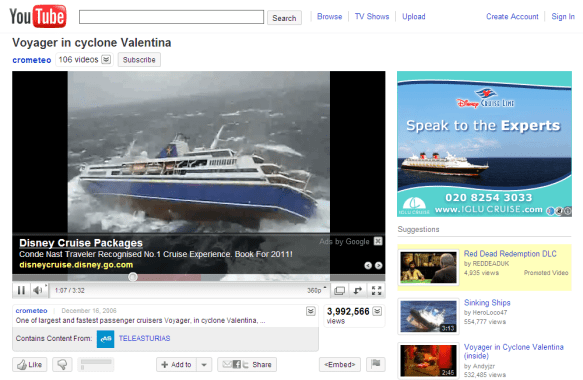
I wonder if advertisers will ever figure out a smarter way of algorithmically placing ads on pages? Or if a video has millions of views, is it worth advertising against, even if the content goes against your message?

Also, this is the first time I’ve seen a ‘contains content from’ notice on a YouTube video. Interesting approach. Continue reading

Posted in Web

How to gracefully promote yourself online

I think I may start a series of posts where I digest articles that may (or may not) have some good information in them. This particular article, ‘How to gracefully promote yourself online’ (CNN), sounds like it may have something insightful in it, but you’d be forgiven if you gave up after reading the first eight paragraphs of nothing much.

Allow me to summarise via the medium of bullet points:

  • Test your PR campaign on family and friends first. 
  • Proofread it first though.
  • Only reach out when you have something to say.
  • Be upfront about how often you will send out email.
  • Be ethical with contact information.
  • Make newsletters ‘unboring’.
  • Thank your customers/fans.

Continue reading

Breadcrumb navigation in the URL bar

Breadcrumb navigation in the URL bar

I propose that the URL bar be modified to fulfill a significant purpose for the user other than just displaying long strings of characters mostly irrelevant to, and mostly ignored by, the user. A user should be aware of his location on the Internet at all times, and of any relevant information that he has requested or transmitted in getting there. The way the URL bar presents that information is completely inadequate.

via Making the URL Bar Useful Again: Where the breadcrumb should have been all along – uxmag.com

Some smart thinking here, and some excellent opposing views in the comments. I can see something very similar to this really working. It would need to be something the browser could figure out itself though, based on the logical arrangement of the site itself, and not by using the extra markup proposed here.

I can see how you could use this space for some neat shortcuts – like logging in through a drop down, or searching within specific sections of a site. Also, when you get a 404, the URL bar could present some navigation options to get you back on track, maybe even by displaying a drop down list of pages you may have been looking for.

Clever website imitates a Google search results page

Michael Jang Photography

Michael Jang Photography imitates a Google search results page with his website.

This is such clever idea, although I think perhaps a photographer would be better off selling himself with his pictures, not his web presence. I actually think it would work a lot better for a social media/SEO type. Nonetheless, I like what he’d done, and is planning to do:

[…] “It is not what it seems,” said Jang, “Along the top and right are ‘ads’ all linking back to photo projects and videos.” As expected of any website, Jang provides his e-mail contact, links to his Facebook, Flickr and blog — all disguised as Google search options in the page header.

Ultimately, Jang intends to cede control of the links featured on his site. “Rather than totally control the content I want more transparency,” said Jang. The site “will link to anything about me, so sometimes there might even be threads that are less than complimentary.”

via wired.com (story found via PetaPixel)

Wikipedia’s comedy synopsis of ‘Baby Got Back’

Quote

The song opens with two young females discussing the physical appearance of a third female, in particular her buttocks, which they find unfathomably large.

In the opening verse, Sir Mix-a-Lot professes his affinity for large buttocks and his inability to disguise this fact from others. He goes on to describe other desirable physical attributes, such as a trim waistline, tight-fitting garments, and unblemished skin. Though the song does not contain a distinct narrative, the author does visit recurring themes, such as female body image as depicted in media, male attitudes toward dating and relationships, and the author’s own sexual prowess.

In later verses he expresses his exasperation with the entertainment industry’s portrayal of the ideal female form. He soundly rejects the notion promulgated by fashion magazines that diminutive buttocks are more desirable. His critique of the women who appeared in contemporary music videos is particularly scathing, likening their appearance to those of prostitutes. To further illustrate his point, he stipulates that the purported ideal proportions of 36-24-36 (measuring the bust, waist, and hip circumferences respectively) would only be pleasing on women with a standing height no greater than 63 inches.

Mix-a-Lot also briefly touches upon the roles that ethnicity, nutrition, and physical fitness play in determining the shape and size of the female buttocks. He recommends that any exercises performed should be limited to the abdominal area. He cautions against a fitness routine strenuous enough to diminish the heft of the gluteal muscles. Though he offers no broad dietary guidelines, Mix-a-Lot contends that the dish “red beans and rice” is an important food staple for maintaining healthy buttocks.

Various lyrics address the fact that some men find no intrinsic value in large buttocks and consequently express a lack of interest. Mix-a-Lot makes clear that he would eagerly strike up relations with any woman overlooked or discarded by such men. The remainder of the narrative is fleshed out with the author’s various attempts to entice women into enjoying a ride in his luxury automobile. [3]

Baby Got Back – Wikipedia, the free encyclopedia

Via codinghorror who says: “I suspect this backdooring (omglol) of humor into Wikipedia through song synopses won’t be tolerated for long.”

Probably, but I had to back this one up here! :D

Updated 2013.01.19 to change the attribution link to the appropriate Wikipedia diff page, instead of the current edit, and to tweak my post title.