The 80-20 Rule

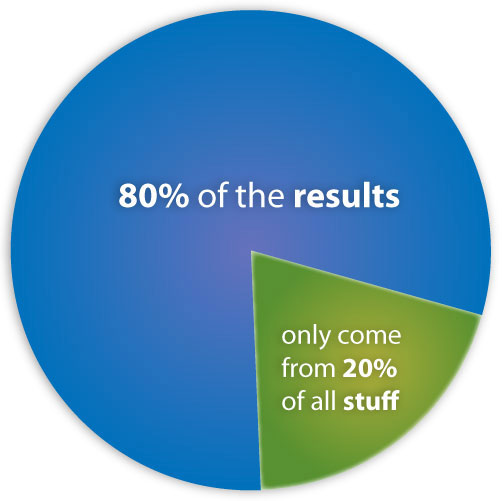
Pareto principle

Business management thinker Joseph M. Juran suggested the principle and named it after the Italian economist Vilfredo Pareto who observed in 1906 that 80% of the land in Italy was owned by 20% of the population. Juran developed the principle after observing that 20% of the pea pods in his garden contained 80% of the peas.

The 80-20 rule is also a common rule of thumb in business, i.e. 80% of your sales come from 20% of your clients.

via Use the 80-20 Rule to Increase Your Website’s Effectiveness – sixrevisions.com

A great article, but I notice the Six Revisions page has some clutter itself. Not anything like as bad as most big blogs though.

This is actually one of the reasons I like this default Posterous ‘Clean Sheet’ theme so much, and I hesitate before adding any extras (even the AdSense ads I wanted to put on). Now I look again with a more critical eye, I think I may remove some of the sidebar links I stuck there when – I doubt they get much use.

Also, what a lovely pie chart!

EDIT: It’s interesting how this seems to contradict the advice from this SEOmoz landing page case study.

Posted in SEO

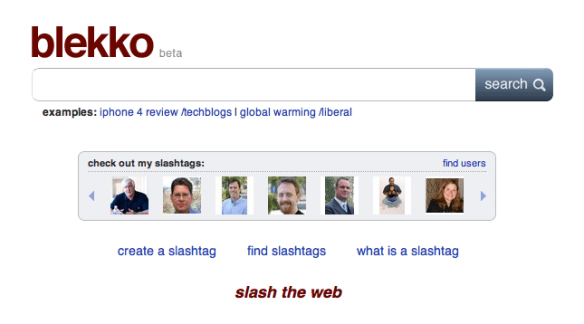
Use Blekko to ‘slash the web’. What?

blekko is a better way to search the web by using slashtags.

I don’t know what that tells you, but the name and the tagline for this new search engine conjure up some pretty nasty images for me, and tell me nothing about the service. Blekko is a nonsense word, and you may think one invented word is as good as another, but Blekko sounds like something you need to clean up. And ‘slashing the web’. I dunno, that sounds nasty. Luckily they go on to explain…

slashtags search only the sites you want and cut out the spam sites. use friends, experts, community or your own slashtags to slash in what you want and slash out what you don’t.

Blekko

Continue reading

Creating linkbait: A guide for the untalented

So you want to get links, but don’t know how to start creating linkable content? Let me walk you through my process for creating awesome linkbait.

via A Simple Guide to Creating Linkbait – SEOmoz

Allow me to summarise:

1. Take your ‘inspiration’ from what your competitors are doing.
2. Can you put a spin on any of that? Don’t copy, just do something similar to whatever is already popular.
3. Create your content. Hire people to do this if you lack talent.
4. Get people to link to your content. Ass licking always helps.

And whatever you do, don’t take any risks!

Posted in SEO

Sexy CSS3 infographics: I propose a revolution!

There have been two separate trends on the web in recent months and years:

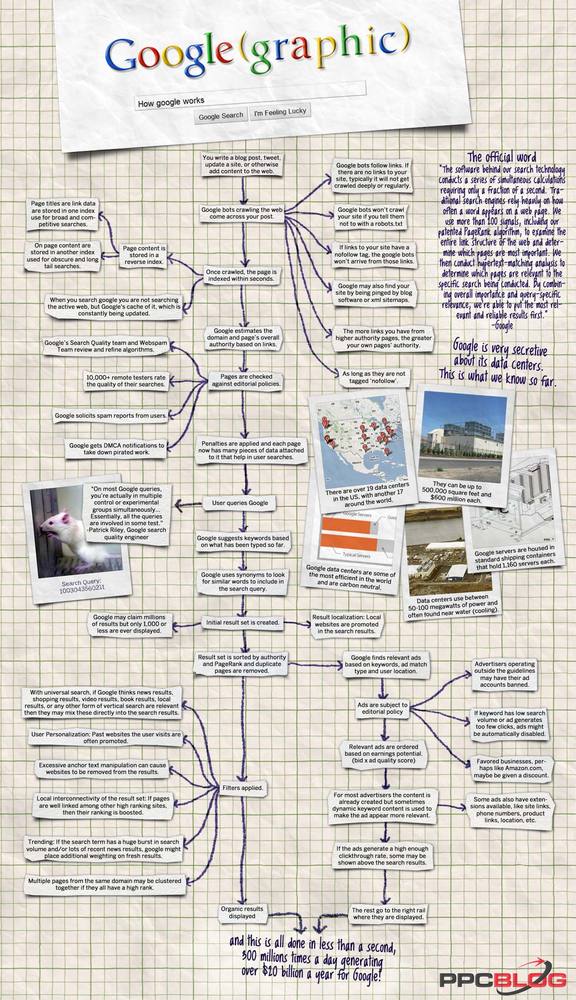
  1. Infographics are everywhere, typically in the form of long JPEGs. These are often criticised as being poor examples of information design (or just poor examples of design), but they still seem popular.
  2. Creating snazzy effects with CSS3 and HTML5. Increasing support for dropshadows, rounded corners, gradients, real fonts, rotation and all other kinds of nice visual enhancements, has resulted in masses of experimental designs. It’s even possible to create many types of fantastic (and terrible) charts and graphs, as well as icons and illustrations.

So CSS3 and infographics are a natural fit. They could be interactive, animated, hyperlinked, semantic and searchable. Besides, making big dumb JPEGs for the web just seems like a retrograde step. Why not put that effort into making a really nice page?

(How the Internet works / “Infographic”)

Continue reading

PageRank explained with an interactive diagram

This is an excellent page that explains the mathematics behind Google’s PageRank and illustrates it with an interactive diagram. You can arrange a series of pages, link them to each other and see the resulting PageRanks.

PageRank explained with an interactive diagram

PageRank explained with JavaScript

After ‘the science bit’ he concludes with this little piece of wisdom that I hope all SEO ‘experts’ actually get to:

How can I use this to drive traffic to my website?

If you take anything from this article take with it the spirit of sharing knowledge. Knowledge is the only type of content that is truly valuable and there should be no doubt that search engines now and of the future will try their best to make sure it ends up at the top of their search results.

He has a pretty cool piece of JavaScript animated ASCII art on his homepage too: http://williamcotton.com/

Graphic Adventures: A book of compiled and expanded Wikipedia entries

What I did was edit the Wikipedia articles through heavy or light rewriting, depending on what I figured the article would need to look good in book form. I then went to find additional information from other sources where I felt having more could be fun, and I added screenshots. And then I conducted interviews with many people who were involved in producing the classic graphic adventures. I interviewed creators like Al Lowe of Leisure Suit Larry, Lucasfilm’s David Fox, and Michael Bywater, who worked with Douglas Adams on the game Starship Titanic. The book took much longer than expected… the original idea after all was to merely compile an encyclopedia from Wikipedia, a book for perhaps a small but dedicated group of fans like me. But after sending myself the first draft version, I realized much more editing was needed to have something really fun.

Graphic Adventures: A book of compiled and expanded Wikipedia entries

(via blogoscoped.com)

What a great way to write a book. Philipp Lenssen says he is donating 50% of the book’s revenues to the Wikimedia Foundation, but doesn’t mention whether he contributed any of his original findings back to Wikipedia (although now I think about it, I’m fairly certain Wikipedia discourages original research).

He’s released it under the GNU Free Documentation License, and you can download the HTML documents in a .zip file.

SEO for content producers – the essentials

I’ve been preparing a single page document to give to colleagues who are unfamiliar with search engine optimisation techniques, and I thought it might be useful to post it here. Constructive comments are very welcomed to help me improve this first draft, but do check my note at the bottom so you understand the intended purpose of this list.

Continue reading

Comment isn’t free: The Sun Chronicle comment paywall

From tomorrow, the Sun Chronicle, a Massachusetts paper, will charge would-be commenters a nominal one-off fee of 99 cents. But it has to be paid by credit card, which means providing a real name and address.

And the name on the credit card will be the name that will appear on comments. So it’s goodbye to anonymity.

(via Paper puts up a paywall for comments – guardian.co.uk)

This actually strikes me as a pretty good idea. I’d return a degree of anonymity by allowing people to choose a display name though. The small fee would stop 99% of trolls dead anyway.

I did notice that the Sun Chronicle had no comments on any of the recent stories I checked. They seem like a pretty small operation though.

I wonder if a service like Disqus could centralise a scheme like this?

Continue reading

John Gruber on Tynt, the ‘Copy/Paste Jerks’

All of this nonsense — the attribution appended to copied text, the inline search results popovers — is from a company named Tynt, which bills itself as “The copy/paste company”.

It’s a bunch of user-hostile SEO bullshit.

Everyone knows how copy and paste works. You select text. You copy. When you paste, what you get is exactly what you selected. The core product of the “copy/paste company” is a service that breaks copy and paste.

The pitch from Tynt to publishers is that their clipboard jiggery-pokery allows publishers to track where text copied from their website is being used, on the assumption that whoever is pasting the text is leaving the Tynt-inserted attribution URL, with its gibberish-looking tracking ID. This is, I believe, a dubious assumption. Who, when they paste such text and find this “Read more:” attribution line appended, doesn’t just delete it (and wonder how it got there)?

via Tynt, the Copy/Paste Jerks

Praise be. There’s also a link to a Google Chrome Tynt blocker plugin, and some other solutions, including how to edit your hosts file.

I’m finding myself at Daring Fireball pretty regularly these days, with a growing amount of respect for Gruber.

Posted in SEO

Another variation on the slider CAPTCHA

Last week there was a blog post by LukeW proposing a sliding alternative to CAPTCHAs:

[…] the sign up form on They Make Apps uses a slider that asks people to: “show us your human side; slide the cursor to the end of the line to create your account.” Moving the slider to the right completely submits the form and triggers error validation just like a standard Submit button would.

But why stop there? I just spotted this super geeky variation on the same idea on the Adafruit Industries blog:

It seems that it’s their own creation, and is offered as a WordPress plugin:

We are thrilled to release a solve-the-resistor CAPTCHA plugin for WordPress! This plugin will draw a random 5% or 10% resistor and four color band sliders beneath it. The commenter needs to match the colors on the sliders to the colors on the resistor. Commenters don’t actually need to know how to read resistors, but this will help them as they post comments on site that use this plugin.

Resisty – Resistor CAPTCHA – solve the resistor values to post a comment!

Of course, as with the slider alternative the resistor reading could still be easily worked around using crowd-sourced labour, but it’s still a fun idea!

I wasn’t using that privacy anyway…

Although [digital coupons] might look similar to the ones in Sunday newspaper circulars, many of today’s digital versions use special bar codes that are packed with information about the life of the coupon: the dates and times it was obtained, viewed and, ultimately, redeemed; the store where it was used; perhaps even the search terms typed to find it.

A growing number of retailers are marrying this data with information discovered online and off, such as guesses about your age, sex and income, your buying history, what Web sites you’ve visited, and your current location or geographic routine — creating profiles of customers that are more detailed than ever, according to marketing companies.

via washingtonpost.com (look under Business for ‘What those savings really cost you’ – the WP is not a big fan of ye olde hyperlink, apparently)

I’m never really sure what to think about this. Personally, I don’t use any reward cards or sign up for anything that collects data in exchange for offers. On the other hand, I’m not sure I see what the big problem is. So what if Amazon know what I like, how much I’ll spend and how often? They can’t force me to spend buy things. I get bombarded with ads all the time anyway, and I don’t think I can be angry because companies can target me better than ever before – it still comes down to me having self control.

Roger Ebert on the merits of Twitter

I vowed I would never become a Twit. Now I have Tweeted nearly 10,000 Tweets. I said Twitter represented the end of civilization. It now represents a part of the civilization I live in. I said it was impossible to think of great writing in terms of 140 characters. I have been humbled by a mother of three in New Delhi. I said I feared I would become addicted. I was correct.

Tweet! Tweet! Tweet! – Roger Ebert’s Journal

Ebert lays out a good set of rules for making the most out of Twitter, describes how it has become particularly important to him, shares some observations and even talks about some of the many other interesting Twitter users he follows, with reasons why.

Simply one of the best posts on Twitter I have read.

If you’re not following him, you should be: @ebertchicago

Some common sense about comments

I don’t see my writing as a collaborative effort, and I don’t see my site as a community in which I need to enable internal discussion via comments.

I also disagree with the widespread notion that comments are “discussion”, or that they form a “community”. Discussion and communities require mechanics such as listening and following up that are rarely present in comments.

via Comments – marco.org

A branding lesson from Leroy Stick, aka @BPGlobalPR

Quote

You know the best way to get the public to respect your brand?  Have a respectable brand.  Offer a great, innovative product and make responsible, ethical business decisions.  Lead the pack!  Evolve!  Don’t send hundreds of temp workers to the gulf to put on a show for the President.  Hire those workers to actually work!  Don’t dump toxic dispersant into the ocean just so the surface looks better.  Collect the oil and get it out of the water!  Don’t tell your employees that they can’t wear respirators while they work because it makes for a bad picture.  Take a picture of those employees working safely to fix the problem.  Lastly, don’t keep the press and the people trying to help you away from the disaster, open it up so people can see it and help fix it.  This isn’t just your disaster, this is a human tragedy.  Allow us to mourn so that we can stop being angry.

(Leroy Stick, The Man Behind @BPGlobalPR)

A justifiably angry article explaining why it’s okay to hit BP with the big Twitter stick. Makes me wish I had fought with Twitter to keep my @virginmedia account. They weren’t destroying the planet or anything, but they did (and do) have terrible customer service.

[Edited post to switch link from Gizmodo to the actual source. Screw Gizmodo, I thought it was their scoop.]

Should you delete your Facebook account?

This May 31st is Quit Facebook Day, but I won’t be deleting my account. No, I got rid of it a few weeks ago. As much as I’d like to claim that this was entirely some kind of ethical stance, the simple truth was that I didn’t actually make much use of the service. If I had the same negative feelings about Twitter, quitting would be a much tougher decision.

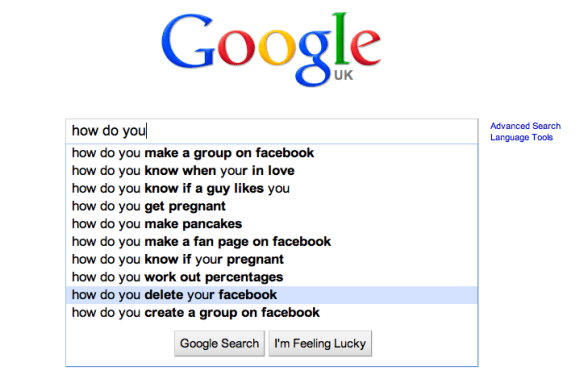
Should you leave Facebook? Maybe. It’s certainly a question that a lot of people are asking. Then, if they decide to, they ask ‘so how the hell do I delete the thing?’ Enough that this has become a Google suggested result:
There’s actually a website dedicated to helping you find the elusive ‘delete’ hidden in the unnecessarily complicated settings. You can find out how well you have protected your privacy at Profile Watch. There’s also a handy bookmarklet at Reclaim Privacy that will similarly assess your profile. For a laugh, you can also read through some posts of other Facebook users, who probably think they are talking to their friends, not the entire internet: Openbook.

Are there real reasons to be worried? Well, after Facebook held a developer conference, lots of worried Google engineers left. And Google has hardly earned any privacy gold stars. And then there’s Mark Zuckerburg, the man behind the company, with a few thoughts on privacy (taken from an IM conversation when he was creating the service, then called The Facebook):

Zuck: Yeah so if you ever need info about anyone at Harvard
Zuck: Just ask. 
Zuck: I have over 4,000 emails, pictures, addresses, SNS
[Redacted Friend’s Name]: What? How’d you manage that one?
Zuck: People just submitted it. 
Zuck: I don’t know why. 
Zuck: They “trust me” 
Zuck: Dumb fucks.

Business Insider also has a fascinating expose on Zuckerburg. Decide for yourself if it holds much water, and if you think his character is likely to have improved in the last six years. 

It’s also interesting to witness how Facebook has eroded the default privacy settings over the years, from friends and family to almost completely exposing everything.
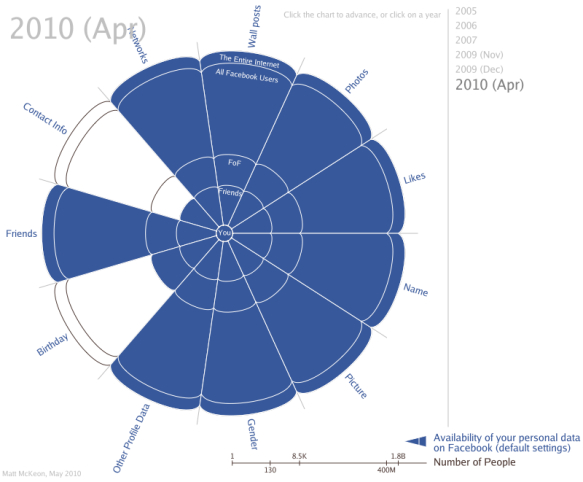
While most users may not understand/care about these issues, there are plenty who do. Enough that when a new project to create an open-source distributed social network asked for $10,000 to get started, they were overwhelmed with donations. As I write this, they have over $170,000 pledged.

So I guess Facebook just gives me the creeps.

Continue reading

HuffPo uses A/B testing to write better headlines

From direct mail to web design, A/B testing is considered a gold standard of user research: Show one version to half your audience and another version to the other half; compare results, and adjust accordingly. Some very cool examples include Google’s obsessive testing of subtle design tweaks and Dustin Curtis’ experiment with direct commands and clickthrough rates. (“You should follow me on Twitter” produced dramatically better results than the less moralizing, “Follow me on Twitter.”)

So here’s something devilishly brilliant: The Huffington Post applies A/B testing to some of its headlines. Readers are randomly shown one of two headlines for the same story. After five minutes, which is enough time for such a high-traffic site, the version with the most clicks becomes the wood that everyone sees.

(via How The Huffington Post uses real-time testing to write better headlines – niemanlab.org)

I also found it interesting that they are considering splitting up the content they serve by IP address, so they can serve the East and West coasts better.