Link

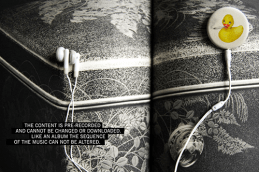
Playbutton is a wonderful idea that would make music collectable again and give artists back the ability to sell an album experience instead of just letting people cherry-pick individual tracks. Music piracy would still be pretty straightforward, but this idea taps into the desire to own and display something that represents what you love. They could be pretty cheap too and – so long as the audio quality is good – be a huge hit.

Would be nice to see a design with an iPod shuffle-like clip instead of a pin.

There, I fixed it…

HP Slate solution to "too many stickers" syndrome

HP Slate solution to "too many stickers" syndrome

Yes, dear reader, that’s a little pull-out drawer who’s only role in life is to hold and display a dizzying array of licencing and serial number data. There’s even more of this stuff on the back too.

If an Apple designer pitched this craplution to Steve Jobs, he’d rip their still-beating heart clear out of their chest.

via HP Slate has a bad solution to “too many stickers” syndrome – tuaw.com / HP Slate hands-on – engadget.com

I don’t even know what to say about this…

Continue reading

i is for Interesting

Andrew Mullins, Managing Director of The Independent, said: “Quality newspapers provide a highly valuable audience for advertisers, but recently print circulations have been in decline and the average age of the audience has been increasing.

“Time-poor newspaper readers, and especially commuters, have been telling us for years that they are inundated with information and just don’t have the time to read a quality newspaper on a regular basis. We are creating a newspaper for the 21st century that is designed for people who have a thirst for information and entertainment in the limited time that they have available. i is a reader-led newspaper with broad reach and intelligence.”

via The Independent launches i – independent.co.uk

Blah, blah, blah. Really, do they have to use such boring, stuffy, patronising marketing copy?

Still, it’s an interesting idea to create a paper for generation-ADD. I can see the name being nothing but a burden for them though!

(via @ramskill)

BrickForge

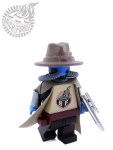
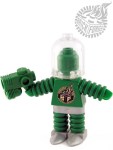
I love this stuff. I could possibly justify buying them as props for stock photography work …right?

“We consider ourselves intermediaries between the community and the lumbering Danish company. For a long time the building experience has been the focus of creativity; but an increasing number of people are realizing their inner child through the role-play of the minifigs included in those sets. The mission of BrickForge is to fill in the gaps left open by LEGO and other brick-building companies.” – Armothe

“A lot of thought (and work!) goes into the creation of these tiny accessories. We do our best to consider ‘how would these look if LEGO made them’ and then we attempt to raise the bar even further.”  – Redbean

(via About BrickForge)

Crapestry / PechaKucha night


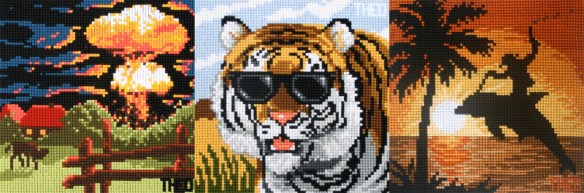
I’ve just come back from my second PechaKucha night at Chapter Arts, and as before the lineup was exceptional. For me, the highlight was Theo Humphries’ talking about his Crapestries. I think I may have to give this a go myself!

Richard Weston kicked off with his own hobby, of scanning incredibly detailed close images of natural materials and using them in art, fashion and architecture. Guto Evans‘ gave an excellent primer on what exactly branding is, and why it is important. Finally, Jon Chase brought the house down with an amazing rap: “Life – An autobiography.”

The other talks were equally good, but these struck a particular chord with me.

I’ve pretty much missed the first week of the Cardiff Design Festival, but there’s still plenty more stuff coming up that looks great. In fact, I’m going to have to run around on Saturday to see everything I want to!

South East Wales Local Exchange Trading System

Update 2012.01.11: Since this post was written, SEWLETS have (wisely) rebranded as Cardiff Taffs Community Currency.

South East Wales Local Exchange Trading System

SEWLETS is all about getting back a sense of community spirit. As a group we exchange all kinds of goods and services with each other, using community credits. You might earn credits by painting a fence for a neighbour, then you could spend those credits getting computer help from someone else in the group. So the circle goes on, always helping people in our community. Our credits are called “Taffs”, and you should value them at about one pound each. LETS are already popular across the UK, including Bristol, Bath, Edinburgh and several areas of London. If you value community spirit then this will be just the thing for you!

via sewlets.org.uk

Discovered via a tweet from Guardian Cardiff, this is my first exposure to the idea of a Local Exchange Trading System. It reminded me of a great science fiction story I read years ago: “…And Then There Were None” by Eric Frank Russell. It’s the final story from a novel where a starship is visiting different human colonies in the hopes of establishing an empire…

The final planet, K22g, has developed an unusual social system. The population call themselves Gands (after Gandhi) and practice a form of classless, philosophically anarchic libertarianism, based on passive resistance (“Freedom – I won’t!” and “Myob!”); and a money-free gift economy based on barter and favour-exchange, using “obs” (obligations). To perform a service for somebody “lays an ob” on them; they can then “kill the ob” by returning the favor.[1]

via The Great Explosion – en.wikipedia.org

SEWLETS are using a Drupal plugin called Local Currencies for functionality:

Local Currencies (Complementary currencies) is an all-embracing and flexible package which includes a mutual credit engine, transaction forms and displays, including several views and blocks. It can be used as a digital back end for paper money projects, or to run an entire LETS or Timebank. With a little tweaking, it can manage currencies conforming to a wide range of designs.

via drupal.org

Interesting stuff. Sadly without signing up there’s no way to gauge how much of a community there is (the forums are certainly quiet). Some kind of dashboard on the front page (ideally showing a thriving community of people trading various skills) would make a huge difference. Maybe I’ll sign up when I have some free time and report back…

Follow SEWLETS on Twitter

Unitarian Jihad

Quote

We are Unitarian Jihad. We are everywhere. We have not been born again, nor have we sworn a blood oath. We do not think that God cares what we read, what we eat or whom we sleep with. Brother Neutron Bomb of Serenity notes for the record that he does not have a moral code but is nevertheless a good person, and Unexalted Leader Garrote of Forgiveness stipulates that Brother Neutron Bomb of Serenity is a good person, and this is to be reflected in the minutes.

We are Unitarian Jihad, and our motto is: “Sincerity is not enough.” We have heard from enough sincere people to last a lifetime already. Just because you believe it’s true doesn’t make it true. Just because your motives are pure doesn’t mean you are not doing harm. Get a dog, or comfort someone in a nursing home, or just feed the birds in the park. Play basketball. Lighten up. The world is not out to get you, except in the sense that the world is out to get everyone.

by Jon Carroll articles.sfgate.com

Hilarious, and worth reading in full. :)

(via @huwlynes)

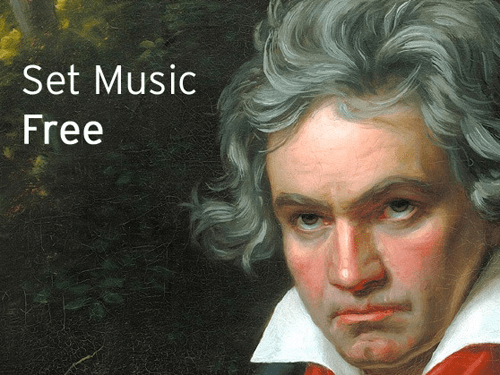
Set music free

Musopen: Record and release free music without copyrights.

A group of classical music lovers have successfully appealed for funds to release copyright-free versions of symphonies by four famous composers. The money will pay for an orchestra to record the music on an “all rights basis”.

The project, Musopen, aims to deal with a problem caused by the way copyright laws work. Although the actual symphonies written by composers in, for example, the 19th century are long out of copyright, there is separate protection for every individual performance by an orchestra. That means that in most cases, the only recordings currently in the public domain are very old performances generally recorded with poor quality equipment and plagued with hiss and crackle.

via tech.blorge.com (via slashdot)

This is such a brilliant project, and another fantastic example of Kickstarter helping people make great ideas become a reality.

Paris, Photoshopped

This slideshow requires JavaScript.

I’ve been working on another batch of my unprocessed Paris photographs tonight, and thought I’d share this one in its before and after states. I usually don’t do this much work to my images, but I thought this one would be worth a bit of extra effort. As you can see, I’ve shifted the elements into more pleasing positions and removed some distracting elements, then tweaked the colours a little.

Continue reading

Wikipedia’s comedy synopsis of ‘Baby Got Back’

Quote

The song opens with two young females discussing the physical appearance of a third female, in particular her buttocks, which they find unfathomably large.

In the opening verse, Sir Mix-a-Lot professes his affinity for large buttocks and his inability to disguise this fact from others. He goes on to describe other desirable physical attributes, such as a trim waistline, tight-fitting garments, and unblemished skin. Though the song does not contain a distinct narrative, the author does visit recurring themes, such as female body image as depicted in media, male attitudes toward dating and relationships, and the author’s own sexual prowess.

In later verses he expresses his exasperation with the entertainment industry’s portrayal of the ideal female form. He soundly rejects the notion promulgated by fashion magazines that diminutive buttocks are more desirable. His critique of the women who appeared in contemporary music videos is particularly scathing, likening their appearance to those of prostitutes. To further illustrate his point, he stipulates that the purported ideal proportions of 36-24-36 (measuring the bust, waist, and hip circumferences respectively) would only be pleasing on women with a standing height no greater than 63 inches.

Mix-a-Lot also briefly touches upon the roles that ethnicity, nutrition, and physical fitness play in determining the shape and size of the female buttocks. He recommends that any exercises performed should be limited to the abdominal area. He cautions against a fitness routine strenuous enough to diminish the heft of the gluteal muscles. Though he offers no broad dietary guidelines, Mix-a-Lot contends that the dish “red beans and rice” is an important food staple for maintaining healthy buttocks.

Various lyrics address the fact that some men find no intrinsic value in large buttocks and consequently express a lack of interest. Mix-a-Lot makes clear that he would eagerly strike up relations with any woman overlooked or discarded by such men. The remainder of the narrative is fleshed out with the author’s various attempts to entice women into enjoying a ride in his luxury automobile. [3]

Baby Got Back – Wikipedia, the free encyclopedia

Via codinghorror who says: “I suspect this backdooring (omglol) of humor into Wikipedia through song synopses won’t be tolerated for long.”

Probably, but I had to back this one up here! :D

Updated 2013.01.19 to change the attribution link to the appropriate Wikipedia diff page, instead of the current edit, and to tweak my post title.

Less of this, more of that

the brief guide

less TV, more reading
less shopping, more outdoors
less clutter, more space
less rush, more slowness
less consuming, more creating
less junk, more real food
less busywork, more impact
less driving, more walking
less noise, more solitude
less focus on the future, more on the present
less work, more play
less worry, more smiles
breathe

(a brief guide to life – zenhabits.net)

I usually find stuff like this to be cringeworthy. ‘Less worry, more smiles’ is the kind of thing I’d expect to see on a fridge magnet at the house of someone who believes it to be a profound message.

Sometimes it’s good to find a list like this though, and actually give the suggestions some thought. I’d have to agree, for example, that I should eat less junk – it’s obvious, but I don’t ever make a serious effort to eat better.

Food for thought.

Cult of less

Mr Sutton is the founder of CultofLess.com, a website which has helped him sell or give away his possessions – apart from his laptop, an iPad, an Amazon Kindle, two external hard drives, a “few” articles of clothing and bed sheets for a mattress that was left in his newly rented apartment.

This 21st-Century minimalist says he got rid of much of his clutter because he felt the ever-increasing number of available digital goods have provided adequate replacements for his former physical possessions.

[ … ]

The tech-savvy Los Angeles “transplant” credits his external hard drives and online services like iTunes, Hulu, Flickr, Facebook, Skype and Google Maps for allowing him to lead a minimalist life.

via Cult of less: Living out of a hard drive – BBC News (Link added by me. ‘Mr BBC’ is funny about inline links for some reason.)

I’m really conflicted about stuff like this. I would love to de-clutter my life and live out of a backpack in a minimalist apartment, but in reality I’m a magnet for clutter. I don’t know where I would be without bookshelves, piles of magazines and boxes of toys and gadgets.

The Cult of Mac: On being an Apple ‘fanboi’

Back in 1994, Italian novelist Umberto Eco (writer of “Foucault’s Pendulum” and “The Name of The Rose”) published a now-legendary, whimsical piece in the Italian news weekly Espresso, contending that the Microsoft/Apple rivalry is “a religious war.” Eco was “firmly of the opinion” that the Macintosh is Catholic; “It is cheerful, friendly, conciliatory, it tells the faithful how they must proceed step by step to reach — if not the kingdom of heaven — the moment in which their document is printed.” He pointed out that with a Mac you deal with simple formulae and sumptuous icons, and “everyone has a right to salvation.”

On the other hand, Eco contended, the (then mostly DOS-based) PC was Protestant, “or even Calvinistic,” demanding difficult decisions and interpretations, taking “for granted the idea that not all can reach salvation.” The PC user “is closed within the loneliness of his own inner torment.”

Is Apple a Cult, a Religion or a Brand? – theappleblog.com

iMac My computer history, briefly, has been Acorn Electron, Amiga 500, various PCs running Windows 95, then ME and finally XP, which brings me to the machines I use now. I have an Eee-PC netbook (which for a year was my only personal computer). I experimented with a few Linux distros and eventually settled on CrunchBang Linux.

I also bought an iPhone 3G in this period, which eventually helped me decide to buy a 27″ iMac, which I think is absolutely fantastic. Continue reading

The Yes Men Fix The World: Movie released on P2P to avoid legal challenge

Another brilliant example of BitTorrent being used for good and further proof that the internet makes it harder than ever for big companies and organisations to have complete control over their own message.

The Yes Men pose as corporations, governmental organizations or NGOs they believe are hypocritical or enacting harmful policies. They deliver speeches, send out press releases and set up websites to either take the organization’s policies to what The Yes Men believes are their logical conclusions, or to reverse the organization’s official position.

In theory, the latter is useful as a PR stunt because it forces the organization to step forward and reiterate its potentially unpopular or controversial stance on an issue, thus raising awareness in the public and turning up the heat.

via mashable.com

You can download “The Yes Men Fix The World” from Vodo, and find out more at theyesmen.org.

(I love the message in the footer of their site: Take what you want! We live in the Creative Commons.)

Continue reading

‘Area Man Passionate Defender Of What He Imagines Constitution To Be’

[…] People ignorant of the facts could simply choose not to vote. But instead, it appears that misinformed people often have some of the strongest political opinions. A striking recent example was a study done in the year 2000, led by James Kuklinski of the University of Illinois at Urbana-Champaign. He led an influential experiment in which more than 1,000 Illinois residents were asked questions about welfare — the percentage of the federal budget spent on welfare, the number of people enrolled in the program, the percentage of enrollees who are black, and the average payout. More than half indicated that they were confident that their answers were correct — but in fact only 3 percent of the people got more than half of the questions right. Perhaps more disturbingly, the ones who were the most confident they were right were by and large the ones who knew the least about the topic. (Most of these participants expressed views that suggested a strong antiwelfare bias.)

(via How facts backfire – mobile.boston.com)

I have a strong opinion that it’s predominantly right-wingers and religious nutjobs that suffer from this fact ignorance, and no evidence will convince me otherwise…

Seriously though, I’ve maintained for a while now that we should live in a referendum based democracy where we vote regularly on all the key issues (that we feel strongly enough to vote on), and that each vote has a factual test with it. You have to score above a certain threshold for your vote to count. Or perhaps your vote has a weighted value. It wouldn’t even matter if people cheated and were provided answer sheets by biased parties – they would still have to tell their followers the truth.

(Headline via The Onion, BTW. It’s mentioned in the Boston Globe article, which is well worth a read. I hope it makes you angry.)