Link

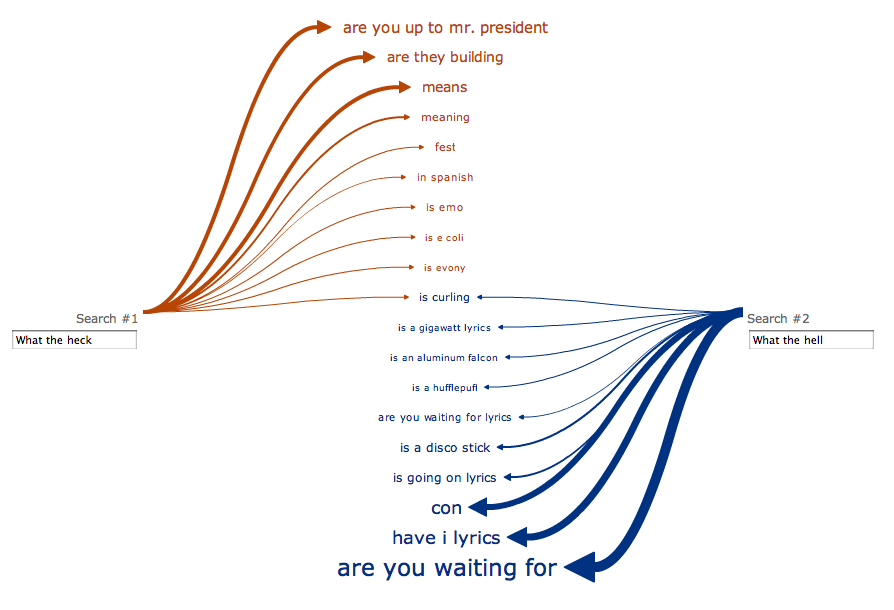
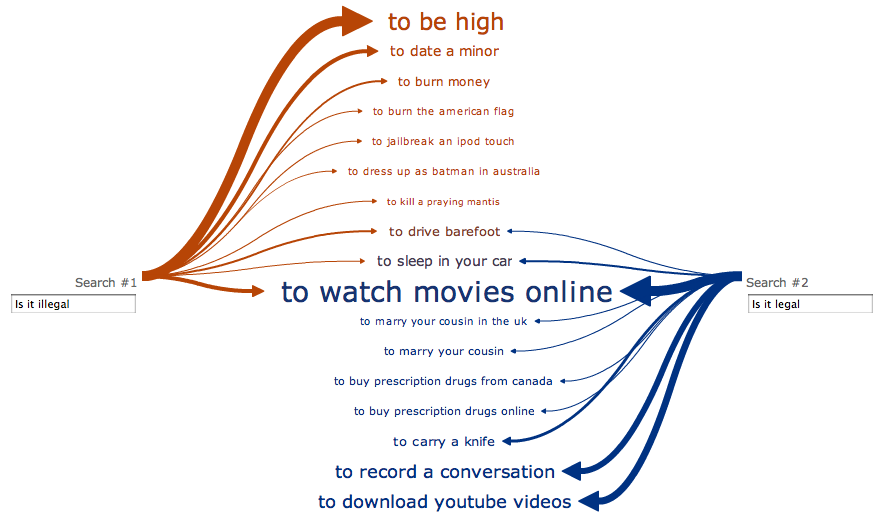
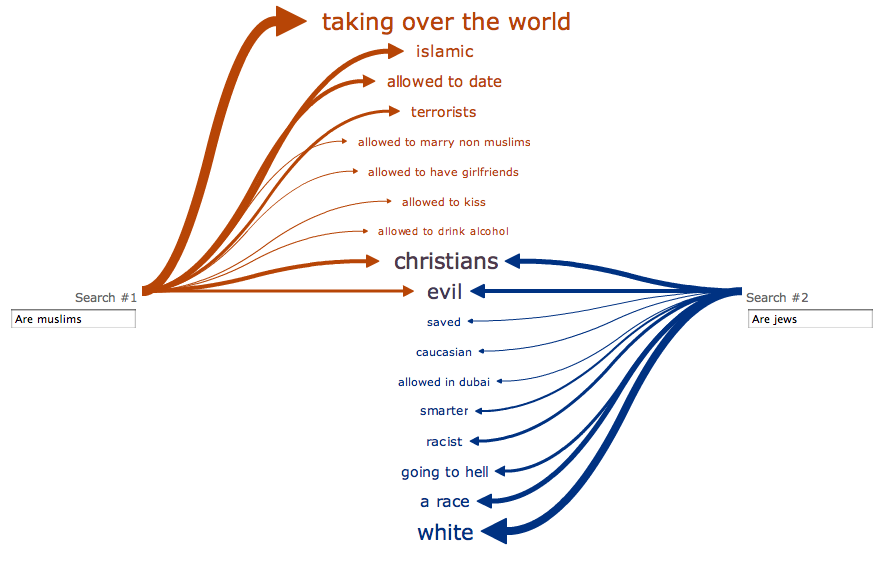
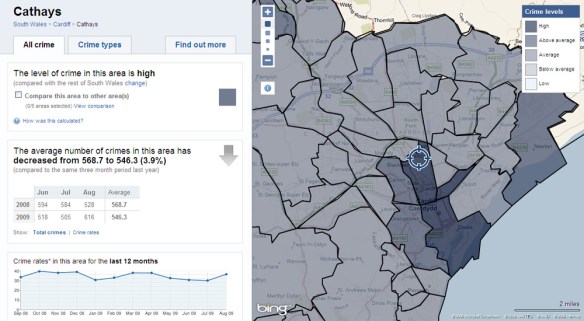
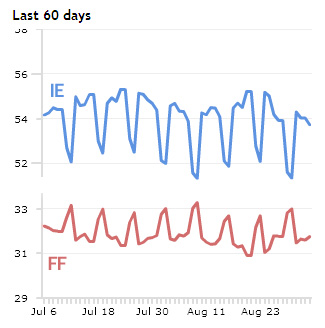
Web Seer is a fascinating tool that lets you explore what questions people are typing into Google, and compare it to other questions to see where they overlap. Admittedly, I can’t think of a real world use for this, but it’s fun to play with. If you find an interesting comparison, please leave a link in the comments!

More info on the Web Seer project page.

Continue reading

8-bit New York

8-bit New York

8-Bit NYC is an attempt to make the city feel foreign yet familiar, smashing together two culturally common models of space: the lo-fi overhead world maps of 1980s role-playing and adventure games, and the geographically accurate data that drives today’s web maps and GPS navigation. I hope to evoke the same urge for exploration, abstract sense of scale, and perhaps most importantly unbounded excitement that many of us remember experiencing on the Nintendo Entertainment System, the Commodore 64, or any other number of 8-bit microcomputers. Maps offer us visual architectures of the world, encouraging us to think about and interact with space in particularly constrained ways. Take some time to think about New York a little differently. Set out on a quest. Be an adventurer.

8bitnyc.com

Continue reading

Britons remain tolerant despite terror outrages

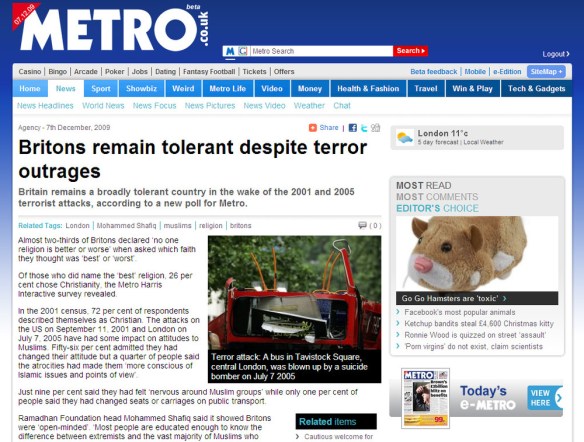
Okay, so I know the Metro isn’t exactly the bastion of great journalism or anything, but they ran a story today based on a Harris Interactive study, that bugged me: METRO: Britons remain tolerant despite terror outrages (the linked story lacks the infographics that accompanied the printed article).
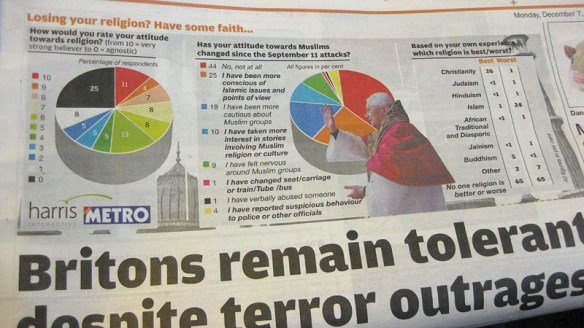
Harris Interactive interviewed 1,296 people, who were asked to rank their strength of faith from 0-10, with zero being agnostic. I’m curious why the Metro used this label. Surely atheist is the correct definition for someone with 'zero faith'? To me, agnosticism implies that some doubt – trace amounts of faith – may remain.

The main issue the data raised for me was completely ignored by the article. Those surveyed were asked which religion was 'best' and which was 'worst'. Sensibly, 65% answered that no one religion was better or worse. Christianity stormed ahead in popular opinion however, with 26% voting it the 'best'. The 'worst', according to 24%, was Islam.

That result, in my view, contradicts the Metro's conclusion that we remain tolerant. Also, there is a very strong implication that it's the Christians that have the biggest problem with Islam. Sadly, the Harris Interactive data hasn’t been published on their site to elaborate on the Metro's assertions.

I left a (polite and reasonable) comment on the Metro post, but it wasn’t published.
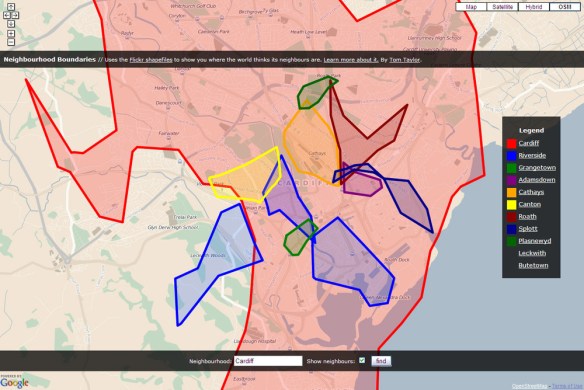
Boundaries – a tool to visualise the shape of neighbourhoods

Boundaries - a tool to visualise the shape of neighbourhoods

Boundaries uses Flickr geotagging data to draw local area boundaries on a map. It’s creator, Tom Taylor, says:

Flickr understands that places are more than unique geographic identifiers; that they are mental models people use to identify with location. Moreover, they are fluid and opinionated, varying based on a number of parameters such as context, ambition and personal background. In true wisdom of the crowds style, Flickr use the combined selections of their thousands of photographers to compute the shape of these places.

I think it’s a wonderful idea. Tom has several other fun projects, including the Flickr game Noticings, and a handy micro-printer you could use for to-do lists or hyperlocal news print outs. He also has a talk up on http://www.dolectures.com/ where he explores more ideas.

Cardiff regions on Boundaries.

Mapumental

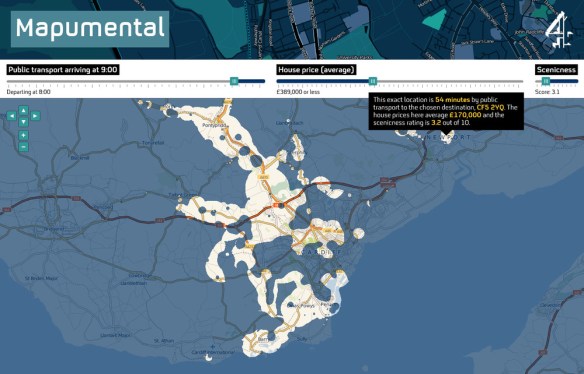
I watched a fascinating presentation on mapping technologies and their use in the BBC yesterday. The highlight for me was an amazing video showing all the Open Street Map edits made in 2008. The Channel 4 / MySociety / Stamen project, Mapumental was also demonstrated (well, just the Mapumental YouTube video actually).

It’s a really useful tool. Here I’m showing a few Cardiff examples.

Mapumental — Cardiff

Continue reading